Author: Paul Wallbank

  • A tale of two telcos

    A tale of two telcos

    Last Thursday saw China Mobile and Australia’s Telstra release their annual results.

    Both have impressive numbers that illustrate how the telco industry is changing along with some stark differences between the two nation’s business culture.

    For both companies their results show how voice and SMS are declining as the ‘rivers of gold’ for telecoms operators around the world; China Mobile’s voice revenues are down 6% while  Telstra’s fixed line voice fell by a similar amount.

    In Australia, the incumbent telco (which sometimes advertises on this blog) continued its dominant position in its market with net profit rising nearly 15% on the back of 6.1% increase in income.

    teslstra-revenue-2014

    Telstra’s results also showed how the Aussie telecommunications market is now primarily a mobile sector; while the advantages of being the incumbent are substantial the real growth and profits in the business are in it’s non traditional sectors. It’s little wonder the company is happy to give away its legacy copper systems to the government’s troubled National Broadband Network.

    In the PRC, the news wasn’t so good with China Mobile’s net profit for the first half of the year falling  8.5 per cent as its traditional voice and messaging businesses faced continued pressure from social media firms, despite revenue being up nearly five percent.

    China Telecom is under pressure from competitors while in Australia the incumbents are doing very well. This is true across much of the Aussie economy.

    While China Mobile is staking its future on its 4G rollout, Telstra is seeing the Internet of Things and Machine to Machine (M2M) markets as being the key markets, despite Gartner flagging the IoT as being at peak of the Hype Cycle.

    It may well turn out to be the other way round — Chinese businesses and governments are far quicker to embrace the IoT than their Australian equivalents while Telstra’s biggest competitive advantage against SingTel Optus and Vodafone is it’s far superior 4G network.

    China Mobile’s and Telstra’s competing fortunes tell us much about each country’s telecommunications markets along with the direction of both nation’s economies.

    Similar posts:

    • No Related Posts
  • Stages of hype – the Gartner Hype Cycle turns twenty

    Stages of hype – the Gartner Hype Cycle turns twenty

    Gartner’s Hype Cycle has been a favourite of this blog as it’s been pretty accurate at describing where various technologies are in the tech media’s eye.

    This year is the twentieth edition and the most notable aspect is the Internet of Things is shown as being right on the peak of industry hype.

    Other sectors struggling on the cycle are cloud computing, big data and machine-to-machine technologies; all of them are tumbling into the trough of disillusionment.

    gartner-hype-cycle-2014

    In itself this isn’t a bad thing for these technologies as the ‘trough of disillusionment’ is where the true business cases are found, certainly for the Internet of Things this will not be bad for a sector that’s clearly overhyped.

    There’s also the thought that not all troughs of disillusionment are the same as some concepts – such as Big Data – are actually trends which means they aren’t subject to the whims of corporate marketing departments.

    How the hype cycle will look in five years will be fascinating as things like brain-computing interfaces and the quantified self start to take form. When they reach the peak of the hype cycle we can expect many of today’s disillusioned technologies will be on the plateau of productivity.

    Similar posts:

    • No Related Posts
  • It’s time to educate our politicians

    It’s time to educate our politicians

    In mid 2003 I put an employment ad online for two computer technicians. I was expecting a healthy response as it was the depths of the computer industry’s depression following the tech wreck two years earlier.

    A healthy response is what I got. Two thousand job applications came in; it took me a week to wade through them.

    I was reminded of that story with the Federal government’s recent thought bubble requiring those on unemployment benefits to apply for forty jobs a months.

    Like most of the business community I was appalled at the thought of being buried under hundreds of pointless job applications that served nothing but to fulfil a Liberal Party staffer’s ideological fantasies.

    Within a week an Adelaide grandfather had come up with the idea of a jobseeker app that would automate the task which shows just how far out of touch both sides of politics have become with the modern world, particularly the digital economy.

    The Australian political classes’ lack of understanding of technology has been on painful display over the last week with the Federal government’s fumbling over proposed data retention laws; one gets the impression George Brandis needs other people to use the toaster for him, let alone be trusted to use a computer without assistance.

    This incomprehension of what’s driving the modern economy among our political leaders is no longer a joke – when the Prime Minister himself proudly states ‘I am not a geek’, it’s clear this nation is being led away from having any serious role in the 21st Century.

    In fairness, this is not the fault of any single party or individual; it’s the result of Australians – particularly Australian businesses – voting like sheep for the blue team or the red team at every election.

    As a consequence, Australian politics is now dominated by comfortable, arrogant and somewhat dim careerists who have little in skills beyond being able to float to the top of the shallow, fetid sewers that are the party political machines.

    This is our fault and it is where Treasurer Joe Hockey is right in bemoaning how business won’t stand up and strongly lead the nation’s reform agenda.

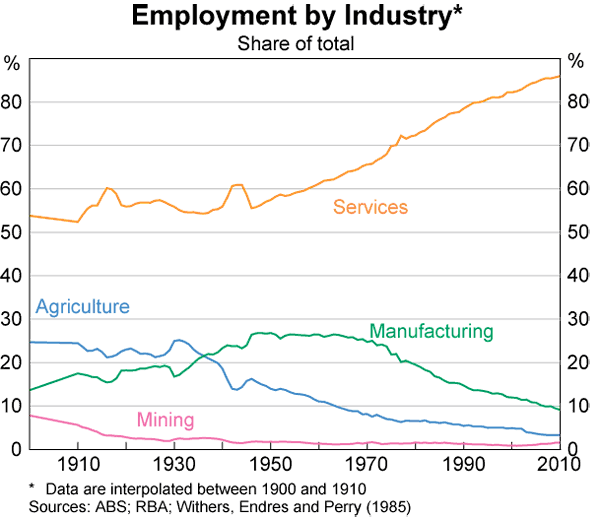
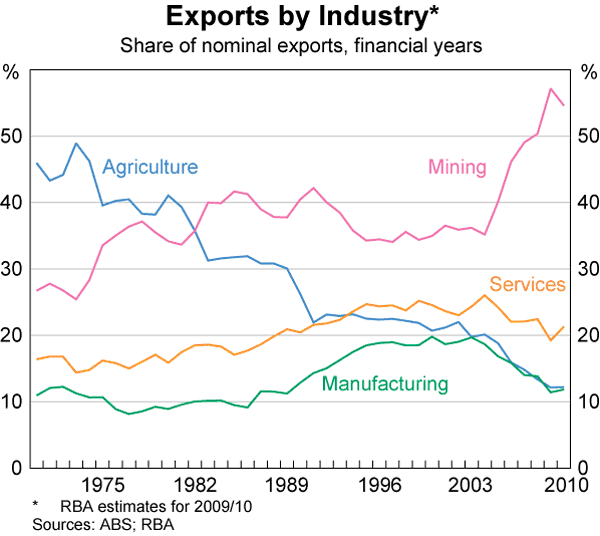
    Unfortunately for Joe, a true reform agenda is about making the nation more competitive in an era where the world’s economy is radically changing. The old ‘ship out resources and watch your property go up in price’ model that has sustained the Aussie economy is not a recipe for long term success.

    If Australia is going to compete in the Twenty-First Century then we are going to have to invest in modern training, education and capital equipment while putting in the tax and social security systems that reward genuine entrepreneurs and job creators over property speculators and corporate ticket clippers.

    Right now Joe, and his friends in both the Liberal and Labor parties, are doing exactly the opposite.

    Joe’s right. We need to voice our concerns loudly. We also need to demand our politicians at least take the time to understand the basics of the technologies that are radically changing today’s world.

    Next time you see a politician, of either colour, try to get five minutes of their time to explain how technology is changing your business. Hopefully it might make them pause before the next thought bubble.

    Similar posts:

  • Standing up to the giants – why the big software companies don’t always win

    Standing up to the giants – why the big software companies don’t always win

    In the latest Networked Globe post I have an interview with QNX founder Dan Dodge on how BlackBerry wants to be at the heart of the Internet of Things.

    One of the things Dodge discusses is how twenty years ago Microsoft told QNX they would be driven out of business by the software giant’s Windows CE operating system.

    As it turned out Microsoft failed dismally.

    QNX’s survival in face of a big competitor is similar to Google’s failed attempts to enter various industries. Everyone assumes Google will succeed against the smaller players because they are rich and smart.

    Often however the rich player doesn’t win because the smaller incumbent is savvy, focused and knows their market well.

    Sometimes bigger is not always better in the software industry.

    Similar posts:

    • No Related Posts