Author: Paul Wallbank

  • Software’s modern loom weavers

    Software’s modern loom weavers

    Are we coming to the end of the hand crafted era of software development? Pegasystem’s Alan Trefler thinks so.

    “Technology has completely dis-served the modern economy;” Alan Trefler, the founder and CEO of software vendor Pega Systems, told the audience at the opening of his company’s new office in Sydney yesterday.

    Trefler sees there being an ‘execution gap’ between what software promises and actually delivers; that development is too slow and programs don’t give users what they need.

    Ending the hand crafted software era

    A key reason for this in Trefler’s view is that too much software is ‘hand crafted’ and that his company’s object orientated methods speeds up development time and delivers a better product.

    This may well be true, Pegasoftware’s client list is impressive, however moving from the age of ‘hand crafted software’ may well spell the end of many IT industry worker’s careers.

    One of Pegasystem’s key Australian customers is the Commonwealth Bank and the company’s CIO, Michael Harte, gave some comments at the opening that illustrated how the software industry is changing.

    Freeing up resources

    “Does an IT organisation want to change fast enough to adopt a new model driven approach so they can free up capital and free up resources?” Harte asked.

    That freeing up resources and capital is exactly what befell the Luddites when the 18th Century mill owners decided to change the technology they used.

    For modern IT workers, the last decade has been tough as a whole generation of business analysts, software engineers and project managers have found the enterprise computing industry has been offshored and automated; Harte and Trefler are describing how that process is by no means over.

    “Older project models necessitated people to build a use case and then to design something, go through requirements and start crafting software, that’s on old idea,” says Harte who sees a model orientated approach as being more effective for modern enterprises.

    Let the machines do the grunt work

    That’s not to say that either men are pessimistic about the future of the software industry; both see an improved industry delivering better results for business.

    “Let’s move people into higher order things and allow the machines to do the grunt work,” Harte urges.

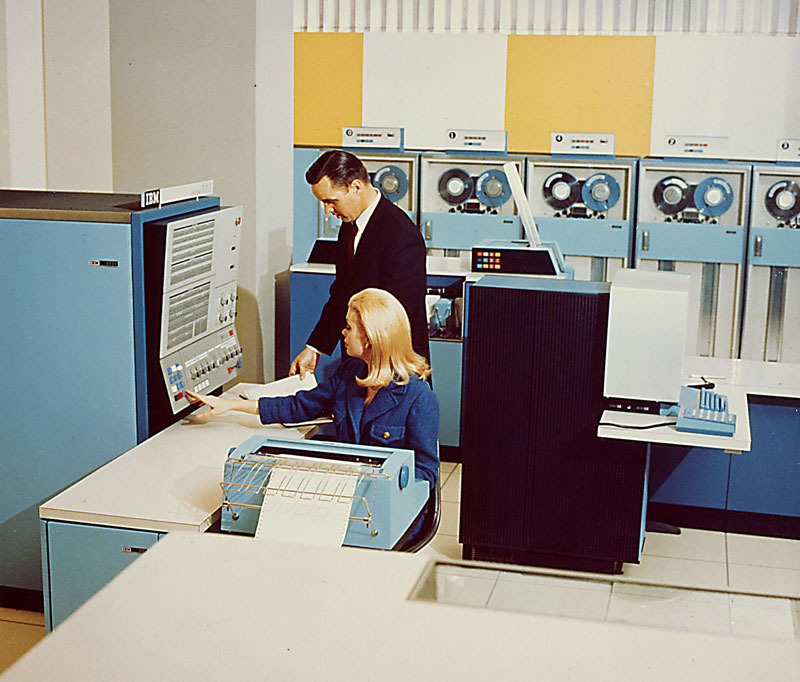
    “Not that long ago when I was learning how to do this stuff we’d have to fill in punch cards and then fill in Word Documents to write out technical requirement, that’s not much fun.”

    “Lets have some fun and get some work done.”

    Harte is describing a very different IT industry and workplace, one that doesn’t need older skills and – more importantly – doesn’t need as many clerks or middle managers carrying out routine administrative tasks.

    It should be noted that both Harte and Trefler were adamant that their visions did not mean job losses when asked by this writer about the employment consequences, but it’s impossible not to come to the conclusion that a fundamental industry change means many skill sets become redundant – again this is what happened to the Luddites in the 18th Century fabric mills.

    “What we think the next ten years are going to be about is changing those metaphors,” says Trefler. “There can be a more highly evolved communication between IT and business folk.”

    Both Trefler and Harte see design as the future of software with most of the human work being in creating the interfaces that work for the people using the computers, this is where the high level, high value work is to be done.

    The changes that Pegasystems are describing is not just an IT industry issue; these are changes that are happening across the workforce and in all sectors. For both managers and workers, it’s a time to refresh skillsets and understand where the value lies in what they do.

    Many industries have products handmade by skilled tradesfolk become a thing of the past, it now appears the time has come for the IT industry’s craftsmen and women.


    Similar posts:

  • Customer service is no longer a department

    Customer service is no longer a department

    When it comes to customer service businesses, Alex Bard calls himself a ‘career entrepreneur’, having founded four startups in the field since the mid 1990s.

    In 2011 he sold his most recent business, Assist.ly, to Salesforce and became the company’s Vice President for Service Cloud and the Desk.com customer service offerings.

    Bard tolds Decoding the New Economy last week how social media and Big Data are radically changing how organisations respond to the needs of their clients.

    “I’ve been in the industry for twenty years and I’ve never been excited as I am now,” Bard says. “The real transformational things that’s happening now are these revolutions – the social revolution, the mobile revolution, the connected revolution.”

    The philosophy of customer service

    “What they’re really driving is this idea that customer service is no longer a department, it’s a philosophy.”

    “It’s a philosophy that has to permeate throughout the organisation. Everybody in the company has a role in support. It’s not just about a call centre or a contact centre or even an engagement center which is what these things are called today.”

    “I really don’t like the word ‘centre’ because I really fundamentally believe that everbody in that company has to interact with customers, has to engage and has to the information – no matter they are – about that customer to provide context.”

    Abolishing the service visit

    With the Internet of Things, Bard sees GE’s social media connected jet engine as illustrating the future of customer service where smart machines improve customer service.

    “They’re going to capture more data in one year than in their entire 96 year history prior,” says Bard. “With that data they’ll be able to analyse and do things on behalf of that product or service that’ll reduce the number of issues.”

    “Because the best service of all is one that doesn’t have to happen.”

    In this respect, Bard is endorsing the views of his college Peter Coffee who told Decoding the New Economy last year that the internet of machines may well abolish the service visit.

    “Connecting devices is an extraordinary thing,” says Coffee. “It takes things that we used to think we understood and turns them inside out.”

    “If you are working with connected products you can identify behaviours across the entire population of those products long before they become gross enough to bother the customer.”

    For Alex Bard, the customer service evolution has followed his own entrepreneurial career having evolved from being personal computer based in the 1990s to today’s industry that relies on cloud computing, big data and social media technologies.

    As these technologies roll out across industry, businesses who adopt the customer service philosophy Bard describes are much more likely to adapt to the disruptions we’re seeing across the economy. Changing corporate cultures is one of the great tasks ahead for modern executives.

    Similar posts:

    • No Related Posts
  • Saving retirement

    Saving retirement

    Retirement age is vexed problem in the developed world; while life expectancy has increased over the last Century, the age where one becomes eligible for the pension has barely changed.

    Harvard University professor Martin Feldstein illustrates this in a post on Project Syndicate, Saving Retirement, where he has a number of suggestions of moving the pension age to ease the pressures on public finances.

    Obviously, retirees deserve advance notice before benefits are reduced. That is why it is important for the US – and for many countries around the world – to act now to make the changes needed to stabilize future pension finances.
    Those pressures are going to become more real in the decade as the baby boomers join the ranks of the retired, the cry “I’ve paid my taxes, where’s my benefits?” is going to get louder.
    Unfortunately for them, the kitty’s going to turn out to be bare – there simply aren’t enough Generation X and Y workers in the developed economies to pay for millions of boomers collecting pensions for the next thirty years.
    Governments around the world have ignored this obvious, and predictable, problem for fifty years and now it’s time to address it. Unfortunately few leaders have the courage to tell their electorates the truth of the challenge ahead.

    Similar posts:

    • No Related Posts
  • Contemplating a jobless future

    Contemplating a jobless future

    Last October, ahead of the company’s Orlando Symposium, Gartner Research Director Kenneth Brant released a paper looking at the effects of technology on the workplace.

    “Most business and thought leaders underestimate the potential of smart machines to take over millions of middle-class jobs in the coming decades,” Brant wrote. “Job destruction will happen at a faster pace, with machine-driven job elimination overwhelming the market’s ability to create valuable new ones.”

    Brant’s view about middle class jobs is a sobering thought, many of the corporate ‘knowledge worker’ positions can be easily replaced by computers to make the decisions now being made by armies of mid level managers, bean counters and clerks.

    Indeed the whole concept of ‘knowledge worker’ that was fashionable in the 1980s and early 90s in describing the post-industrial workforce of nations like the US, Britain and Australia is undermined by the rise of powerful computers and well crafted algorithms to do the jobs unemployed steel workers and seamstresses were going to do.

    Twenty years later and the ‘knowledge workers’ had morphed into the ‘creative class’ and it appears the computers are coming for them, too.

    Personally, I subscribe to the view in the medium to long term new jobs in new industries will evolve – a view shared by economists like GE’s chief economist, Marco Annunziata.

    Over the next decade however there’s no doubt we’ll be seeing great disruption to established industries and the hostility to Google buses in San Francisco may be just an early taste of a greater antagonism to the technology community in general.

    For managers, the problems are more complex; while their own departments, corporate power bases and even their own jobs are at risk, they are going to have to find ways to incorporate these changes into their own business. Gartner warns CIOs in its briefing paper;

    The impact will be such that firms that have not begun to develop programs and policies for a “digital workforce” by 2015 will not perform in the top quartile for productivity and operating profit margin improvement in their industry by 2020. As a direct result, the careers of CIOs who do not begin to champion digital workforce initiatives with their peers in the C-suite by 2015 will be cut short by 2023.

    Few industries are going to be untouched by the disruptions of the next decade and the resultant job losses are going to present challenges for all of us.

    Similar posts:

  • A breach of trust

    A breach of trust

    “Today I’m happy not to have an RSA Conference badge on me;” Mikko Hypponen, head researcher of Finnish security company F-Secure told the inaugural TrustyCon conference in San Francisco yesterday.

    Hypponen was referring to what was one of the world’s most prestigious information security conferences hosted by industry vendor RSA.

    RSA are known to many corporate computer users for their SecurID authentication tags; the little key fobs that give a passcode for secure networks that illustrate this post.

    Sadly for RSA’s users those tags were compromised in 2010 and the company did its best to obscure, if not downright hide, the problem both from the industry and its customers.

    However the killer blow for RSA’s reputation was an article in Reuters at the end of last year claiming the US National Security Agency had paid the company $10 million to weaken its security protocols.

    The company denies this but the damage was done, as Hypponen says “When a security company can’t be trusted, what do they have left?”

    How the RSA lost the trust of security professionals is a good lesson for all of us; our businesses rely upon the goodwill of our customers and our peers. If we betray their trust, we’re hurting ourselves.


    Similar posts:

    • No Related Posts