
Author: Paul Wallbank

  • Solving intractable problems

    Solving intractable problems

    Developing counter terrorism strategies is an unlikely path to founding a business that deals in organisational change, the latest Decoding The New Economy video covers exactly this in an interview with David Snowden.

    Snowden is the Chief Scientific Officer and founder of UK based consulting network Cognitive Edge that assists organisations with change and solving ‘intractable problems’.

    A failing Snowden sees with the way most businesses approach organisational change and problem solving is “the case based approach that dominates most of society.”

    “The idea is you find what other companies have done and you imitate it.” Snowden explains; “apart from the fact you can’t imitate the context, no company has succeeded other by imitating other people – they succeed by doing things differently.

    “We take what we know about how the human brain works and we help people work those problems out.”

    Safe to fail experiments

    In approaching ‘intractable problems’, Snowden believes there are two ways to approach them; one is to set up ‘safe to fail’ experiments where smaller experiments are run in parallel within the organisation to see what innovative solutions arise.

    The other approach involves using Snowden’s software based approach where staff or customers’ views are captured in real time to create a crowdsourced view of problems and their possible solutions.

    “You can’t afford, for example, in market research to spend three months commissioning something, two months gathering the data and one month interpreting it.”

    “If we create a sensor network of your customer we can give you data in real time.”

    Consumers and terrorists

    Dealing with real time data in public security are the origins of Cognitive Edge; “we started in counter terrorism where you have to deal with weak signal detection, you need fast real time feedback loops and you need to intervene very quickly.”

    “There’s no difference between a terrorist, a customer, a citizen and an employee,” says Snowden. “They all represent the same problem which is how the hell does a large authority make sense of fragmented data.”

    Developing human sensor networks

    Snowden sees ‘human sensor networks’ where groups contribute their stories to create a narrative around a topic, as being one of the strongest intelligence and communications channels.

    “Big data can tell us where you travelled, a narrative approach can tell why you travelled. If something goes wrong, I can also use that network to communicate.”

    One project Snowden is looking at brings these concepts together to create new communication channels at airports, an idea that came to him after being stuck for two days at Toronto airport in a snowstorm, “frequent fliers have smartphones, they can be activated by the airlines and used as a communication mechanism.”

    The interview with David Snowden is one of the most information and concept dense videos that I’ve done to date. It’s worthwhile listening this a few times to understand some of the fascinating fields he and Cognitive Edge are working in.

    Similar posts:

    • No Related Posts
  • Learning to ask the right questions

    Learning to ask the right questions

    How do we make sense of the masses of data entering our businesses? Tableau Software founder – and multiple Academy Award winner – Pat Hanrahan thinks he has the answer.

    A major challenge presented by the Internet of Things is in understanding the data that’s generated by devices, data visualisation companies like Tableau Software are making easier to interpret what machines are telling us.

    “The streaming data coming from sensors is a very interesting opportunity,” Tableau co-founder Pat Hanrahan told Network Globe when discussing machine to machine technologies, “there’s so much potential.”

    A Stanford Professor and winner of three academy awards for Computer Generated Imagery, Hanrahan founded Tableau with Christian Chabot and Chris Stolte in 2003 with a mission to help people to understand data. Today the company employs a hundred people after going public last year.

    The origins of Tableau came from Hanrahan tiring of the movie industry which he’d been part of since joining Pixar on graduating in 1987, “I was thinking could we use computer graphics for other things, I want to find something more work related so I got interested in data visualisation.”

    Hanrahan teamed with Stolte, who was one of his students, to set up a company called Polaris that became the basis of Tableau; “it was a classic Stanford start-up, Google was literally right next to us. I remember when the company started, Larry Page came to our office party.”

    Making data accessible

    “I’ve always been fascinated with taking the high end stuff and making it more accessible” says Hanrahan. “We’re in a transition phase, where we’re tying to figure out how to make it more accessible.”

    Helping those who are passionate about facts and reasons is one of Tableau’s missions,”we have fanatical customers,” says Hanrahan.

    “If you’re one of the rare people who use facts and reasons to solve the world’s problems then you are persecuted, you are on a mission, you’re going to convince those crazies that you’re right and you’re wrong and that’s why they’re so fanatical about our product.”

    “There’s a little bit of hype around big data right now, but it’s a very real trend;” states Hanrahan. “Just look at the increase in the amount of data that’s been going up exponentially and that’s just the natural result of technology; we have more sensors, we collect more data, we have faster computer and bigger disks.”

    A good example of the exponential growth in computing power is in how the smartphone has developed, citing how far computers have come since 1997 when IBM’s Deep Blue computer beat Kasparov, “at the time both Kasparov and the computer were rated 2700, the best chess programs now are rated 3800.”

    “The chess program running on my iPhone is rated above 3000,” observes Hanrahan.

    Despite the leaps in power, Hanrahan doesn’t see algorithms completely replacing the human touch, “you have the technology and resources to do this but you still need someone to figure out how to make it accessible.”

    One of the keys to understanding information is to be literate in using it, “every student should be efficient in using data,” Hanrahan says and he sees data analysis skills as being essential in the future workforce; “we have to know how to ask the right questions.”

    Making the data generated by connected machines accessible to the public, workers and managers is going to be one of the big challenges for organisations over the next decades; it’s an area where companies like Tableau are going to do well.

    Similar posts:

    • No Related Posts
  • You can’t get there from here

    You can’t get there from here

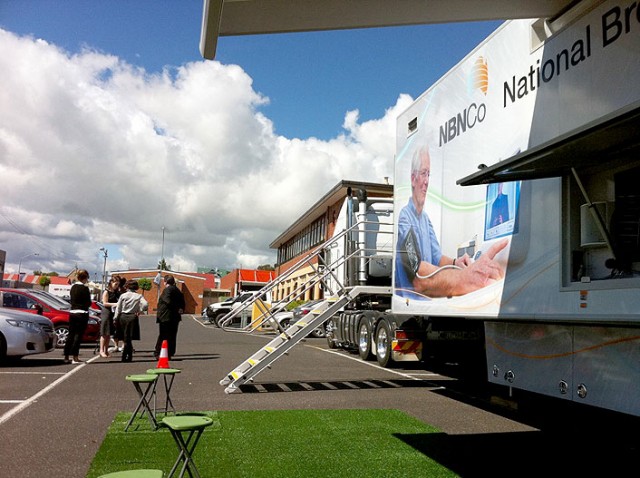
    I swore – mainly for my own sanity – that I wouldn’t discuss Australia’s National Broadband Network on this site anymore, today though the topic raised an interesting point about business leadership and project management that can’t be ignored.

    Australian Communications Minister Malcolm Turnbull today released the Broadband Availability and Quality Report (PDF) along with the accompanying My Broadband website that identifies the nation’s telecommunications blackspots.

    Extraordinary failure

    “It is extraordinary that in six years of Labor talking about Australians having inadequate broadband they never bothered to do the work of actually identifying where services were good, bad or indifferent,” said the minister at the announcement.

    Turnbull’s comments are correct, although the criticism is just as valid of previous Liberal and Labor governments who’ve all made incredibly poor decisions in the telecommunications portfolio without considering what was actually happening outside the ministers’ offices.

    A bigger lesson though is that before commissioning a project the size of the NBN – estimates have put its cost anywhere between twenty and eighty billion US dollars – it’s a good idea to know where you are are and where you want to go.

    Big Hairy Audacious Goals

    To put the comments that follow into perspective, I was a supporter of the NBN concept although I thought it was a Big Hairy Audacious Goal.

    In the shadow of the Global Financial Crisis the NBN project ticked all the boxes; it put cash into the economy, it employed an army of workers and upgraded Australia’s telecommunications network that had been neglected by thirty years of incompetent government policies mixed with incumbent telco greed.

    Australia could have afforded ten NBNs during the mining boom of the 2000s; it was an opportunity to rebuild the nation’s ports, roads, railways, schools and tax system that all needed reinvestment and reinvention to meet the needs of the 21st Century.

    Building a middle class welfare nanny state

    Rather than reform the economy or build modern infrastructure, the Howard Liberal government decided to spend the mining boom’s proceeds on building a middle class welfare state.

    Keen students of Australian politics crack a wry smile that the recently elected Abbott Liberal government, of which Turnbull is a member, proposes a paid parental scheme that will complete John Howard’s grand vision of a Middle Class Welfare Nanny State.

    One of the tragedies of the populist and cowardly Gillard and Rudd Labor governments that succeeded Howard was neither had the courage to dismantle the Liberal party’s middle class welfare state.

    At least though both Rudd and Gillard were prepared to make some big infrastructure investments, even if they weren’t fully thought through and chronically underfunded.

    Failing to think through the needs, scope and costs of the project meant the National Broadband Network project quickly collapsed into a managerial mess exacerbated by the dribbling incompetence of the company’s executives, government officials and contractors, which bought us to Turnbull’s announcement today.

    A project in search of a scope

    The project’s failure is a worrying commentary on the abilities of Australia’s management elites in both the private and public sector, however the lesson for the entire world is understanding both where you are and where you want to go to is essential for a project’s success.

    Spending on well planned and necessary infrastructure is good, but to avoid disasters like Australia’s NBN it’s good to start with understanding the problems you want to fix and a project scope that clearly identifies the work that needs to be done.

    Unfortunately too many governments and businesses don’t know where they are or where their plans will take them.

    Similar posts:

  • Going to the cloud is not for the faint hearted

    Going to the cloud is not for the faint hearted

    “The cloud is not for the faint hearted,” warns Technology One CEO Adrian Di Marco in describing his company’s evolution into a software as service provider.

    “We thought that this was five to ten years away, I’d like to say we got that wrong and this phenomena is happening now.” Di Marco said at the company’s 2014 Evolve conference on the Gold Coast today, “we’ve seen huge uptake in companies going to the cloud.”

    A virtuous circle

    Responding to that demand meant that Technology One had to redesign their software and update it to the meet the very different requirements of cloud services.

    What Di Marco found in moving Technology One’s software onto the cloud was it became easier to identify problems and inefficiencies in his product, creating what he calls a “virtuous circle”.

    It’s not just Di Marco’s customers who’ve been through that process, Technology One itself has gone all cloud internally with the company using services like Google Docs and Salesforce.

    The aim of moving online is to make organisations more flexible with Di Marco citing the newly reformed Noosa Council in Queensland as being able to get up and running in four months by using cloud services.

    Problems with the cloud

    Despite being an enthusiast for cloud computing, Di Marco does sees some problems with the cloud, the first being that the term is overused and ill-defined which results in services being mis-sold.

    A bigger problem in Di Marco’s view is a ‘gold rush’ has developed around the concept with revenue hungry vendors looking at making money

    “IT companies, particularly consultancy firms, have over the last few years seen their revenues decline so to find new sources of growth they are all targeting the cloud.”

    “Everybody wants to become a cloud provider, everyone wants to provide strategic services to do with the cloud.”

    “There’s a lot of people offering very mediocre ideas, concepts and services.”

    The key takeaway for businesses from Di Marco’s presentation was businesses need to be careful about their choices of cloud services providers.

    Di Marco’s other point is that cloud services work best when there aren’t intermediaries such as resellers and integrators involved that reduce efficiencies and add costs.

    “The cloud is a platform for the future of business,” sums up Di Marco. “Businesses that move to the cloud have an enormous strategic advantage, they can move at a pace that normal business can’t. They can move fast and innovate quickly.”

    Similar posts:

    • No Related Posts
  • Neglecting the small business sector

    Neglecting the small business sector

    I’ve previously flagged how the IT industry fixates on the consumer sector, the Kickstart forum on Australia’s Gold Coast emphasised this with vendors, particularly those in the Internet of Things market, focusing on home users.

    This is mindset is understandable given the huge numbers being cited for consumer applications, but the sneaking suspicion is that home users simply aren’t going to pay for these technologies and that the real money will be made in helping the retail sector deliver services to customers.

    On Networked Globe today we discuss that quandary, it’s something that both vendors, consumers and small businesses should be thinking about given the way it’s going to change supply chains and entire industries.

    Similar posts:

    • No Related Posts