It turns out his bravery wasn’t rewarded as Blackberry’s brave attempt to reclaim their smartphone market share failed and now their hopes of a private equity takeover has failed with Heins announcing his resignation.
Still he walks away with several million dollars, so life isn’t too hard for Thorsten.
For Blackberry though the struggle continues with the company hoping to raise a billion dollars through a convertible note issue. It would be an investor braver than Thorsten Heins who takes that offer.
That’s not to depreciate IT, it means the technology is now becoming so embedded in society and business that people no longer notice.
Like roads, electricity and water people assume it will be available but don’t notice the massive effort or investment required to make sure these services work.
With cloud computing, pervasive internet and connected devices, most business never need to see an IT worker.
For telco executives, IT managers and tech support people this is a blow to their egos as they always wanted their industries to be more than utilities.
In one way being a utility legitimises IT as it makes the industry more important than just a bunch of geeks playing with computers.
That also means that things have to work, ‘best effort’ services no longer cut it when you’re a utility and things have to work 99.99% of the time. Just like in plumbing.
Becoming the plumbing could be the best thing that happened to the IT industry.
During last week I spent the last two days travelling by train between conferences in Spain and the UK while trying to work, write and blog. The lesson is you need to leave the tech at home if you want an enjoyable holiday.
Some of us however are travelling for business so the option of leaving the technology at home isn’t an option. Here are some tips on how to work effectively while on the road.
Charge, charge, charge
If you want to be connected you have to charge your devices at every opportunity, you never know when the next opportunity will arise.
Three pin European power socket
One trap for players is the earthed adaptor plug as the third pin basically renders your equipment useless on most trains and bathrooms. So beg borrow or steal one that lacks the pin which will almost certainly leave you with dead batteries on a night train.
Get Connected
Don’t rely on WiFi, in many places it’s patchy and in France requires convoluted sign up plans. When you can get it, consider it a bonus.
If staying more than three days in a city buying a local pre-paid SIM saves money, but when travelling a lot in Europe it’s best to buy a European wide SIM which will cost more but won’t die at the border.
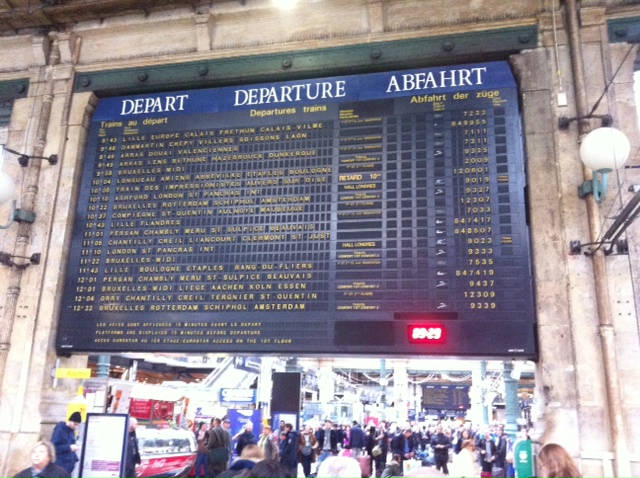
The dying on the border shouldn’t be understated. On the night train from Barcelona to Paris the service – which the salesman assured would work in France – stopped working the moment the train exited the tunnel from Spain at Cerbere.
Avoid night travel
Should you be intending to work while on the road, avoid night travel. You’ll get more work done in a hotel room or hostel than on a stuffy night train and be more productive than after an overnight flight.
Travel light
Keep things to a minimum, if you’re working that might mean laptops and big cameras but for leisure keep it simple. The less tech you carry, the fewer the power, security and other hassles you’ll encounter.
Forget a schedule
Work where you can and when you can. If you’re diligent then flight and train delays can be your friend in getting stuff done.
Get a room
Working in hostels is almost impossible and you risk having things stolen, staying with friends and relatives is great but their hospitality makes it hard get things done. Get a cheap room so you can work in peace.
An important thing about travel is that you are away from home to learn about and experience other places, spending your time stressing about finding a power socket or Wi-Fi access point is not why you’re on the road.
Overall, tech is a hassle when you’re travelling. If you’re on the road for pleasure keep most of it at home, if you’re working then keep it all to a minimum.
Sitting next to Frank Gehry’s giant goldfish on the city’s waterfront and marina, Barcelona’s Arts Hotel was part of the city’s redevelopment after the 1992 Olympics.
Like the giant fish, the hotel is a quirky building with a strange layout including an entrance that requires guests to catch a lift to the lobby on first floor.
Once you find the lobby, the staff are an incredibly friendly bunch hailing from around the Eurozone, including Dutch, French and Icelandic workers among the Spanish staff.
If you happen to be in the hotel between five and six, the management puts on free cava and nibbles in the lobby.
Free Wi-Fi is available is available in the lobby which adds to it being a comfortable place to sit if you have time to kill after checking out.
The standard suites, known as Deluxe Rooms, are comfortable with all the features expected in a five star hotel.
Double beds are comfortable with a high tech bedside control panel with several pre-set lighting configurations, a built in alarm clock and electric blinds that do a very good job of keeping the sun out if you want to lie in.
The bathroom has a spacious bath with a separate shower, bidet and toilet along with a generous range of toiletries, toothbrush and razor. The bathrobes are particularly comfortable.
The writing desk is good but suffers from a lack of power sockets with only a double, standard European three pin plug slot that’s already used by the desklamp and cordless phone. You’ll have to at least unplug the phone to get some work done.
Both ethernet and wireless access are available with a 25 Euro a day charge for access. It is possible to leech off the free hotel access as it appears to allow consecutive logins after each twenty-four period expires.
The inroom coffee machine is a Nespresso unit — the innovation that has change hotel coffe. One drawback with these devices is that management restricts guests to two free cartridges a day with additional ones charged at an extortionate four euro each. If you’re a coffee addict, it’s worthwhile buying a box of cartridges from the supermarket two blocks away.
While you’re at the supermarket it’s worth buying some drinks and snacks to get around the standard extortionate five star minibar prices, be warned though that the term ‘mini-bar’ was coined for the tiny fridges in the hotel so if you bring your own supplies don’t expect to fit in anything larger than a 600ml bottle.
A similar problem affects the room safe which is big enough to fit passports, wallets and phones but not a 10″ iPad.
One of the features with the Arts Hotel are the delightful roof top gardens with quiet nooks and crannies featuring various sculptures and architectural features.
The hotel’s swimming pool is 25m but is fiendishly cold, it’s good to wake up to but the idea of doing 40 laps quickly evaporates as any more than ten minutes in the pool isn’t comfortable.
Warming up after a swim isn’t so bad with some hammocks to relax in, these are popular with conference delegates killing time after checking out from the hotel, so grab one early.
Overall, the hotel is a good choice if you’re not travelling on a budget. While the location is a little way from Barcelona’s major tourist attractions it’s a 15 minute walk from the El Born district of Barcelona and two of the city’s tourist bus routes.
The most notable thing about the Hotel Arts is the friendliness of its staff – even if you can’t afford to stay there it’s worthwhile dropping around the lobby at 5pm for a glass of cava.
Spain and Barcelona have faced challenges in recent years as the economy was hit hard by the 2008 crisis. Now the city is looking to the internet for the next wave of prosperity.
This quest for reinvention isn’t new for the city, “Barcelona used to be an industrial city, that was badly hit by the economic crisis of the seventies,” said Deputy Mayor Antoni Vives. “There were some guys in the city at the time that decided that we had to keep on being an important city.”
“There’s a new generation of politicians, civil servants, of thinkers and people committed to the city that ten years ago started to work on a new phase of what the city was to become.”
Antoni Vives – Deputy Mayor of Barcelona
“We decided that Barcelona had to become the edgiest city in the world related to the new revolution and the new revolution was this one — the technology related to mobility, devices and mainly the internet.”
That vision resulted in Barcelona starting to rewire the city which was one of the reasons for Cisco choosing the city as the venue for its inaugural Internet of Things World Forum.
As part of the event, the City took delegates on tours of some of the connected infrastructure the city has installed. Here’s what we learned on the press tour.
The digital bus stop
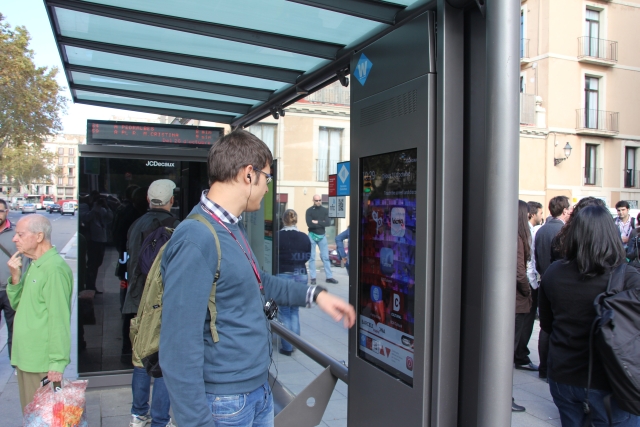
Digital bus stop
The digital bus stop is one of the prides of Barcelona, not only does it display digital advertising and real time bus schedules it also offers tourist information, USB charging sockets and acts as a free WiFi base station.
One of the barriers Barcelona has encountered has been the Spanish telecoms regulators objection to the city providing municipal WiFi so services are restricted to the city’s property, which happens to include bus stops.
The bus stops themselves are connected to the city’s fibre network that runs most of the backhaul and connects many of the fixed devices.
Smart parking spots
Smart parking space
Connected to the city’s WiFi network are these smart parking spaces that detect the presence of cars through a combination of light and metal detectors.
The city’s plan is that payment and monitoring of the smart parking spots will happen online and with smartphone apps.
Powering the dot, which is a fairly dumb device, is a battery with an expected five to seven year lifespan. Interestingly, the dots don’t work with motorcycles.
One of the reporters on the tour questioned the durability of these devices given Barcelona doesn’t get extreme temperatures, the response from the Cisco and city staff indicates that ice or hot weather may shorten the lifespan of these devices.
Smart lighting and monitoring
Smart lights and monitors
In the square outside the Born Cultural Centre, the city has installed a row of streetlights with multiple features including CCTV, air monitoring and Wifi. All of these lights are connected to the city’s 500Km long undeground fibre network.
The fibre network itself is being installed progressively as the city carries out routine maintenance to roads and other underground services. By co-ordinating the work with other trades it reduces the installation cost dramatically.
Smart censors in the street lights
Smart rubbish bins
Smart rubbish bins in Barcelona
The connected garbage bins are one of the showpieces of the city’s services. By monitoring trash levels, the council’s sanitation team can plot the optimal routes for collection services.
Smart rubbish bins sensor
Again the sensors on the bins are fairly dumb devices that connect wirelessly to a base station, shown on the pole above the bins in the earlier photo, these track rubbish levels and later versions are expected to detect the presence of obnoxious or hazardous materials that might be dumped in the bin.
Single person operation of the connected garbage truck
Operators of the garbage trucks get real time updates to their routes which optimises their productivity. It’s cost savings in the city’s operations which is one of the key drivers for the city’s investment in these technologies.
Power savings
Smart lighting systems
One of the major cost savings identified by the Barcelona Council is in energy costs. Along with the expense of running garbage trucks unnecessarily are power bills.
Part of the smart lighting system is that it will dim when there’s no motion detected in the streets and lighten when pedestrians are around. This is intended to save money and help the city meet it’s zero carbon emission targets.
Barcelona and the future
Every single one of the technologies being shown today in Barcelona will be commonplace in most developed cities in the near future.
The problem for adopting these systems is going to be connectivity, in places where there aren’t the fibre optic services or easily deployed WiFi it will be difficult to install smart devices and monitor them.
Every major city is going to be facing the question of how they deploy these devices over the next decade as their residents expect better and more efficient service. Barcelona has taken the first steps that most others will follow.