Author: Paul Wallbank

  • Firing your customers

    Firing your customers

    Running your own business can be tough, but one of the therapeutic advantages of dealing with the stresses of self-employment is the ability to fire stroppy customers.

    Steve Cody, the proprietor of marketing agency Peppercom, gives a list of five types of clients worth sacking in Inc Magazine.

    It’s a good list although it misses the general “pain in the ass” client who demands a solid gold level of service for a pittance. These are particularly common if you pitch to the lowest end of the market.

    Lists like Steve’s are good reminder of Pareto’s Law, or the 80/20 rule which is usually put in terms of 80% of business revenues come from 20% of customers.

    The converse is also true, 80% of business hassles come from just 20% of customers and they are almost certainly not the most profitable ones.

    Pandering too much to the bad customers can hurt your health as well – running your own business is stressful enough without dealing with troublesome clients.

    So sacking bad clients is good, not only is it therapeutic but it also helps the bank account. It’s worthwhile doing whenever a customer drives you too far.

    Go on, you know you want to.

    Similar posts:

  • Australia’s grapes of wrath

    Australia’s grapes of wrath

    In a great post, The Wine Rules looks at what ails the Australian wine industry after the news of Cassella Wine’s problems.

    Three things jump out of Dudley Brown’s article – how industry bodies are generally ineffectual, the failure of 1980s conglomerate thinking and how fragile your position is when you sell on price.

    Selling on price

    It’s tough being the cheapest supplier, you constantly have to be on guard against lower cost suppliers coming onto the market and you can’t do your best work.

    Customers come to you not because you’re good, but because you’re cheap and will switch the moment someone beats you on price.

    Worse still, you’re exposed to external shocks like supply interruptions, technological change or currency movement.

    The latter is exactly what’s smashed Australia’s commodity wine sector.

    A similar thing happened to the Australian movie industry – at fifty US cents to the Aussie dollar filming The Matrix in Sydney was a bargain, at eighty producers competitiveness falls away and at parity filming down under makes no sense at all.

    Yet the movie industry persists in the model and still tries to compete in the zero-sum game of producer incentives which is possibly the most egregious example of corporate welfare on the planet.

    When you’re a high cost country then you have to sell high value products, something that’s lost on those who see Australia’s future as lying in digging stuff up or chopping it down to sell cheaply in bulk.

    Industry associations

    “It’s like a Labor party candidate pre-selection convention” says Brown in describing the lack of talent among the leadership of the Australian wine industry. To be fair, it’s little better in Liberal Party.

    There’s no surprise there’s an overlap between politics and industry associations, with no shortage of superannuated mediocre MPs supplementing their tragically inadequate lifetime pensions with a well paid job representing some hapless group of business people.

    Not that the professional business lobbyists are any better as they pop up on various industry boards and government panels doing little. The only positive thing is these roles keep such folk away from positions where they could destroy shareholder or taxpayer wealth.

    Basically, few Australian industry groups are worth spending time on and the wine industry is no exception.

    Australia conglomerate theory

    One of the conceits of 1980s Australia was the idea that local businesses had to dominate the domestic market in order to compete internationally.

    A succession of business leaders took gullible useful idiots like Paul Keating and Graheme Richardson, or the Liberal Party equivalents to lunch at Machiavelli’s or The Flower Drum, stroked their not insubstantial egos over a few bottles of top French wine and came away with a plan to merge entire industries, or unions, into one or two mega-operations.

    It ended in tears.

    The best example is the brewing industry, where the state based brewers were hoovered up in two massive conglomerates in 1980s. Thirty years later Australia’s brewing industry is almost foreign owned and has failed in every export venture it has attempted.

    Fosters Brewing Group was, ironically, one of the companies that managed to screw the Australian wine industry through poorly planned and executed conglomeration. Again every attempt at expanding overseas failed dismally.

    In many ways, the Australian wine industry represents the missed opportunities of the country’s lost generation as what should have been one of the nation’s leading sectors – that had a genuine shot at being world leader – became mired in managerialism, corporatism and cronyism.

    All isn’t lost for the nation’s vintners or any other Aussie industry, Dudley Brown describes how some individuals are committed to delivering great products to the world. There’s people like them in every sector.

    Hopefully we’ll be able to harness those talents and enthusiasm to build the industries, not just in wine, that will drive Australia in the Twenty-First Century.

    Picture courtesy of Krappweis on SXC.HU

    Similar posts:

  • Who rules the company parking spots?

    Who rules the company parking spots?

    While at school I worked at a local shopping centre and one of the many ways to  irritate managers was to park in the spots closest to the shops.

    “If the staff take all the spaces near the shops” said the store manager, “then customers have to walk further and might go somewhere else. The customers alway comes before the staff.”

    That’s true and one of the surest signs of a poorly run business is the location of the staff parking spots, particularly when they are reserved for management.

    executive-car-parking-spot

    Similarly the type of company cars management award themselves with can be a warning sign for wary partners.

    If customers, staff and suppliers have to walk past an array of expensive prestige cars in the shady and sheltered executive parking spots they can be pretty certain they are not going to be the number one priority at that business.

    While running PC Rescue I quickly learned this when visiting potential customers, one client in particular invited me to review their network and make recommendations.

    On arriving, I had to feed a parking meter in the street before picking my way past a series of high end Mercedes, two Porsches and a Maserati.

    After looking at their network, which hadn’t had a cent spent on it for the best part of a decade, I gave the Managing Director a ballpark figure of what he was looking at to bring his systems into this century.

    “That’s way too much!” he thundered and proceeded to lecture me on why my rates were extortionate – all the while I politely listened while thinking I’d driven to the job in a base model Holden Barina and was paying for parking.

    Needless to say we didn’t get the job.

    One of the worst, most soul destroying things in business is dealing with entitled customers and this client was a classic example. I genuinely feel sorry for whoever landed the job.

    Who parks where and what they drive is a good measure for the calibre of a business’ leadership and the egos of management. It’s a good starting place for deciding who you’re going to do business with.

    Similar posts:

  • What happens when software is wrong

    What happens when software is wrong

    The Las Vegas Review Journal yesterday told the story of Wayne Dobson, a retiree living to the north of the city whose home is being fingered as harbouring lost cellphones thanks to a software bug at US telco Sprint which is giving out the wrong location of customer’s mobile devices.

    While it appears funny at first the situation is quite serious for Mr Dobson as angry phone owners are showing up at his home to claim their lost mobiles back.

    Making the situation even more serious is that 911 calls are being flagged at coming from his home and already he has had to deal with one police raid.

    While the local cops have flagged this problem, it’s likely other agencies won’t know about this bug which exposes the home owner to some serious nastiness.

    That a simple software bug can cause such risk to an innocent man illustrates why we need to be careful with what technology tells us – the computer is not always right.

    Another aspect is our rush to judgement,  we assume because a smartphone app indicates a lost mobile is in a house that everyone inside is a thief. That the app could be wrong, or we don’t understand the data to properly interpret it, doesn’t enter our minds. This is more a function of our tabloid way of thinking rather than any flaws in technology.

    The whole Find My Phone phenomenon is an interesting experiment in our lack of understanding risk; not only is there a possibility of going to the wrong place but there’s also a strong chance that an angry middle class boy is going to find himself quickly out of his depth when confronted by a genuine armed thief.

    For Wayne Dobson, we should pray that Sprint fixes this problem before he encounters a stupid, violent person. For the rest of us we should remember that the computer is not always right.

    Similar posts:

  • Towards the post car society

    Towards the post car society

    We don’t often think about it, but the design or our cities reflect the technologies of the day. Right now the way we live is built around the motor vehicle, but are we moving into a new era?

    After a visit to Ford Australia’s Centre of Excellence For Design and Engineering, Neerav Bhatt has some thoughts on the role of the motor car in an era where people don’t have to travel to their workplaces.

    One of Neerav’s points is that car use is falling among younger workers, a trend that’s happening across the western world.

    Much of this is put down to the generations of Millennials and Gen-Ys being more interested in technology purchases rather than cars along with changing work patterns.

    A more fundamental reason could be that we’re reaching the end of the motor car era.

    If there is one technology that represents the Twentieth Century it is the motor car; the automobile has shaped our cities, our lifestyles and our culture.

    However we are now in the Twenty-First Century.

    The three eras of motoring

    Roughly speaking, we could break the Twentieth Century’s love affair with the motor car into three phases; development, consolidation and dependency.

    In the first period, the automotive industry was developing with thousands of manufacturers experimenting with the technology and production methods. At the same time governments were beginning to build road networks and communities were demanding improved links.

    By the beginning of World War II, the motor car was an important part of life but ownership was largely restricted to affluent households and business.

    Following World War II governments made huge investments in road networks and automobiles became cheaper to own.

    This gave a generation a new taste of freedom as you could go anywhere with a tank of gas. It also changed the layout of our suburbs as people could now travel further to work, allowing them to move into bigger houses on the fringe of town.

    As government investment was focused on road building, passenger train and tram networks were starved of capital with many cities abandoning their transit systems altogether.

    Suburbs built in the early to mid Twentieth Century had evolved around trams and the legacy of that can still be seen today. However customers no longer wanted to fight for parking spots on crowded streets designed for horse drawn carriages and trams.

    Responding to this developers started building supermarkets and shopping malls which became popular largely because they offered easier parking. Cheaper goods made available by improved logistics systems – another effect of the motor car – was the other main reason.

    The beginning of dependency

    With the advent of the 1970s oil shock, the role of the motor car turned from being a tool of liberation into one of dependency. The suburbs of the 1960s and 70s had been built around the assumption of universal car ownership and cheap fuel. When fuel ceased being cheap, then households budgets were affected.

    Not coincidentally after the oil shock the reversal of ‘white flight’ – the movement of the middle classes to outer suburbs – started with the gentrification of inner suburbs that had been abandoned by the working class.

    Through the 1970s and 80s the cost of owning a motor car became more expensive as governments stopped externalising the costs of maintaining roads and saw car use and petrol taxes as a revenue source.

    At the same time the obvious effects of saturating society motor cars became obvious as roads increasingly became choked and planners began to realise that building more roads only attracted more traffic.

    Times of decline

    By the turn of the Twenty-first Century technology had also started to move away from centralised offices and factories. Today technologies like the internet and increasingly 3D printing mean that workers don’t have to commute vast distances. Automation also means many levels of management are no longer necessary.

    Changing work patterns is also affecting incomes, with car ownership being expensive many employees – particularly young workers – don’t want to buy automobiles.

    This all means that the era of the motor car is coming to an end, it’s not going to vanish quickly but the decline has started.

    For business, this means the post World War II assumptions that saw the rise of the supermarket, shopping mall and big box discount store are no longer valid.

    Some managers, most notably those of doomed department stores, won’t learn these lessons and will pass into history like the stagecoach companies.

    Just as the end of the horse and carriage era saw the demise of buggy whip makers and blacksmiths, the rise of the motor car saw an unprecedented rise in wealth, employment and productivity. Not only were the lost jobs created elsewhere, but many more were created.

    While the motor car isn’t going to disappear overnight, the decline has started and our society is adapting. For business and government leaders, the task is to understand those changes and adapt.

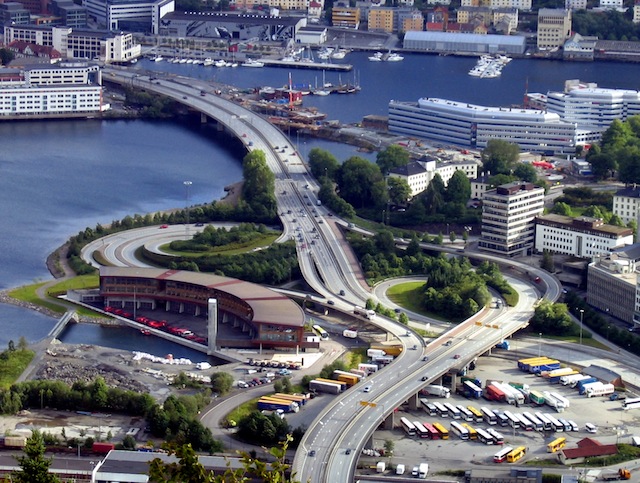
    Image courtesy of a Norwegian motorway by Ayla87 through SXC

    Similar posts: