Author: Paul Wallbank

  • Today’s business Neanderthals

    Today’s business Neanderthals

    “Bringing a knife to a gunfight” describes showing up hopelessly ill-equipped for the task at hand.

    Two recent conferences, the massive Dreamforce in San Francisco and the smaller, but still fascinating, Australian Xerocon in Melbourne illustrate just how radically the commercial world is changing and how many business leaders are poorly equipped for today’s times.

    In July, the Melbourne Xero Convention bought together 400 Australian partners of the cloud accounting service which showed how how one New Zealand based company is building it’s business through engaging other suppliers who add features to the basic service.

    Vend, a Point Of Sale cloud service provider, was one of the companies exhibiting at XeroCon. In the past POS systems have been a pain for retail businesses with most suppliers’ business models being about locking customers into expensive contracts.

    With cloud services, the old vendor lock in model dies as stores can use any device they like such as a PC, tablet computer or a smartphone so a business is no longer locked into using an overpriced and often antiquated piece of equipment.

    Making the cloud offering even more attractive is that Vend, and many of their competitors, also take advantage of APIs – Application Program Interfaces – built into other services so they can seamlessly change records.

    So a shop can make a sale in their physical store and inventory levels will automatically change in the online stores and on services like eBay. If an item is now of stock, the websites are automatically updated to reflect this.

    This business automation makes it easier and cheaper to run a business. It’s everything that computer have promised for the last thirty years and is now being delivered through cloud computing services.

    At Dreamforce in San Francisco last week, Salesforce.com CEO Marc Benioff showed the 90,000 attendees how these services work on a corporate level with demonstrations from companies as diverse as General Electricski company Rossignol, and Australia’s own Commonwealth Bank.

    What really stood out with all of these presentations was how each business had made major technology investments that in turn allowed them to deploy modern tools.

    The Virgin America Dreamforce presentation was particularly telling. Having just endured a 13 hour United Airlines flight in a plane that had been barely refurbished since 1988 it was clear that the older airline simply didn’t have the hardware to compete with the upstart even if management and staff wanted to.

    From both Dreamforce and XeroCon the message has been clear, those legacy managers who won’t invest in new technologies or re-organise their businesses to meet the realities of the 21st Century are simply doomed.

    In Australia this sense of doom in the business community is confirmed when MYOB and Google missed their target of giving away 50,000 free business websites as part of their Getting Aussie Business Online program.

    Depending on whose figures you use, between 50 and 65 percent of Australia’s 1.7 million small businesses don’t have a website – and websites are last decade’s technology.

    Business has moved onto mobile and social platforms, those 800,000 businesses who are yet to move into the new century are roadkill – the competition are just going to run over them.

    If you are still struggling with the idea of a website – let alone a mobile site, mobile phone app or social media strategy – then you haven’t bought a knife to a gunfight, you’ve bought a sharpened stick. It’s time to figure out whether you still want to be in business.

    Disclaimer: Paul travelled to XeroCon in Melbourne courtesy of Xero and to Dreamforce in San Francisco as a guest of Salesforce.com
    Similar posts:

  • Towards the social media enabled jet engine

    Towards the social media enabled jet engine

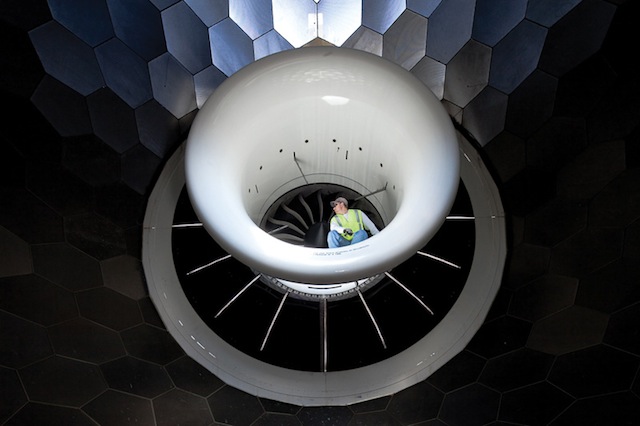
    “What if my jet engine could talk to me and what would it say?” Asked Beth Comstock, General Electric’s Chief Marketing Officer, at the Dreamforce 2012 conference.

    The idea of social media connected jet engine is strange, but the idea that a key piece of technology can talk to engineers, pilots, salespeople and management makes sense.

    At the Dreamforce conference, Salesforce.com were showing how their Chatter social communications tool can be applied to more than just salesteams, in GE’s case by giving their new GEnx engine the opportunity to talk to its support teams.

    In flight telemetry is nothing new to the aviation industry, ACARS – Aircraft Communications Addressing and Reporting Systems – have allowed airlines to monitor the performance of their aircraft over high frequency radio or satellite links during flight since 1978.

    The difference today is the sheer amount of data that can be collected and who it can be shared with. If relevant data is being shared with the right people it makes managing these complex systems far easier.

    More importantly, it helps teams collaborate. The GEnx engine is a new design that’s fitted to Boeing’s latest airlines including the troubled and late Dreamliner 787 so streamlining the design process of a new, high performance piece of technology pays dividends quickly.

    Although things can still go wrong – one wonders what the final tweet from this engine would have been.

    We’ve been talking for a long time about how social media and cloud computing services improve collaboration in a work place, the GEnx jet engine illustrates just how fundamental the changes these technologies are bringing to organisations.

    If an industrial jet engine can be using social media it begs the question why service based companies and workforces aren’t. It’s where the customers and staff are.

    These tools are radically changing the way we work right now – the question is are we, and the organisations we work for, prepared for these changes?

    Paul travelled to Dreamforce 2012 courtesy of Salesforce.com

    Similar posts:

  • Meeting the solid state Woz

    Meeting the solid state Woz

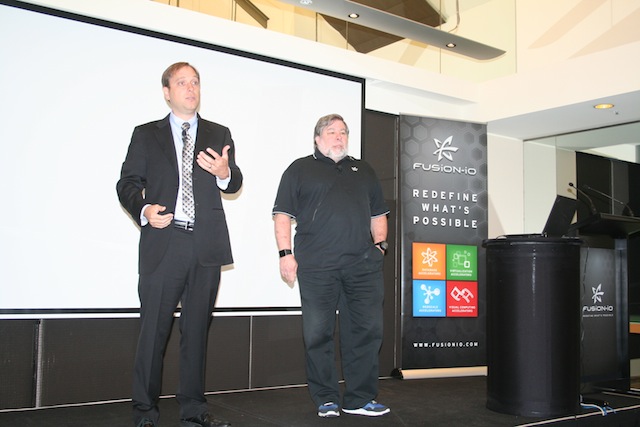
    When the opportunity comes to meet co-founder of Apple computer Steve Wozniak you jump at it, despite being jet lagged from the previous day’s flight.

    One of the tough things when writing about Steve Wozniak is that he is a fast talker. You have to be quick to keep up with his ideas and words.

    Steve was in town to show off the range of solid state computer memory cards manufactured by Fusion-iO, a company based in Salt Lake City.

    Wozniak liked the idea so much he became Fusion-iO’s chief scientist in 2009. “When I first saw the iO drive, it was so beautiful I had to buy one from the company and put it in a frame just to frame it at home.”

    What enthused Woz were Fusion-iO‘s range of NAND flash memory cards that speed up servers while reducing their power and cooling requirements.

    Those power savings are important for data centres when hundreds of thousands of servers might be in one building, Fusion-iO’s CEO and co-founder David Flynn estimates this could save up the industry a $250 billion a year in operating costs.

    Probably the biggest benefits though are in the corporate space, one Flynn’s boasts is how one movie studio used Fusion-iO’s products to reduce transcoding between formats from two hours to 39 seconds.

    Another case study they show off is how grocery chain Woolworths were able to reduce the 17 hours to run their weekly trading reports to three hours meaning they were able to capture weekend figures for their weekly Monday morning board meetings.

    For smaller businesses, the biggest benefit is these products can turn fairly basic desktop computers into workstations with the $2,500 ioFX card promising some serious post production capabilities for a system although one would expect an entry level box wouldn’t have the data connection, hard drive or – most importantly – power supply to cope with the demands of such a device would put on the typical cheap components in a basic desktop system.

    All of these changes though are heralding some pretty big changes for big and small businesses.

    Where Steve Wozniak sees the greatest application of moving data faster is in Artificial Intelligence applications like voice recognition. Apple’s Siri is a good example of this.

    The barrier to effective voice recognition is the sheer amount of data processing required to effectively understand voice commands. Doing this on cloud services is a far more efficient and effective way of doing this.

    As we saw at Dreamforce last week, the sheer amount of data pouring into companies is changing how they manage information. Getting access quickly to relevant information is an important part of managing it.

    “I’ve never gotten so excited about or fell in love with a technology like this since Apple.” Says Wozniak.

    Having a chance to speak to Steve Wozniak up close shows that fast talking enthusiasm is for real. The Woz is a real geek.

    Like all true geeks Wozniak is passionate about what he believes in – whether it’s about NAND flash cards or becoming an Australian resident he bubbles with enthusiasm. Just don’t try writing notes down while he’s in full flight.

    Similar posts:

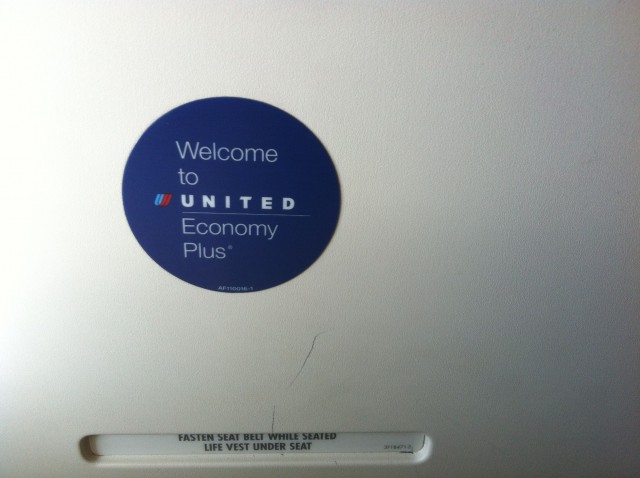
  • Economy Plus – the United Way

    Economy Plus – the United Way

    One of the tough things about long haul, overnight flights is getting a decent night’s sleep. I find this can only be done in a windows seat where you can snuggle against the fuselage and get reasonably comfortable. So it’s a priority to get those windows seats for a big flight.

    With the return flight to Sydney from San Francisco it turned out there were no window seats in the basic economy section so a $150 upgrade to United’s Economy Plus section was needed to grab one of those essential windows seats.

    Check-in

    The United online check in, while clunky, still worked and the upgrade to Economy Plus was a simple online credit card transaction with a straightforward seat allocation, the selection was painless and effective.

    At San Francisco airport the check in, albeit three hours early, was friendly and quick with no quirks and thankfully the seat allocation had been kept.

    One thing to keep in mind with United’s seat allocations is they reserve the right to change them and even kick you out of Economy Plus, albeit with a refund of the supplement, if the flight is full and the Sydney flights are usually packed.

    So it’s a good idea to get the airport and check in early to reduce the chances of losing your seat which is highly likely if there’s been disruptions elsewhere in the United network meaning connecting passengers have missed earlier flights.

    Getting through security is the usually fraught hassle however the TSA staff deal with flummoxed tourists and language barriers with a brisk efficiency. Keep your sense of humour and accept that travellers’ dignity was one of the early causalities of the War On Terrorism and the process shouldn’t be traumatic.

    Airside

    San Francisco’s International Airport is a delight compared to the snarling, customer unfriendly Sydney Airport. While food outlets aren’t cheap, San Francisco’s are decent and there’s plenty of accessible power sockets, working desks and free wi-fi that works.

    The gates themselves can be some distance from the facilities so be prepared not to stray too far. The gate lounges themselves are fairly spartan and there’s no reason to wait there until a few minutes before the aircraft starts boarding.

    The seats

    Sadly I didn’t get the aircraft registration numbers for this flight or the previous inbound trip but it appeared that this plane was newer – say mid-1990s – than the flight into San Francisco which could well have been one of the first 747-400s ever built in the late 1980s.

    The United Airlines Economy Plus 37" seat pitch
    United Airline’s Economy Plus is far more comfortable than standard economy

    The Economy Plus seats’ additional 3″ of legroom are definitely worth it. The moment you get in the seat, you know the extra room makes a much more comfortable trip than the cramped 31″ of standard economy class.

    One thing to keep in mind is that while Economy Plus adds nothing more in service, being at the front of the economy cabin does mean you get first choice of food, beverages and easy access to the middle toilets which is a slight advantage over those crammed at the back. It’s also a little quieter as the seats are over the wing rather than behind the engines.

    Another benefit with the additional pitch is that you don’t get a faceful of headrest when the seat in front of you reclines so it is possible to work on a laptop, read or eat in comfort even when the person ahead of you is still sleeping.

    Inflight entertainment

    While the system was still the shockingly decrepit 1990s cabin screens, there were for some reason additional choices on the audio channels including a classical music selection which made it far easier to relax than cheesy 1980s love songs or gangsta rap.

    Naturally there was no inflight power in the cheap seats so take advantage of the plentiful power sockets at SFO to make sure you’re fully charged before boarding.

    Shortly after take off the cabin crew come around with meals. Overall the cabin crew seem tired and beaten, while they aren’t rude or unpleasant one wonders if they have all received too many stern memos from management about being friendly to customers.

    Food

    An interesting thing about cheap airline food is how they cook and serve it in ways that make it difficult, if not downright dangerous to eat with plastic cutlery.

    Tough chicken for dinner on United Airlines
    Careful trying to cut that chicken

    In this respect UA 863 didn’t disappoint. The tough, mystery chicken lying under a red sludge masquerading as barbecue sauce was difficult to cut and risked sending one’s drink flying into your neigbour if you weren’t careful. This isn’t helped by the weird ridges United insist on putting underneath their trays.

    The bread had a strange chemical taste while the Love and Quiches Double Chocolate Crunch Bar was the highlight of the meal. The red wine was nice as well.

    After as good a night’s sleep as one can get in an economy class seat, breakfast was served around two hours before landing in Sydney. Again it was tough to eat.

    French toast for breakfast on United Airlines out of San Francisco
    You’ll need lots of syrup to soften that tough toast

    Like the chicken earlier in the flight, the French toast was tough to cut and hard to eat. Fortunately a good soaking in maple syrup makes it almost edible.

    The fruit salad was spartan but fine while the cold croissant tasted strange like the roll served the night before. It’s a shame United can’t find one of San Francisco’s excellent bakeries to supply their bread.

    Arrival

    The plane arrived on-time and without problems with immigration straightforward after dodging the embarrassing and garish duty free ripoff shops.

    Customs is the standard mass brawl that’s normal for early morning international arrivals at Sydney when a dozen or so wide bodied jets arrive at the same time from Europe, Asia and the US.

    If you have the choice, it may be worthwhile choosing a flight that arrives in Sydney after 8am so you can avoid both the customs hall and traffic peak hours.

    Once past customs it’s welcome to the snarling, belligerent and anti-traveller horror that is Sydney Airport. Get out of there as quick as you can by train, taxi, bus or car.

    Note if someone is meeting you, the pick up area is on the far side of carparks A and B. It’s not marked for either passengers in the terminals or for those driving into the complex. None of this is an accident and it’s best for both parties to have mobile phones so they can co-ordinate movements.

    In many ways the customer hostile attitude of the Sydney Airports Corporation is good news for United Airlines as it makes their tired inflight service feel warm and inviting.

    Overall the United Economy Plus option is worth the extra $150 charge to at least get earlier service and more legroom if you have to fly UA. It’s difficult though to recommend United while they fly such awfully old equipment and you should only consider it if the connections or the fare make them the best option.

    Similar posts:

  • They thought they didn’t have a problem

    They thought they didn’t have a problem

    As Apple fans howl about the about the new iOS6 Maps feature which replaces the old one driven by Google Maps, it’s useful to get a cartographer’s view of how Apple got things wrong.

    Michael Dobson’s analyis deep dives into the complexities of mapping which can be summed up in one phrase;  “their problem is that they thought they did not have a problem.”

    Those Rumsfeldian ‘unknown unknowns comes back to bite a company again.

    Like many things in life, mapping is a lot more difficult than it looks and assuming that a drawing or an older map is correct or the features unchanged is risky.

    This is not a job you just leave to machines sucking down data from various sources; details needs to be checked, validated and checked again before being added to a map.

    What’s worrying about Apple’s map snafu is this probably wouldn’t have happened under Steve Jobs as he’d have used the app himself and yelled at people when it didn’t work.

    Apple’s decision to run with a substandard service smells horribly of decision by committee and compromised products being release to suit managerial imperatives rather than delivering one perfectionist’s vision of what worked.

    We may well be seeing the beginning of Apple’s evolution into an anonymous corporation.

    One of the positives of that is we may also discover a less secretive or hubristic Apple.

    How Apple fix their map application is going to be interesting, they certainly have the funds to hire the best brains in mapping along with the 7,000 other employees Google are estimated to have in their mapping division, the question is should they?

    For Google, having a huge division building and improving their maps search as geolocation is a key part of their local services and search tools.

    Apple on the other hand doesn’t need a stand alone mapping division and while they can afford one, it certainly isn’t an effective use of their capital or management time.

    It may well be that Apple will have to swallow their pride and license the data feeds back from Google or even Nokia, or perhaps they could even put in a bid for Nokia just to mess with the minds of Microsoft’s management.

    Regardless of which way Apple decide to go, they’ve got themselves in an expensive mess which is going to take some time or money to fix.

    For now, I’m sticking with iOS5 on my phone as I like my mapping app too much, particularly the integrated public transit features. My guess is I’m not alone.

    Similar posts: