Author: Paul Wallbank

  • Losing the hospitality battle

    Losing the hospitality battle

    Travel review site Tripadvisor released its 2012 Industry Index examining the 25,000 responses from hotels around the world and 1,000 Australian hospitality businesses who took part in the survey.

    The index covers a wide range of areas of how the hospitality industry is dealing with connected customers, the web and how hotels are dealing with the relative performances of markets in Europe, North America and Asia.

    A disturbing part of the survey was how many smaller businesses are falling behind their bigger competitors with less than half of Australian Bed & Breakfasts agreeing the statement that an “ability to book via my property’s website on a mobile device is ‘very important,” while 70% of hotels agreed.

    The failure of smaller properties to engage online is borne out anecdotally as well, at a recent business breakfast a B&B owner – whose main business was furniture retailing – moaned about the negative TripAdvisor reviews his place had.

    When it was suggested he might want to engage with the unhappy customers, the proprietor threw his hands up and said “our solicitor told us that it was too expensive to sue.” He wouldn’t accept that the dissatisfied guests might have a legitimate complaint that should be addressed.

    At the same time larger hotel chains have full time teams monitoring comments on Tripadvisor, Facebook and other online forums, fixing problems that are being mentioned and then telling the world they have resolved the issue.

    There’s a good reason for this. Ask someone planning a major holiday and you’ll find almost all of them are reading reviews on sites like Tripadvisor, Fodors or Lonely Planet’s Thorn Tree before booking accommodation or flights.

    While many of the hotel management responses are boilerplate – repeated replies like “Thank you for your review and we appreciate you taking the time to share with us your experience as we are always pleased to receive feedback from our valued guests” is not what social media or customer service is – at least there is a perception that senior management is listening.

    At many establishments senior management really is listening, a country manager of one of the world’s biggest chains describes how his three person team sends him a report each day of any complaints being listed online. These are checked out and any systemic problems they find such as surly front of house staff, poor housekeeping or incorrect billings are addressed immediately.

    Having a direct line to happy or dissatisfied customers is one of the major benefits social media offers businesses. That smaller hotels aren’t doing this while their multinational competitors indicates the independent sectors of the hospitality industry are falling behind the majors.

    The furniture shop owner with a B&B investment illustrated the problem, not only was he not engaging with dissatisfied customers on TripAdvisor, he had no idea whether his businesses were listed on Google Places, Facebook or any other online listing service – “my wife does that” was his dismissive answer.

    Possibly the most overused quote in modern business is ice hockey star Wayne Gretzky’s “skate to where the puck is going to be, not where it has been”. Those smaller hospitality businesses not taking the mobile web, review sites or social media seriously aren’t even in the skating rink in today’s game.

    There’s a lot more interesting ideas in the TripAdvisor report that should have any hospitality thinking about how customer service and marketing are evolving in a connected society. It’s worth a read.


    Similar posts:

  • Good critic, bad artist?

    Good critic, bad artist?

    With the passing of art critic Robert Hughes I’m re-reading a passage of his autobiography, Things I Didn’t Know.

    In Hughes’ passage describing his leaving Australia he talks of attempts at painting and makes an observation about art criticism that is true of every field.

    “You do not have to be a good painter to be a good art critic,” he said. “But there is, to me, something a little suspect about an art critic who has never painted and who cannot claim to grasp even the rudiments of intelligent drawing.”

    The same could be said of any critic – knowing the technicalities, skills, difficulties and effort enables a critic to make informed judgement. That isn’t to say they are superior at their trade than those they criticise.

    It’s been said that we are all two bad decisions from ruining our lives or careers. That’s true in the artistic or professional fields – many managers, entrepreneurs, politicians, artists or just men going through middle aged crises have come unstuck from making the wrong choice at the wrong time.

    It’s why we always have to view the stories of great success with caution, as the winners’ tales are tinged with survivor bias and for every winner there a field of skilled, hard working people who didn’t succeed.

    In some fields, like arts and sport, the winners have to have skills before they will even get a chance of winning. Although there are many who could have be successful but weren’t because they never had an opportunity to pick up a paintbrush, guitar or ball at a key moment in their lives.

    That isn’t quite so true in more subjective fields like business, politics or journalism. In those callings it is possible for a suburban apparatchik, dour accountant or talentless hack to rise because of their mentors, rat cunning or just pure dumb luck.

    One of a critic’s roles is to call out those talentless but lucky hacks and in doing so they do society a great favour.

    In a world where spin and PR often trump good policy or ethical behaviour, we have to pay attention to the informed critics who help us filter out the misinformation and lies that is part of our information diet.

    Similar posts:

  • Undoing the untrained workforce

    Undoing the untrained workforce

    One of the notable things about the 1980s way of doing business was how front line workers weren’t valued for their skills and knowledge.

    In call centres, shopping malls and government departments, those who dealt with customers were seen as an unnecessary expense who should be outsourced at the first opportunity or, if it wasn’t possible to hive them off, then encourage them to get more money out of the customer while providing less service.

    An example of this was at electronic superstores where sales staff with little product knowledge were given rudimentary training and then encouraged to sell easy payment plans and expensive acccessories – the HDMI cable scam where connectors of dubious quality earned more profit and commission than the HiFi systems or plasma TVs they plugged into illustrated how lousy a deal this way of doing business for the customer.

    Much of that mentality has been inherited by web2.0 companies that think customer service is an optional extra.

    Some of those companies can’t even be bothered protecting their clients’ data properly, such is their unwillingness to provide service.

    The stack ’em high, sell ’em cheap self service culture of the 1950s and 60s reached its limits in the 1980s and was only given a reprieve by the easy credit boom of the 1990s. With the end of the credit boom, electronic or household goods stores that simply sell cheap tat on interest free terms at a fat mark up without adding value now struggle.

    Gerry Harvey is getting out of electronics partly for this reason – his business model is dead and it’s been difficult for a decade to make the fat profits on consumer computers or electricals without hooking the customers with interest free deals or expensive and pointless accessories or software.

    One of the conceits of management through the last part of the Twentieth Century was the mantra “our greatest asset are our people”, today business have to start valuing the skills, knowledge and corporate memory of their workforces.

    Similar posts:

  • Why would a plumber want a broadband connection?

    Why would a plumber want a broadband connection?

    A question that still bugs me from the Cloud + NBN forum this week is “why would a plumber want a broadband connection.”

    It doesn’t seem so long ago that question was asked about mobile phones – in the early 1990s the question made sense as cellphones in those days were heavy bulky things that sat in cars. They were of little use to plumbers or anyone else except the executives and politicians who could afford them.

    Today there are few plumbers who don’t have a mobile phone.

    Why would plumbers want a broadband connection? Job scheduling, inventory management, stock ordering, quoting and invoicing are five tasks that spring to mind.

    One of the big areas for all business is research and training. Keeping up with industry changes, particularly in fields where professional development is required to maintain your license or accreditation, is made far easier with online learning services.

    For the plumber, being able to find out what’s new on the market and how to install or maintain the latest products keeps them in the marketplace.

    Then there’s the necessity of being listed online – without a broadband connection the local plumber will struggle to keep up to date with the sites customers are using to find tradesmen.

    Even asking the question “why should a plumber be online?” betrays just how many of us aren’t understanding how business is changing.

    Similar posts:

  • Extending the knowledge graph

    Extending the knowledge graph

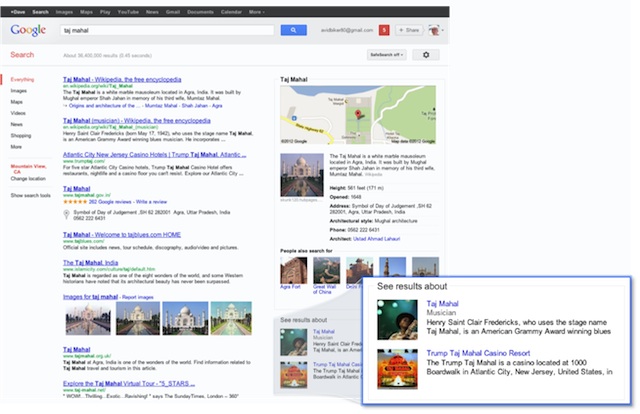
    Google’s latest search changes – introduced by Search Senior Vice President Amit Singhal – are another development, or baby step as Amit would call it, in making data more useful for us.

    The flood  of data that’s washed over us since the web arrived has left most of us befuddled. Increasingly, a basic keyword search just hasn’t been enough to find the information we’re looking for and we’ve had to trawl through pages of irrelevant information.

    One of the aims of Google’s new features is to make data more relevant to a user – so if someone in the US types “Kings” into Google, they will be given details of the Los Angeles Kings hockey team or the TV series “Kings”.

    Those details will include snippets of information about the topic. It could be the teams venue or the cast of the TV show. For tourist locations it could be some basic facts or transport information.

    Amit is particularly proud of integrating tourist information and flight details into search and Gmail which indicates Google is beginning to leverage its buyout of the ITA travel booking network last year.

    Google’s treatment of data reflects what’s happening with other services. At the recent Australian Xero conference and in an interview with MYOB executives, it’s been emphasised how knowledge is being aggregated to give customers and users better, more useful results.

    With Google’s knowledge graph we’re seeing the realisation of what big data can do, there’s many baby steps ahead but there’s a lot of potential.

    Similar posts: