Author: Paul Wallbank

  • Book review: The Information Diet

    Book review: The Information Diet

    We all know a diet of fast food can cause obesity, but can consuming junk information damage our mental fitness and critical faculties?

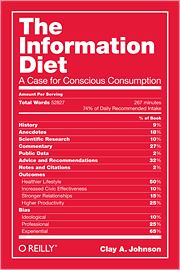
    In The Information Diet, Clay A. Johnson builds the case for being more selective in what we read, watch and listen to. In it, Clay describes how we have reached the stage of intellectual obesity, what constitutes a poor diet and suggests strategies to improve the quality of the information we consume.

    The Information Diet is based upon a simple premise, that just as balanced food diet is important for physical health so too is a diverse intake of news and information necessary for a healthy understanding of the world.

    Clay A. Johnson came to this view after seeing a protestor holding up a placard reading “Keep your government hands off my Medicare.” Could an unbalanced information diet cause a kind of intellectual obesity that warps otherwise intelligent peoples’ perspectives?

    The analogy is well explored by Clay as he looks at how we can go about creating a form of “infoveganism” that favours selecting information that comes as close from the source as possible

    Just as fast food replaces fibre and nutrients with fat, sugars and salt to appeal to our tastes, media organisations process information to appeal to our own perceived biases and beliefs.

    Clay doesn’t just accuse the right wing of politics in this – he is as scathing of those who consider the DailyKos, Huffington Post or Keith Olbermann as their primary sources as those who do likewise with Fox News or Bill O’Reilly.

    The rise of opinion driven media – something that pre-dates the web – has been because the industrial production of processed information is quicker and more profitable that the higher cost, slower alternatives; which is the same reason for the rise of the fast food industry.

    For society, this has meant our political discourse has become flabbier as voters base decisions and opinions upon information that has had the facts and reality processed out of it in an attempt to attract eyeballs and paying advertisers.

    In many ways, Clay has identified the fundamental problem facing mass media today; as the advertising driven model requires viewers’ and readers’ attention, producers and editors are forced to become more sensationalist and selective. This in turn is damaging the credibility of these outlets.

    Unspoken in Clay’s book is the challenge for traditional media –their processing of information has long since stopped adding value and now strips out the useful data, at best dumbing down the news into a “he said, she said” argument and at worse deliberately distorting events to attract an audience.

    While traditional media is suffering from its own “filter failure”, the new media information empires of Google, Facebook, Apple and Amazon are developing even stronger feedback loops as our own friends on social media filter the news rather than a newsroom editor or producer.

    As our primary sources of information have become more filtered and processed, societal and political structures have themselves become flabby and obese. Clay describes how the skills required to be elected in such a system almost certainly exclude those best suited to lead a diverse democracy and economy.

    Clay’s strategies for improving the quality of the information we consume are basic, obvious and clever. The book is a valuable look at how we can equip ourselves to deal with the flood of data we call have to deal with every day.

    Probably the most important message from The Information Diet is that we need to identify our biases, challenge our beliefs and look outside the boxes we’ve chosen for ourselves. Doing that will help us deal with the opportunities of the 21st Century.

    Clay A. Johnson’s The Information Diet is published by O’Reilly. A complimentary copy was provided as part of the publisher’s blogger review program.


    Similar posts:

  • Losing the supply chain

    Losing the supply chain

    The New York Times’ weekend feature on Why Apple Manufacture iPhones in China focused on the underlying reasons why manufacturing has become concentrated in the PRC.

    While much of the commentary on the article has – correctly – focused on how US manufacturing move to China is destroying the economic bases of the American working and middle classes, there’s also another serious consequence of the story; the destruction of the US supply chain.

    The story itself emphasised this;

    In part, Asia was attractive because the semiskilled workers there were cheaper. But that wasn’t driving Apple. For technology companies, the cost of labor is minimal compared with the expense of buying parts and managing supply chains that bring together components and services from hundreds of companies.

    While wage costs are important, far more critical are the surrounding supply chains. Without those, even if you want to manufacture in the US or anywhere else you’ll struggle to find suppliers and skilled labour.

    The amazing thing with the United States is the world’s most powerful economy has managed to dismantle most of their supply chains that took a century to develop inside twenty years whil China has built up most of theirs since they joined the World Trade Organisation in 2001.

    For the United States economy, the effects are more subtle and dramatic than they first appear. The accompanying video to their story illustrates how the multiplier effect, the number of jobs created in the wider economy for each industry worker is as much 4.7 for a manufacturing job, while a service sector worker is less than 1.

    That means less employment and less wealth.

    For the US, and most the Western world, we were able to avoid the effects of becoming less wealthy over the last decade by spending big on credit cards. Homes that would have been out of reach to the average American – or Australian, Brit or Irishman – were kept accessible by easy, cheap credit.

    As that credit dries up with the end of the Twentieth Century debt supercycle, the economic basis of this model is eroding.

    For most of us in the Western, developed world it means we are going to become poorer. Chinese and Indian workers might catch up with our living standards, but that standard will be at a lower level that we anticipated a decade or two ago.

    The most interesting consequence of the New York Times’ story is what happens to the managerial classes?

    Right now they appear to be riding high as their companies’ profits increase and they award themselves trips to the Paris Ritz and receive 50 million dollar payouts when caught cheating on their expenses.

    Over time though this cannot continue as the senior managers themselves have become major cost centres which will eventually have to be reduced.

    Indeed Apple, the leader in the outsourcing trend, is unique among US companies in that it had a driven, visionary leader and doesn’t have a bloated, self indulgent cohort of bureaucrats managing the business.

    With every stage of the deskilling of America and the offshoring of supply chains, there’s been the belief that “it could happen to me” to various groups of workers – we’re now seeing the same process happen in white collar professions like the law are subcontracted to Indian and Philipino service providers.

    Senior managers should have no illusions the same will happen to them as the search for cost savings runs out of targets in the rest of organisations.

    The biggest problem though is that loss of supply chains and industry knowledge. The question is, can you rebuild that capacity in decade in the way China did?

    Supply company image courtesy of Stock Xchange and Andy McMillan.

    Similar posts:

  • Megaupload, cloud computing and trust

    Megaupload, cloud computing and trust

    The closing down of file sharing site Megaupload has raised the question of trust in the cloud; “It has made cloud services look that much less legitimate” one daily paper quotes futurist Mark Pesce as saying.

    For those of us advocating cloud services and advising businesses on using them, this trust issue isn’t anything new. All of us have to be careful about who we trust with our data and Kim Dotcom, the founder of Megaupload, doesn’t come to mind as someone who would stand a great deal of due diligence.

    Like investments – another area where trust is essential – we have to spread our risk around. Saving copies of data to your own computer and making sure the information you save on the cloud is in a form easily read by different systems is important, as is not trusting any one service for critical services.

    The taking down of Megaupload also raises other questions – as privacy advocate Lauren Weinstein points out;

    “But the Megaupload case is more akin to the government seizing every safe deposit box in a bank because the bank owners (and possibly some percentage of the safe deposit box users) were simply accused — not yet convicted — of engaging in a crime.

    What of the little old lady with her life savings in her box, or the person who needs to access important documents, all legitimate, all honest, no crimes of any sort involved.

    They are — to use the vernacular — screwed.”

    It’s this over-reaction by government agencies which is the real concern and the co-operation of large corporations in shutting down services – as we saw with the shutting down of Wikileaks – probably does more to damage trust in all online services, not just cloud computing.

    Cloud services are no less trustworthy than our computer systems, all of which can breakdown, catch viruses or be compromised by staff making mistakes. We have to understand that all technologies carry some degree of risk.

    For businesses and home users, we need to spread the risks around – don’t just trust one service or technology to deliver your products or services and have a fall back plan if things go wrong.

    Similar posts:

  • Closed for business

    Closed for business

    This post originally appeared in Smart Company.

    Many industries hoped this Christmas was going to be their saviour – across the country businesses in the retail, tourism, real estate and many other service sectors hoped they’d see an upbeat end to a tough year.

    When you’re doing it tough you don’t turn customers away, yet thousands of businesses did that over the Christmas and New Year break by not updating their website to reflect their holiday trading hours.

    Almost every business I encountered over the break had little – if any – information about their Christmas trading hours. In holiday towns where visitors are unfamiliar with the local businesses many cafes, restaurants and service businesses didn’t have a website or a local listing despite customers searching for them on iPads and smartphones.

    Smart Company’s sister site Property Observer discussed this problem in the real estate industry where tenants were being left with problems over Christmas because there are no emergency contact numbers shown on websites.

    What’s even more amazing about real estate agents in holiday areas is many pack up for a week or two and miss possible vacation rentals or even sales to enthusiastic out of towners. Who would have thought real estate agents would let commissions pass them by?

    For me, I found information lacking on sites for both small and big businesses. To check the opening hours of Myer stores for instance required downloading a PDF file, Australia’s biggest retailer surely can spare a few hours of a junior’s time to updating the opening hours in their already inadequate store finder.

    Similarly the City of Sydney fell down on their swimming pools, with their fabulous Victoria Park and Boy Charlton complexes both showing the wrong opening hours. This customer took his business to Leichhardt and North Sydney instead.

    Most of the local shops did poorly as well – few had any mention of opening hours at all let alone Christmas trading times. Those who did open probably missed business because people assumed they were closed or found another place online.

    Not updating a website would have made sense ten years ago when even the smallest change meant a fat bill from your web designer. Today online publishing tools like WordPress and Drupal mean there is no reason for you or your staff not to log on and make minor changes like revised hours or holiday specials.

    If you still fear a fat bill each time you ask for a change to the website then it’s time to sit your designer down and discuss making some changes to the way your site works – not to mention some strong words about your billing arrangements.

    Having up to date content isn’t just good for helping your customers, it also adds credibility to search engines like Google and Microsoft Bing which like sites that are regularly updated.

    Almost every business has something to say during the year, whether it’s a new product line, welcoming a new staff member or having a special offer. There are also seasonal factors like Christmas, back-to-school, end of financial year and whole range of annual events that affect your industry.

    The beauty of the web right now is that we aren’t constrained in what we want to say about our businesses, so next Christmas let your customers know great you are and which days and times you open.

    Similar posts:

  • Successful Sources Will Not Be Paid

    Successful Sources Will Not Be Paid

    The whole world wants a freebie, and many of us are giving our ideas, intellectual capital and service away to online magazines in the hope of getting a link or a little bit of publicity.

    Bringing the idea undone is the unfortunate reality that web is awash with free pointless material that adds little value. Your contribution, however valuable, gets lost in the static of PR driven articles and SEO optimised fluff.

    This is why Google are trying to tie social recommendations into their search results, although it’s hard to see how your cousin’s LOLCat posts are going to add any more value than the generic garbage served from services like eHow.

    Yet every day there’s more callouts for  free content – desperate journalists and publishers beg for our ideas or labor in return for some ‘exposure’.

    And that ‘exposure’ floats away into the ocean of noise and irrelevance filled with the rest of the ‘free’ content.

    Giving stuff away for free isn’t working well anymore and for those of us who are trying to build a business around that model, we’re struggling to get found or heard in the morass.

    Along with the wasted time, the danger is we start giving away our best, most valuable work in order to get attention and then we have nothing left to sell.

    Consumers are waking up to this and beginning to focus about what they read online. We should too.

    Similar posts: