
Author: Paul Wallbank

  • Australia’s one trick economy

    Australia’s one trick economy

    Earlier this week, Reserve Bank of Australia Governor Glen Stevens gave a speech to the Australian Industry Group on the world’s changing economic currents.

    That presentation has a number of pointers for Australian businesses on how we use technology, our investments and, most importantly, where the Canberra sees our economy going.

    Much of the Governor’s speech discussed how those of us who at the beginning of the century believed Australia’s economy had to diversify into new industry sectors — such as the IT sector — were proved wrong by the Dot Com Bust and the subsequent boom in the resources sector.

    “Australia would probably do best, in its production structure, to stick to its comparative advantages in minerals or agriculture or various services.” Mr Stevens quoted from ten years ago, “but it was hard going trying to make sensible points against the barrage of market and media commentary.”

    Perfect hindsight

    It’s impressive the Governor had this perfect hindsight which can overlook the role of ramping the housing markets by the Rudd and Howard governments to avoid the 2001 and 2008 US recessions along with the sheer good luck of having a resources boom through the last half of the decade.

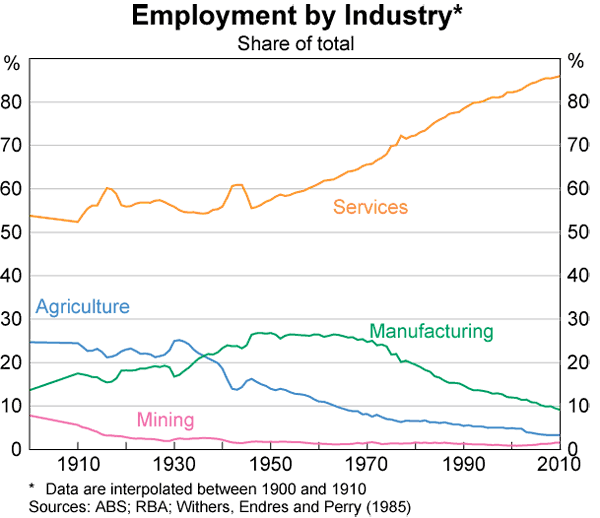
    During his speech the governor referred to an RBA research paper, Structural Change in the Australian Economy which casts an interesting light on the comparative advantages in those “various services”.

    That paper shows that service sector employment has risen to nearly 85% while its share of GDP has stayed around the same for the last twenty years, which to this non-economist’s mind implies the portion of national wealth is declining for service based workers and businesses.
    Sleepwalking into the dutch disease

    Of course those of us in the service sector could make it up by exporting but here again, service sector exports haven’t done much over the last decade which won’t be helped by the current high Aussie dollar — another aspect of the Dutch Disease we seem to have sleep walked into over the Howard and Rudd years.
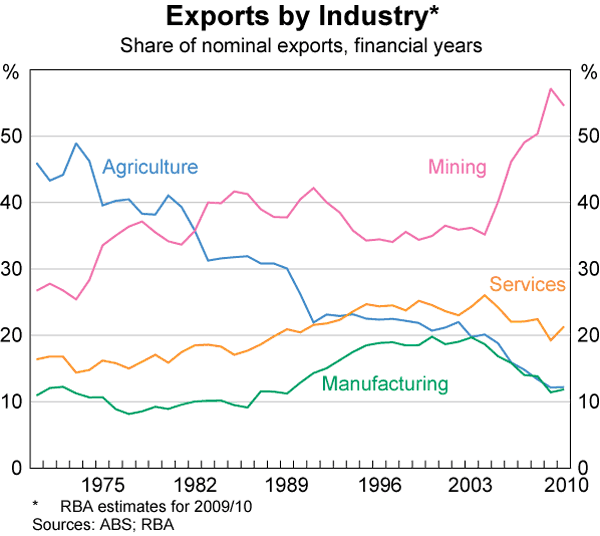
    Those same statistics show mining employment has declined over that period as well and if you’re considering sending your kids down the pit, or even packing in your own city job to drive a mining truck, you might want to read the interesting work being done by the University of Sydney’s school of robotics.

    Generously, Governor Stevens didn’t completely write off the role of technology observing that, “in the old versus new economy stakes, it was probably in the use of information technology, rather than in the production of IT goods, that the gains would be greatest.”

    Invest in, but don’t develop, technology

    The Governor’s messages are clear to business people; our businesses have to invest in technology to be more efficient and we need to understand that government policy will be geared around the mining sector.

    Most importantly, we need to understand that on a national level there is no Plan B.

    In the last election it was clear both sides of politics based their policies, such as they were, on the assumption the China boom will last for the foreseeable future. Yesterday’s speech shows Glenn Stevens and the Reserve Bank share that outlook and no other alternative is being planned for.

    That’s fine for Glenn, Julia, Tony and their colleagues as they have safe, indexed pensions when they deign to cease giving us the benefit of their visionary leadership.

    In the business community we don’t have that luxury; a plan B is required just in case things don’t quite work out the way we hope. As the Governor says:

    Succeeding in the future won’t ultimately be a result of forecasting. It will be a result of adapting to the way the world is changing and giving constant attention to the fundamentals of improving productivity. That adaptability is as important as ever, in the uncertain times that we face.

    That’s excellent advice. How adaptable is your business in these uncertain times?

    Similar posts:

  • The next business era

    Ray Ozzie, Microsoft’s outgoing Chief Software Architect, has some interesting reflections on the future of the PC as he steps down after five years.

    His views on the mobile, pervasive always connected world and how the Personal Computer fits into it come at a time when there are real questions on how the Microsoft will fare in coming years.

    Scoble’s article, based on an interview with Starbucks Chief Information Officer, Stephen Gillet, describes how laptop usage is falling as customers are moving to slate computers such as the iPad and smartphones. He also touches on how standards like HTML 5 are beginning to replace proprietary products like Adobe Flash and Microsoft Silverlight.

    Is this necessary bad news for Microsoft? Perhaps not, but it what it means is they will have to reinvent the business away from the old, PC based, model of selling operating system licences.

    That’s not to say it can’t be done, Bill Gates successful turned the entire company around to an Internet Explorer view of the computer industry shortly after the launch of Windows 95 as it became apparent the bet on the Microsoft Network was wrong and the open Internet was where the market was going.

    One salient point that we should remember is the biggest businesses are not forever. In his post, Ray referred to the 1939 New York State Fair where one of the key exhibits was the S1 locomotive which was built by the Pennsylvania Railroad

    At one stage the Pennsylvania Railroad was the world’s biggest listed company, it went a hundred years without missing a dividend payment and at one stage employed more people than the US government.

    It ceased to exist in 1976.

    No business is forever and even the most powerful is at risk during times of great change. We need to remember that when looking at today’s seemingly untouchable business giants.

    Similar posts:

    • No Related Posts
  • The 360º brand

    “How do I advertise on LinkedIn? Asked a business owner at a recent workshop.

    While I answered that LinkedIn advertising probably isn’t the right path for many small businesses, one of my fellow presenters, Lara Solomon, disagreed and made the point LinkedIn is an important marketing tool.

    There’s no doubt about that as a marketing, rather than an advertising tool, all online channels — including LinkedIn pages — are important to businesses as customers, suppliers and potential staff check the web before doing business with an organisation.

    A good illustration of this was over the weekend when digital marketer, Raz Chorev, called out chicken chain Oporto’s for not training their staff on honouring Foursquare deals. Raz also made a point about censoring web comments which might be the topic of a future post, but really isn’t the issue here.

    Raz’s comments appeared on Twitter, Facebook and on web searches. To their credit, Oporto responded quickly by isolating the damage, explaining their position and learning a lesson on letting their staff know about all the offers they post.

    It isn’t just cranky customers posting on their own sites or any one of the thousands of review services such as Eatablity or Tripadvisor, we’re being judged on the comments of ex-employees, suppliers and even the quality and content of our own online utterings.

    our brand is out there, on line, all the time.

    A surly call centre, missed deliveries or billing mistakes all add up and damage our brands. Eventually, the massed weight of negative comments can overwhelm even the best, most expensive advertising campaign.

    Our brands, both as individuals and our businesses are bigger than just marketing, we have to make sure we are consistently doing the right thing by our customers, suppliers and staff.

    We’re in an era of accountablity which forces us to deliver on our promises. This is not a bad thing.

    Similar posts:

    • No Related Posts
  • A time for fresh ideas

    Stale old thinking doesn’t cut it anymore. In an age when plagiarism and rip offs can be uncovered with a few minutes searching on the web, simply copying someone else’s work has ceased to be an option.

    The same can be said for just recycling past ideas; the days of money for old rope are over.

    It’s time for new, innovative ideas and work. The opportunities for getting fresh thinking into society and business have never been greater.

    We can all do better than just leeching of other people’s work.

    Similar posts:

    • No Related Posts
  • Eight online tips for franchising

    The world wide reach of the web has always been a problem for territory based franchises. As a consequence, many franchise networks have a token web presence which they use mainly as a recruitment tool for new franchisees.

    An aversion to the web presents a difficulty for these franchisees as most customers are now online. By not actively using the net, those locally based franchise chains are finding themselves at a disadvantage to their non-franchised competitors.

    The franchising industry’s problem was illustrated last week by Ben who called into to my ABC radio spot last week on Internet business trends to ask about how a territory based lawn mowing franchisee can use the web.

    Ben’s question raised some important points that franchise holders — and anyone considering entering a franchise — should check to make sure that business is competing in today’s marketplace.

    Does the franchise have an individual page for each territory?

    Each franchise area should it’s own page within the chain’s site. While the contact details can redirect back to the central phone or form, the territory page should include some local testimonials and few other localised features.

    Is the home page regularly updated?

    A static index page that rarely changes isn’t attractive to search engines or customers. A vibrant business should be updating their page regularly. This is particularly true if there is a substantial network of franchisees.

    How does the site rank?

    When searching for the product or service the franchise sells, how high does the franchise’s page come up. If it doesn’t appear in the first page, then the franchise isn’t working.

    Does local search work?

    Type in a search for the franchise’s product and an established territory such as “lawn mowing Footscray”. If the Footscray franchise doesn’t appear in the local listings then the franchisor hasn’t listed their sites in the local search listings.

    What does the site sell?

    In researching this article, I found the biggest franchised lawn mowing chain appears in paid ads for “buy a lawn mowing franchise” but not for a actual lawn mowing. A site or digital strategy designed to sell franchises is good for the franchisor but doesn’t do much for the franchisee looking for customers.

    Is the franchise engaging with social media?

    Whether you trust social media or not, the market is talking about you on forums, blogs, Facebook, Twitter and other channels. A great example of this was Oporto last weekend. A franchise needs to be engaging with customers, critics and fans.

    Where are the franchisees?

    Are the franchisees listing themselves? This is always a worrying sign that a franchise isn’t controlling its marketing properly. On the other hand, if their personal profiles aren’t appearing on sites like LinkedIn, it can indicate too tight a control on franchises.

    What is their media strategy?

    The whole point of buying a franchise is to have a ready made brand and marketing strategy. If a franchise is locked into a print mindset with only at best a token online presence then they aren’t going where the customers are. Have a look at the online versus print effort before signing up.

    Many franchisors are playing by 1990s rules. Which was great for the last twenty years, but the old models are evolved as customers and potential franchisees have changed the way they shop and do business.

    The web and social media are more than just a passing fad or a blunt advertising and marketing tool. They are a key part of your business identity and are being used by suppliers, recruiters, job seekers and commercial partners to figure out whether you are worth doing business with.

    A franchise that doesn’t use today’s media tools is stuck in yesterday’s market.

    Similar posts:

    • No Related Posts