Author: Paul Wallbank

  • Champagne tastes and short runways

    Champagne tastes and short runways

    One of the curious things about the Silicon Valley business model is how fundraising is seen as an end in itself.

    Most business proprietors would be philosophical or mildly irritated if they’d had to give up equity or go into debt to fund growth, but in startup land a whack of money is seen as success in itself.

    Sadly that money isn’t always well spent as the story of the free spending Guvera streaming service shows.

    Over the company’s eight years the founders raised $185 million which ran out last week leaving the 3,000 small investors out of pocket.

    That small investors were even involved in such a venture raises eyebrows and suspicions aren’t helped by a funds manager charging huge commissions for their services.


    Just the use of a middle man like AMMA Private Equity – which happened to be run by one of the co-founders – should have raised concerns however the high commissions should prompted questions from the investors about advisors’ interest in getting them into a high risk venture.

    In the current overheated startup space it’s necessary to be skeptical about many of businesses claims and the amounts of money being raised, as big pots of honey attract the flies.

    Similar posts:

  • Digital disruption and civil rights

    Digital disruption and civil rights

    Next Saturday, on the 21st of May, I’ll be sitting on a panel for the Talking Justice series on how digital disruption is impacting on journalism, individual rights and social justice. This is an early draft of what I plan to be saying about the topic.

    The series will be held at Bendigo’s Ulumbarra Theatre in regional Victoria, tickets are available from the Loddon Campaspe Community Law Centre website.

    In the middle of last year I stopped writing for The Australian after their budget for freelance tech journalists ran out. Over the previous two years the newspaper had been my main source of income.

    To be fair to The Australian’s management, this was not surprising as at the turn of the century the paper’s IT section was the bible of the nation’s technology industry, often running to 64 pages as standalone liftout. It was a true river of gold for News Limited that employed over a dozen staff and contributors.

    Now, on a good week there’s a couple of adverts in the single page section and it employs two and half full time equivalent staff.

    The decline of The Australian’s IT section is not in itself remarkable – almost every newspaper has the same story as advertisers have moved away. In the case of the Australian IT, the employment adverts that funded the section’s heyday long ago moved to dedicated online sites.

    How a million flowers didn’t bloom

    For the broader media – including most news websites – Google and Facebook’s dominance in online advertising has meant even the digital dimes have become scarcer. Many of the ‘born digital’ or ‘web native’ publications are just as cash starved as their incumbent competitors, albeit with far lower cost bases.

    The drying up of advertisers’ cash has left the media model in tatters and the early promise of the internet allowing millions of new media sites to bloom has long ago proved false leaving the world of journalism a hungry, desperate place.

    For cyber utopians like myself who believed the web would usher in a new era where power  could be held accountable through citizens’ websites, blogs and social social media accounts, that disappointment is even greater as the internet is seeing power further centralised with extensive data dossiers being collected on every individual.

    An example of just how comprehensively data is being collected and used is shown in this clip from the 2008 US Presidential election campaign.


    That description is almost innocent by today’s standards as there are many, many more data points with social media, connected devices and – most of all – our smartphones tracking every moment of our lives and activities.

    Imbalance of Power

    A good example of how data is being used against citizens is the recent Not My Debt debacle where the government and Centrelink misused information to harass social security recipients.

    Stung by the public outrage, the agency saw fit to leak a critic’s confidential personal data to a journalist, an action later justified by a departmental secretary as necessary to protect their organisation,. A view seemingly legitimised by both the Australian Federal Police and the responsible minister who both saw no legal or ethical problem with such behaviour.

    That a experienced and long serving journalist along with a metropolitan newspaper saw fit to publish that lady’s personal circumstances also tells us the mainstream media, struggling as it is with both money and ethics, may not necessarily the protector of our civil liberties.

    Rights and data brokers

    Governments are not the only risk to our civil liberties, our connected lives give businesses huge control over what we say and do as well.

    With the Internet of Things our cars, smoke alarms, electricity meters, even toasters and fridges are gathering information on everything we do and this information can be used in ways we don’t expect, from denying credit to identifying us as employment or credit risks.

    Added to this is the end of ownership, where a purchase is only a license to use a product and that right can be cut off at any time.

    In the US, farmers are downloading pirated Ukrainian firmware for their tractors so they can maintain them. In many countries, including Australia, even that may be illegal.

    Should a consumer find their product is remotely shut down, they may have few legal remedies as many agreement insist on compulsory, and expensive, private arbitration rather than using the courts or tribunals to settle disputes. The terms and conditions underpinning the software licenses are so restrictive that it’s almost impossible to hold any supplier to account.

    Ultimately to protect the general public from these corporate and government excesses, a strong media is required to publicise official malfeasance and equalise the power imbalance with the rich and powerful.

    Where will a strong media come from?

    Right now it’s hard to see where that strong media will come from with today’s broken advertising and revenue models. However it was equally hard a hundred years to see how people would make money from producing radio programs yet the broadcasting industry turned out to be one of the Twentieth Century’s most profitable.

    To the question of ‘is everyone now a journalist?’ the answer has to be ‘no’ – the risks and costs are too high for the ordinary person who has to worry about keeping their job in a world where timid managers, not just at Centrelink, are frightened of even the mildest criticism.

    Coupled with that are the high legal barriers, from defamation to confidentiality clauses the barriers to reporting on matters are steadily being increased and the costs of defending oneself from plaintiffs who’d rather not see stories written are punitive and beyond the means of all but the richest media organisations.

    Rethinking journalism

    It could well be that we’re returning to an earlier period of journalism where the trade was poorly paid and regarded, it was only during the post World War II years that the occupation became something that supported middle lifestyles.

    With the stakes so high in an increasingly data driven world, it’s essential we do define the role of journalists is in today’s world along with give citizens the technological and legal tools so we can hold the powerful to account in the connected and data rich 21st Century.

    Digital disruption has deeply affected the media and it is redefining our rights as corporations and governments use technology to amass more power. We as citizens, voters and consumers have to exercise what influences we can to ensure our rights in a digital word.

    Similar posts:

  • Ransomware and innovation – links of the week

    Ransomware and innovation – links of the week

    Last week finished with a big bang as the Wannacry ransomware attack spread around the world with a curious twist which led one New York Times columnist to suggest software companies need to take more responsibility on security.

    In the meantime the world goes on companies still struggling with the definition of innovation and Facebook crushing anyone who dares to try out-innovating them.

    On a lighter note, Cary Grant spend much of his Hollywood years on LSD but it all turned out well and VentureBeat asks do humans have a role in a world run by Artificial Intelligence?

    The future of humans

    Is there a future for humans in a world run by artificial intelligence controlled robots? Venture Beat staged a panel in New Orleans that looks at where we fit into the automated world.

    Ultimately the panel concluded, it’s up to us to make some serious choices. Something we shouldn’t leave to engineers.

    The ethics of driverless cars

    Autonomous vehicles should give priority to occupant over passers by in the case of an emergency suggests a Mercedes Benz engineer.

    Christoph von Hugo, Mercedes’s manager of driver assistance systems, probably hasn’t helped the development of autonomous vehicles with his comments but the ethics of driverless vehicles is a discussion we should be having.

    Defining innovation

    Innovation is very simple, it’s about trying new ideas says Pete Williams, Deloitte Australia’s chief edge officer.

    “You need ideas, they need to be new, new for you. If everyone in the world is doing something and you haven’t done it and you do it for the first time, you’re innovating. You’ve got to try stuff. Not just have new ideas, you’ve got to try stuff. Innovation is something you do,” he said.

    Rethinking public transport

    British transport app Citymapper is to launch its own ‘popup’ bus service in London with the promise of a modern and user friendly operation. An interesting twist for a software service.

    “There will be a large screen that shows riders where they are in real time, and what’s coming up on the route — similar to how its smartphone app works. And they also have USB charging ports.”

    Snapchat feels the market chill

    One the darling unicorns of the tech industry, Snap, reported its first results as a listed company and the results were not good as Facebook’s shameless copying of the service’s features takes its toll.

    Sadly Facebook seems to be following the Amazon playbook of crushing upcoming competitors that refuse to be bought out. This is a part of a broader problem with modern American capitalism.

    What is Wannacry

    Security researcher par excellence, Troy Hunt, gives a full run down on the Wannacry ransomware and how to combat it.

    Towards the end of his article he has a list of eight actions computer users – from major organisations to households can do to protect their systems. Depressingly these are exactly what the computer tech support industry has been telling people to do for the past twenty years.

    Wannacry’s accidental hero

    An anonymous British IT security researcher realised the malware has a ‘kill switch’ – so he activated it. He does have an important message for computer users though.

    “This is not over. The attackers will realise how we stopped it, they’ll change the code and then they’ll start again. Enable windows update, update and then reboot.”

    An age of insecure machines

    One of things that might bring down an AI controlled world is insecure machines as Wannacry shows. In the New York Times technology commentator Zeynep Tufekci suggests we can’t stop the wave of attacks taking advantage of systems running out of date software and vendors need to take responsibility.

    “It is time to consider whether the current regulatory setup, which allows all software vendors to externalize the costs of all defects and problems to their customers with zero liability, needs re-examination.”

    100 trips in tinseltown

    Cary Grant got through his Hollywood years by microdosing on LSD claims a new documentary. When he retired from the movies he quit the speed and lived happily every after.

    Interestingly, microdosing is one of the strategies used by today’s Silicon Valley workers to get by in their stressful and demanding roles. Some things never change.

    Earworm of the week

    Similar posts:

  • Monopolies and innovation

    Monopolies and innovation

    An interview with Media scholar Jonathan Taplin, author of the new book Move Fast and Break Things, on the Pro-Market website poses some interesting questions about the direction of the digital economy and innovation as market power coalesces around the big four internet giants. 

    This power is particularly marked in online media with Facebook and Google pocketing most of the global advertising spend which leaves little for content creators.

    I kept coming back to these three—Google, Facebook, and Amazon. All have extraordinary market shares. Google has an 88 percent market share in search advertising and an 80-plus percent market share in Android. Amazon has a 74 percent market share in e-books, and Facebook controls 70-plus percent of mobile social media when you add Instagram, Messenger, and WhatsApp. What more empirical evidence does one need to prove concentration?

    Over the past decade we’ve seen the power of the big four online gatekeepers growing although ironically Apple’s light seems to be dimming as the company’s innovative vision fades following Steve Jobs’ passing.

    The monopoly problem is broader than just the tech industry though, as The Atlantic pointed out last year, market dominating corporations are suppressing innovation throughout the US. The problem is even greater in Australia and some other countries.

    The rise of the monopolies shouldn’t be a surprise as the neo-liberal policies of the United States and most of the western world for the last 40 years have been largely focused on increasing the wealth and power of corporations and their managers. It’s fair to say those policies have been successful.

    Where we go next is the big question. An economy dominated, and suffocated, by a handful of well connected and powerful corporations is not going to drive wealth creation, particularly in a world where more businesses functions are being automated.

    One short term step may be to break up the monopolies, something that Taplin himself suggests.

    This just goes to show how quickly the ground is shifting. I now have a piece coming out in the New York Times that explores the idea of breaking them up, but when writing the book, I tried to be reasonable. I thought no one would buy the idea of breaking them up. And now people are raising that idea.

    While that’s a start there’s vastly more that needs to be done from bankruptcy reform – the last 40 years have seen governments make it harder for small businesses and households to seek financial protection – through to intellectual property reform.

    Generational change may turn out to be the solution though as the lucky generation of business and government leaders – those born between 1935 and 55 – responsible for the ideology and policy that allowed such an accumulation of corporate power move on.

    Similar posts:

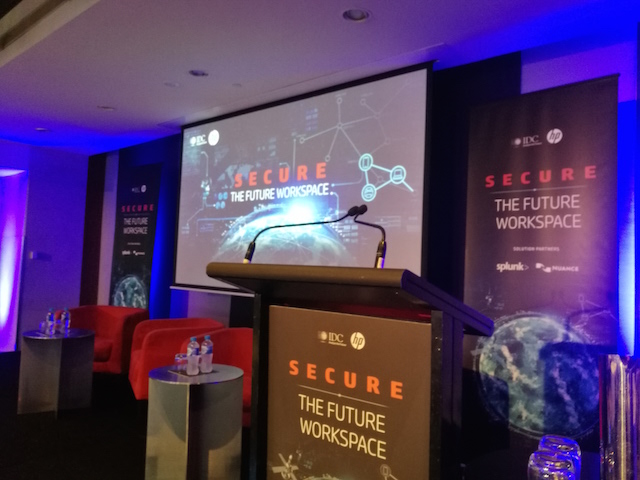
  • Securing the future workspace

    Securing the future workspace

    This post is part of a corporate blogging assignment for HPI and IDC covering their Secure the Future Workplace event.

    Security is probably the Internet of Things’ greatest weakness and probably the first devices to illustrate the weakness were networked office printers.

    For HPI, the devolved printer and hardware arm of Hewlett-Packard, those IoT weaknesses is an opportunity to showcase their products. However the security of printers is only the tip of a frightening iceberg of technology risks facing businesses and homes.

    Security starts at the top

    The first keynote for the morning was Simon Piff, Vice President of IDC Asia/Pacific’s IT Security Practice Business.

    Simon gave an overview of the challenge of digital transformation and the risks involved.

    To Simon, digital transformation has five different aspects within an organisation – Leadership, omni-experience, information, operating model and workforce transformations – all of which have different demands upon management.

    One thing he sought to emphasise during his keynote is an organisation’s IT security is a top down process. “If your CEO doesn’t care about cyber-security then how are you going to execute?” He asks.

    For printers he makes an important point. “They are essentially a single function server.” He says, “this is another server.”

    “There haven’t been headlines about printer hacks but we are about to hear about them.”

    Simon’s points about enterprise security and networked printers are something that all computer users, be they in home or business, understand – almost every connected device can be a network server. Being hacked is a real risk for everyone.

    Death of the perimeter

    “Don’t accept complacency,” is the key message from the second keynote speaker, Edmund Wingate.

    Edmund, HP’s Vice President and General Manager of the company’s JetAdvantage Solutions division, described how securing a company’s networking perimeter and relying on firewalls was “backward looking.”

    In the printer world, that the typical office device has over 250 settings alone creates risks for network administrators and security officers.

    Compounding that problem is the use of proprietary software in these devices. A plethora of custom operating systems, many of them based on outdated Linux distributions, opens opportunities for an infinite range of exploits.

    It’s better for the industry and vendors like HP to be open about the systems they are using and any vulnerabilities they find as otherwise governments will be forced to step into the space, warns Edmund. “The absence of standards lets things percolate too long.”

    Edmund’s point about proprietary and old software are important aspects in the entire Internet of Things security discussion. That there will be billions of devices ranging from network printers to traffic cameras and connected kettles running antiquated software is a problem the entire IT industry will have to manage.

    When your networked is hacked

    The day’s final session was a panel featuring Simon Piff, Managing Director ANZ for IDC; Carl Woerndle, Executive Director of Elevate Security; Hugh Ujhazy, Associate Vice President, IoT Practice Lead, IDC APeJ and Edmund Wingate.

    Carl was the proprietor of Distributed IT, an Australian domain registrar that was spectacularly hacked in 2011. The damage done to the business was so debilitating that it eventually forced the company out of business.

    The alleged perpetrator turned out to be an unemployed Australian truck driver with no formal  IT qualifications who had 700 other companies targeted. It’s a sobering lesson on how businesses are vulnerable.

    Random attackers are the norm, Hugh Ujhazy pointed out, and ransomware is another factor which wasn’t widespread when Distributed IT was hacked.

    Ujhazy sees Blockchain as the opportunity to rethink security. “We are on the cusp of changing the way we deal with devices and applications,” he says.

    The consensus from the panel was all enterprise networks are vulnerable to inside threats – whether they are IoT devices like network printers, disaffected individuals, malware or hackers. For executives and boards, that’s an important message on how critical security is in the modern organisation.

    Similar posts:

    • No Related Posts