Author: Paul Wallbank

  • Television’s argument for relevance

    Television’s argument for relevance

    One of the notable things about the media’s collapsing business model is how television has suffered nowhere near the same downturn in advertising revenues as the other channels.

    This has been baffling for many of us pundits so a series of interviews I’m doing with media executives on digital disruption was a good opportunity to discuss why television is holding the line where print has dismally failed.

    While the executive has to remain anonymous at the moment, the series is for a private client, their view on why television has so far avoided the advertising abyss is simple – accountability.

    We have something, as do my friends at other media companies, that YouTube and Facebook don’t have which is we create quality content. What will differentiate us is we have premium, locally produced content that is one hundred percent brand safe and one hundred percent viewable and, most importantly, is independently measured by third parties.

    My view is that advertisers in that environment is a much more powerful experience than advertising in Facebook or YouTube

    While many of us may laugh at Australian commercial TV being described as ‘quality’, it does appeal to audiences far bigger than the typical YouTube channel or Facebook Live stream.

    The advertising industry’s established systems also, unsurprisingly, work for the television industry in giving the sector accountability that the online services lack in a world where ‘click fraud’ – software tricks to report false web impressions – is rampant.

    Even more importantly for the new media giants is the ‘brand safe’ message being pushed by the incumbents. The advertising crisis for Google is real and the established players intend to exploit it.

    While the TV executive is pushing their own product, it’s clear the fight for advertising and marketing dollars is far from over.

    Similar posts:

    • No Related Posts
  • Freelancer and the sugar daddy problem

    Freelancer and the sugar daddy problem

    Last week Facebook’s Mark Zuckerberg announced the social media platform will be hiring three thousand content moderators following a string of shocking incidents on the company’s live streaming service.

    Facebook were the most successful of the generation of businesses promising algorithms and the user community – coupled with common sense – would act as gatekeepers.

    That was handy for their business models, as the reduced administration costs would mean a much more scalable and profitable business.

    Managing users’ sins

    Along with Google, AirBnB and Uber, Facebook found that relying on users’ feedback and their own algorithms wasn’t enough to cover the myriad of sins humans commit or one in a million edge cases which occur a thousand times a day when you have a billion daily users.

    Even the biggest of the web2.0 companies, Google, found their core business being shaken as the limits of algorithmic advertising were explored and advertisers didn’t like where their brands were appearing.

    Most striking was AirBnB who quickly found ignoring aggrieved landlords didn’t work when you’re a billion dollar company. Uber, Facebook and Google have similarly found the “we’re just an agnostic distribution platform” doesn’t fly when you’re boasting millions of users.

    Freelancer and the sugar daddies

    Which brings us to Freelancer, the labour sites were always problematic in this space as services are rife with ripoffs, misunderstandings and inexperienced operators – on both the seller and buyer side.

    Another problem though which seems to be appearing is the advertising of adult services on this site, such as this advert which appears to be either an advert for a sugar daddy or a webcam performer – the mangled English makes it hard to tell.

    Bizarrely a Freelancer administrator has removed some of the advert’s content but has left the post itself up.

    Clicking on the related links brings up a whole range of strange projects including someone who needs a photoshop expert to insert an individual into sex photographs.

    Holding the service harmless

    It’s hard to say whether these posts comply with Freelancer’s Terms and Conditions as they are the usual vaguely written screeds seeking to shift all responsibility away from the company which have become the norm with online services.

    The reputational risk to Freelancer though is real, as company listed on the Australian Stock Exchange it has public investor base and, given its competitive market, it has to appear respectable to user – becoming a Tindr for adult performers – is probably not where organisation would like to be positioned.

    Hitting the profit margin

    Ultimately though Freelancer’s problem in this space is the same as most online platform services, the promise of negligible administrative costs is an illusion as managing a large user base brings up legal, regulatory, reputational and even political risks as Facebook is finding.

    Like many of the early promises of the internet, the idea of a hands off platform where users do the work while owners sit back and pocket profits has gone. Where there’s people and edge cases, there’s risk and those profits may not be as great as they appear.

    Similar posts:

  • Labor’s pitch to repair Australia’s broken technology dreams

    Labor’s pitch to repair Australia’s broken technology dreams

    “It’s like we lived through five minutes of innovation sunshine,” says Federal shadow treasurer Chris Bowen about the Australian government’s innovation policy.

    Bowen was appearing at the Future of Innovation panel at Sydney’s Stone and Chalk fintech hub with his colleague Ed Husic where laid out the Labor Party’s platform for the tech industry and the changing workforce.

    Both Husic and Bowen represent Western Sydney electorates which, along with outer suburban Melbourne, are key election battlegrounds and the districts dealing with most of Australia’s surging population growth.

    Uneven spoils

    As Bowen indicated in his speech, those regions haven’t shared in the country’s economic growth over the past ten years.

    Some parts of the Australian economy are doing well.  Other parts are doing it tough.

    Half of all the jobs created in Australia in the last decade have been created right where we are: in a two kilometre radius of the Sydney and Melbourne CBDs.

    The economy feels good from this vantage point.


    Not understanding the mismatch between different parts of the economy was one of the failures of the government’s 2015 Innovation Statement. The multi million dollar advertising campaign was full of fine buzzwords but none of the rhetoric resonated with the broader electorate, something not helped by the Prime Minister retreating from his policies at the first opportunity.

    Spreading the gains

    Bowen and Husic made a good case for their policies being focused on the wider population as a changing workforce is going to affect all parts of the economy.

    So I spend a lot of time travelling to and talking to people in regional economies.  It doesn’t feel as good there.

    Regional central and North Queensland. Tasmania. South Australia.

    Here, unemployment and youth unemployment are high and show no signs of budging.

    So Bowen’s commitment for his party to work on innovation, education and industry policies that help suburban and regional Australia – not just the leafy bits of upper middle class Sydney and Melbourne – is welcome and essential for the nation.

    Refreshingly Bowen also acknowledged many of the jobs that currently exist in suburban and regional Australia are very likely to be automated and that education, reskilling and investment are all critical factors in dealing with employment shifts.

    A familiar tale

    However we have heard this before, the Rudd Labor government came in with high hopes when it was elected in 2007 which it quickly dispelled and then compounded its errors with cancelling the COMET commercialisation program and making a mess of employee option schemes.

    Given this history of poorly conceived thought bubbles posing as policy, this writer asked (or rather begged) Bowen to consult with industry and the community before announcing major policy changes – something both parties have become notorious for.

    In answer to the comment about consulting with the electorate before substantive policy changes, Bowen suggested a Shorten ALP government will be requiring senior public servants to be more engaged with industry.

    Suggesting that senior public servants should engage with the community and industry is a good idea. That the idea is seen as revolutionary illustrates the problem found by former Digital Transformation Office boss Paul Shetler when he arrived in Australia with the country’s top bureaucrats being isolated and aloof from the citizens they deign to rule. This isolation is in itself a challenge facing Australian governments.

    Memories of earlier oppositions


    The Sydney tech community’s lauding Husic and Bowen bought back some memories. Fifteen years ago Australian technologists  were doing the same thing with another Labor shadow spokesperson, Kate Lundy. We ended up with factional warriors Stephen Conroy and Kim Carr when Labor finally won. While both were no doubt wonderful at delivering the numbers to party faction warlords their understanding of the changing economy was marginal at best.

    While the Rudd government at least paid lip service to the Twenty-First Century, unlike the Howard government which was firmly focused on taking Australia back to the 1950s – with some degree of success it should be said, the Labor Party did little apart from getting the National Broadband Network underway.

    In opposition, the Liberal Party too made similar noises however communications spokesperson Paul Fletcher, like Lundy, has been marginalised since winning power and Paul Keating’s description of Malcolm Turnbull as ‘Fizza’ has never seemed more apt since Malcolm became Prime Minister.

    For Australians hoping some of the Lucky Country’s luck would be applied to the nation’s tech sector, government policies from both parties have been a succession of broken dreams.

    Husic and Bowen are promising this time it will be different. Many of us hope it will be, it may be the last chance for Australia to have a fair economy fit for the 21st Century.

    Similar posts:

  • Harnessing refugee talent

    Harnessing refugee talent

    Last week saw the inaugural Sydney Techfugees Meetup at the Australian offices of TripAdvisor, an initiative that not just assists new arrivals to the country but shows the importance of keeping a society diverse.

    Techfugees is a UK founded initiative harnessing the international tech community’s skills to assist with the global refugee crisis, the Australian offshoot was set up in 2015 with the aim of helping refugees settle into the Australian community.

    Moving countries is stressful for most people and migrants often face problems accessing services and capital. For refugees who’ve been traumatised by dislocation and war, the problems are even greater.

    Having had four hackathons, the Sydney meetup was an opportunity for the organisers to showcase their work and five new projects that addressed problems facing immigrant communities.

    A refugee’s story

    Kicking off the event was a brief presentation from Mahir Momand, former refugee from Afghanistan and now the Australian CEO of Thrive, a microfinance business for refugee businesses.

    Momand’s story tells us much about the refugee story, born in Afghanistan his family fled to Pakistan after the 1979 Soviet invasion. Twice he returning to his home country before having to flee each time after his charitable work incurred the wrath of the Taliban.

    For migrants and refugee families, microfinancing an important idea, with few assets or business links in their new country is hard for them to access capital so this is an important way to stimulate employment among groups that tend to be entrepreneurial. This is one area where an concept designed for developing communities applies just as well to advanced economies.

    Presenting the apps

    The groups that presented at the meet up were diverse, One Step App offers walking tours which aims to build bridges between the immigrant and established communities while Cinema of the Oppressed looks at using video and other creative tools to help alleviate depression and isolation among new arrivals.

    On a more functional level, Water Democracy is developing a cheap and accessible device to purify water in disadvantaged communities while mAdapt uses mobile technology to increase refugee access to essential reproductive health services.

    Upload Once, the first project to present, is intended to keep a new arrival’s documentation in one place to make it easier for them to maintain and access important records which is essential for dealing with the bureaucracy when arriving in a new country.

    Bringing in diverse skills

    All of the Techfugees projects showed the diverse range of needs and talents of refugees and new immigrants.

    In these troubled, and scared, times it shouldn’t be forgotten how refugees and immigrants have been the strengths of most the successful Twentieth Century economies – most notably the United States and Australia, countries which are erecting greater barriers at the same time they are congratulating themselves for their successful immigrant societies.

    With technology changing the workforce, harnessing the talents and work ethic of displaced people could well be one of the strengths for this century as well. Techfugees is a small taste of what could be done.

    Similar posts:

    • No Related Posts
  • Coping with ignorance in a dysfunctional market

    Coping with ignorance in a dysfunctional market

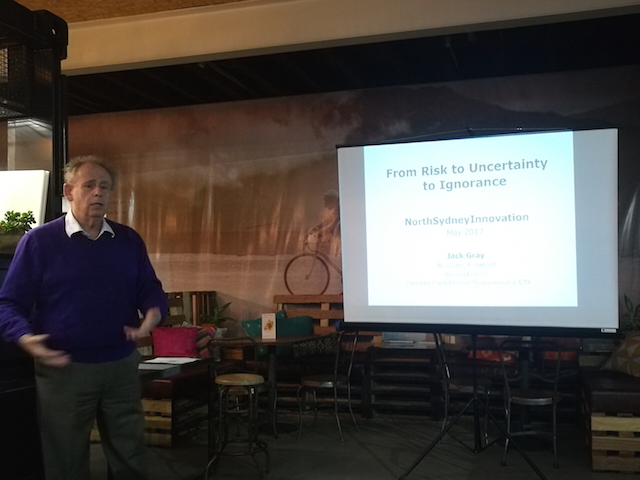
    “We discount uncertainty and ignorance too much,” says funds manager Jack Cray.

    Cray was giving his From Risk to Uncertainty to Ignorance presentation at Sydney’s North Shore Innovation Network where he went through some of the lessons from a career of managing funds in North America and Australia.

    Groupthink is one the great risks Cray sees in the investment community with funds managers tending to recruit from a monoculture drawn from economics and finance degrees. “Diversity amplifies signals,” says Cray.

    Compounding the groupthink is the focus on risk, believes Cray. Risk can be managed while the other factors in investment – uncertainty and ignorance – can’t.

    Traditional investors, particularly those in the public equity markets, understand risk well. However those established models also mean create process driven risk averse institutions.

    In the Uncertainty field, typified by the private equity markets, fixed models don’t work so well as a consequence investors have to be more risk tolerant and patient as they deal with a world where things can’t be assumed.

    And then there is the world of ignorance where no-one can quite be certain of what’s going on, which is typical of the tech startup field. In this space, investors have a high risk tolerance and are often muddling through while being buffeted by unexpected factors.

    “To succeed in a world of ignorance you have to be honery and less concerned about certainty,” Cray observes with a wry smile.

    This explanation makes a lot of sense when looking at why institutional investors struggle with the startup world and why private equity investors – largely a group of financial pirates – are so profitable.

    In answer to my question that saying startup investors are operating in a world of ignorance implies that sector really is an insider game, Cray was ambivalent – it can be, but the endorsement of a major VC or highly regarded investor will by its nature be seen as information in a field where everyone is short of data.

    Cray also had an interesting perspective on how markets and pundits see change differently, “investors overlook while futurists overcook.”

    Speaking to Cray after the event, he had some thoughts about the internet itself, while it’s a great source of information it also creates too much noise. Cutting out that noise is essential for a good investor.

    When it comes to investment all of us are dealing with different degrees of ignorance, Jack Cray’s views were an interesting insight into how managing a stock portfolio or picking ventures is more than just understanding risk.

    Similar posts:

    • No Related Posts