Category: Australia

  • Ending the motor industry’s 1950s delusions

    Ending the motor industry’s 1950s delusions

    Today Ford announced the pending closure of its Australian manufacturing operations, bringing to an end ninety years of the company building automobiles down under.

    Ford’s announcement is small on a global scale – the Broadmeadows factory built 40,000 cars out of a worldwide supply of sixty-three million – it does illustrate some major structural issues facing both the global automobile industry and the Australian economy.

    An Automotive Depression

    Over capacity has been the curse of the automobile industry for decades as governments have propped out producers around the world.

    KPMG’s 2012 Global Automotive Survey forecast the global industry would be 20 to 30 percent over capacity in 2016.

    This doesn’t seem to worry industry executives or their government supporters, as KPMG reported;

    Alarmingly, most auto executives still seem to regard the risk of overcapacity and excess production as a necessary evil to remain competitive. As the rapid growth of recent years eventually slows down, manufacturers that fail to address overcapacity could face some tough decisions.

    Ford’s Australian executives could at least be credited with facing some of those tough decisions.

    Many governments though are still in denial as they continue to subsidise motor manufacturers in an effort to copy the industry model that worked for the US Midwest during the 1950s.

    Indeed, the Australian government in 2008 committed 5.2 billion dollars to support their domestic industry through to the end of this decade. Ford’s announcement today coupled with General Motor’s cutbacks last year show that policy is in ruins.

    At the Ford and government press conferences, journalists pressed the Prime Minister and the Ford Australia’s CEO about repaying some of the millions of corporate welfare doled out to the multinational over the last decade. Naturally little was to be said about that.

    In a stark comparison to Ford Australia’s announcement, US electric car manufacturer Tesla Motors repaid a $465 million US government loan.

    While no-one can say Tesla’s future is certain, at least US investors are putting their money on 21st Century technologies instead of propping up declining industries of the last century.

    Australia’s predicament

    The car industry is just one sector that faces global overcapacity – ship building, real estate and mining are just three with similar excess production.

    For Australia, the mining industry is winding down investment as worldwide production capacity expands. At the same time, the blue sky projections of China’s resources demand are being challenged.

    While the mining boom comes to an end, Australia now has to face the consequences of the nation’s economic decision to focus on resources and property speculation in the 1990s and early 2000s.

    As the Thais and Indonesians found in 1997, and the Irish and Icelanders a decade later, economies based on unsustainable foundations seem to work fine until suddenly they don’t.

    It may well be that Australia is about find out what happens when the economic tide suddenly changes.

    One bright side is that the government has the best part of five billion dollars to invest in new industry – assuming Australia’s politicians can wean themselves off their 1950s view of the world economy.

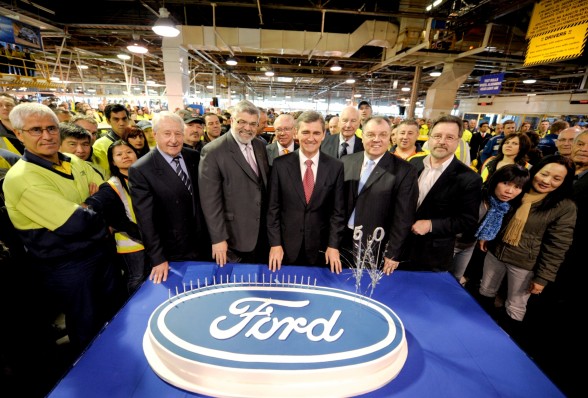
    Image of Ford Australia celebrating 50 years of Falcon Production courtesy of Ogilvy Communications.
    Similar posts:

  • Travel Review – Crown Metropole Melbourne

    Travel Review – Crown Metropole Melbourne

    Sitting on Melbourne’s Southbank and tucked in behind the Casino, Crown Metropole is a convenient and comfortable business hotel, particularly if you’re attending conferences at the city’s Exhibition and Conference Centre.

    In Sydney, the city’s casino is tucked on an old power station site in an inconvenient location so the locals can – and mainly do – ignore it. Melbourne’s Crown Casino on the other hand, has one of the best locations in the city.

    While I’m personally uneasy about the role Crown seems to play in Melbourne’s social and political circles, that location makes the casino’s hotels a very convenient place to stay.

    Networking vendor Cisco kindly flew me to Melbourne and put me up in the Crown Metropole hotel, part of the casino complex, for three nights to attend their Cisco Live! conference at the convention centre.

    Attending a conference

    While Crown Metropole isn’t attached to the conference centre like the Hilton South Wharf, in many ways it’s more convenient being just over the road from the other end of the Melbourne Conference and Exhibition Centre. If your exhibition is in the Eastern end of the building it’s a far shorter walk between the room and the event.

    That convenience also translates to seeing the rest of Melbourne with major tram routes nearby and a short walk to Southern Cross Station. For Cheap Charlies, there’s a supermarket and liquor store across the road if you don’t want to partake of the expensive mini bar.

    In room facilities

    the tea making facilities in melbourne's crown towers
    Nice choice of teas in the room

    Along with the usual expensive mini-bar, there’s a good range of in room facilities including a nice range of Madame Flavour teas.

    In the bathroom there’s also a pleasant range of amenities and very comfortable bathrobes. The bathroom itself has a full size bath to use some of the lotions in.

    Work desk in Crown Towers hotel room
    crown towers hotel room work desk

    For the connected traveller though the most important thing are power points and there were plenty available including two easily accessible on the room’s desk. If you need more they are scattered around the room including under the bedside tables.

    There’s also HDMI and component video connections to the TV if you want to stream feeds or practice presentations from your laptop. The TV has the standard hotel range of Australian Foxtel channels but lacks some of the international stations.

    Wi-Fi is available at an extra charge but I didn’t use it and instead relied on a Telstra 4G hotspot. Some guests did report that they found the hotel’s network could get congested.

    Hotel facilities

    Outside the room, the hotel has the standard facilities of a five star hotel. The rooftop fitness centre is very nice though while it’s possible to do 25m laps in the pool, it will get crowded during the day. It also appears the gym is open to the public so there will be busy times there as well.

    For eating, the first floor has the Mr Hive Restaurant which Cisco were kind enough to host dinner one night. It’s a nice place with good food at standard restaurant prices. Crown has dozens of eating establishments in the complex along with a somewhat expensive food court .

    There’s no reason to eat in the Crown complex when its an easy walk into the city for cheaper dining options or down Clarendon Street to South Melbourne. The 96 and 112 trams which stop nearby will take you to St Kilda where there’s no shortage of pubs, cafes and restaurants.

    Getting in and out

    When it comes time to leave, checkout is easy and the service at all times was professional and courteous. Rooms were made up and cleaned properly. The beds were comfortable and the rooms quiet with very good block out curtains.

    Overall, Crown Metropole is a good choice for business travellers attending the Melbourne Conference and Exhbition Centre, it’s also conveniently located for tourists. In all, it’s a good mid-priced hotel.

    Similar posts:

  • Training for mediocrity

    Training for mediocrity

    In researching the tech angle of the 2013 Australian Federal budget for Technology Spectator last night one thing kept really bugging me – the government’s cap on tax deductible education expenses.

    The decision to cap self education deductions was made earlier in the year by Treasurer Wayne Swan.

    The Government values the investments people make in their own skills and recognises the benefits of a tax deduction for work related self-education expenses. However, under current arrangements these deductions are unlimited and provide an opportunity for people to enjoy significant private benefits at taxpayers’ expense.

    So the government is going to save $500 million dollars over the next few years by capping legitimate educational expenses on the grounds they were ‘unlimited’.

    We could ask why negative gearing continues to be unlimited where taxpayers claiming the expenses of property speculation cost the Federal government eight billion dollars last year.

    So Treasurer Wayne Swan says a salaried worker has effectively no limits on claiming losses from property speculation against their taxes but is subject to a ludicrously low limit for claiming education expenses.

    This one comparison – between negative gearing and self education expenses – shows the magic pudding fairyland that Australia’s political leaders live in and their cowardice.

    What’s bizarre about this policy is that most industries are undergoing major changes and almost every worker will have to reskill a number of times through their careers.

    Many of those workers will be able to get their courses and education expenses under the limit, many others won’t.

    As the New Australian points out, Wayne Swan – like most lifetime Australian political apparatchiks – has never to worry about reskilling as the party has nurtured and cared for him all his adult life.

    In the real world though, Australia’s economic future will depend on the workforce picking up the skills to operate in rapidly changing times.

    That Australia’s politicians and economic policies are focused on encouraging property speculation over skills only guarantees mediocrity.

    Although mediocrity might be the world that suits Wayne Swan, Tony Abbott and the rest of Australia’s political classes.

    Similar posts:

  • Protecting the knaves among us

    Protecting the knaves among us

    “The biggest risk for Australian business journalists is being sued into oblivion” said Paddy Manning at a Walkley Media Talks Panel in Sydney last Thursday.

    Joining Paddy on the panel was The Australian’s Anthony Klan, the ABC’s Tikki Fullerton and moderator Peter Ryan who looked at the challenges facing business journalists seeking to separate truth from business PR spin.

    Business superinjunctions

    The problem facing Australian business journalists is a legal system that favours those who want to suppress facts – it’s a game only the wealthy can play and rich fraudsters use it well as we’ve seen over the years in corporate Australia.

    Manning described one occasion where he obtained information on a prominent businessman’s affairs and, within hours of asking the gentleman for comment, found he and the Fairfax had been hit with a court injunction with such vague wording it may have any of his employer’s outlets from mentioning the man at all.

    These injunctions were the rule, not the exception. Manning went on to tell how Sydney Morning Herald business writer Michael West spends one day a week on legal matters while his colleague Adele Ferguson was even preventing from writing about documents that were on the public record.

    Klan trumped that with the seventy injunctions he’s received over stories on the mortgage debenture scandals, an ongoing sore on Australia’s investment industry which threatens to steal many retirees’ savings.

    The problem of pre-emptive injunctions stemmed from the ethical requirement of giving a ‘fair opportunity for reply.’ In seeking comment from those engaged in shoddy – or downright – illegal practices, it gives those with something to hide the opportunity to run to the courts who are all to willing to issue wide ranging orders.

    An advantage for bloggers?

    Interestingly, Justice Leveson of the UK inquiry into press conduct made an observation about the disadvantage mainstream media has before the law during his visit to Australia earlier this year.

    online bloggers or tweeters are not subject to the financial incentives which affect the print media, and which would persuade the press not to overstep society’s values and ethical standards.

    While Leveson had it wrong about financial incentives, it’s actually the media’s ethical standards which are the restraining influence. Professional journalists quite rightly don’t like breaching their trade’s code of conduct.

    As Leveson opined, bloggers don’t necessary hold themselves to the same standards so they are more likely to publish and be damned.

    Where Leveson was utterly and totally wrong is bloggers’ immunity to the law.

    Bloggers rejoice in placing their servers outside the jurisdiction where different laws apply. the writ of the law is said not to run. It is believed therefore that the shadow of the law is unable to play the same role it has played with the established media.

    That’s nonsense and it’s a matter of time before a blogger goes to gaol for disobeying a court. When that does happen it will be interesting to see how the established media reacts to this.

    From the panel discussion it was quite clear that professional business journalists have no intention of breaking the law or their code of ethics, although all are united in their determination to protect sources if they were order to divulge by a court.

    The cost of suppressing news

    What really stood out from the panel was how the law is being used to stifle examination of Australian business behaviour. In the audience Q&A, veteran reporter Colin Chapman pointed out Australia sits at 26th on the World Press Freedom Index.

    The lack of a truly free press could just be seen as journalistic hand wringing, but there’s a real world effect of this – those retirees who will be ripped off by crooked financial advisers and mortgage funds would have a better chance of protecting themselves were they able to see Anthony Khan’s articles on the topic.

    Just as crooks have been able to prosper in the absence of press scrutiny, so too have supine, incompetent and lazy regulators.

    All too often agencies – such as the ACCC, ASIC, ASX or ATO – have only been woken from their slumbers when prodded by a media scandal, lack of scrutiny has allowed government regulators to get away with not doing their jobs.

    This poor enforcement is reflected in international comparisons. The World Bank ranked Australia as 70th in the world for protecting investors, way below Colombia, Thailand or Kazakhstan.Australian business reporters find themselves in a difficult position being caught between the tightening economics of the media industry and a legal system that is more focused on protecting knaves rather allowing society to be informed.That problem facing journalists is a problem for every Australian who’s being kept in the dark about their investments.

    Similar posts:

  • Snapping out of Australia’s China Dreamtime

    Snapping out of Australia’s China Dreamtime

    Australia’s leaders need to snap out of their China dreamland analyst Patrick Chovanec told the Australian Davos Connection’s China Forum two weeks ago.

    What triggered this comment was a speech by Australian Treasurer Wayne Swan to the Financial Services Council in Sydney last September where the Treasurer compared China’s economic performance to sprinter Usain Bolt;

    It’s like Usain Bolt easing off a bit at the end of the 100 meters because he’s 10 meters in front and has already smashed the world record.

    “My response was that if that’s the way Australia’s leaders are thinking about China’s economy, if that’s the dreamland that they are in, then they need to snap out of it really fast,” Chovanec said in his keynote.

    “Because China is facing a very serious and potentially disruptive economic adjustment. A realistic idea of where this adjustment is going is essential to countries like Australia.”

    Chovanec’s view is that China cannot sustain current growth rates by “providing the fodder of the consumerist economy.”

    This was borne out in the Global Financial Crises where exports fell from 8% of GDP to 2%. To make up for the drop the PRC government stimulated the economy and investment went 42% of the economy to half.

    It was this stimulus that drove the soaring commodity prices in recent years and underpins the Blue Sky Vision of Australia’s political and business leaders.

    The establishment view is that China will move from infrastructure spending driving the economy to a consumption driven society.

    Moving to a consumption driven economy though means a very different Chinese society which means a different group of winners and losers, Chovanec warns.

    He also doesn’t see urbanisation as the real driver of the Chinese economy, “If you look around the world, urbanisation has not always driven economic growth.”

    “It’s based on a premise that moving people from a rural environment to an urban environment generates productivity gains.”

    “Now for China over the past thirty years that has proven largely true,” says Chavonec, “but going forward most of that hanging fruit has been picked.”

    “In order to realise productivity gains, China is going to have to discover new areas of competitive advantage.”

    The biggest risk that Chovanec sees at present though is the level of bad debts in the economy and the rate of credit expansion with a trillion dollars pumped into the Chinese economy over the last quarter.

    “You’re getting less and less bang for the buck from credit expansion.”

    Chovanec doesn’t see China’s future as bleak though, “the China growth story doesn’t have to be over.”

    “There are a lot of sectors in China where there’s real potential for true productivity gains – agricultural, logistics, health car, services, consumer branding, retail.”

    “The challenge for China is not that the growth story is over but the engine of that growth story is going to have to change.”

    Dealing with those changes is also a challenge for countries like Australia who have staked all on the current growth story.

    Chovanec’s wake up call to Australia’s leaders is timely – the question is how quickly they can wake up to the changes in China.

    Similar posts: