Category: business advice

  • Ten business uses of cloud computing services

    Ten business uses of cloud computing services

    As part of the City of Sydney Let’s Talk Business program, we’ve put together a list of some of the more popular uses of cloud computing for the small business.

    Cloud services offer a lot to all business, particularly small and start up enterprises that need to move fast and are often cash strapped.

    There’s a massive range of services available on the cloud and here are a few that are worth exploring to help your business.

    email

    Electronic mail is the cornerstone of every business, in the past it’s been a nuisance sharing the email account or keeping track of users and passwords. Today most cloud email services are free and offer as much, if not more than the computer based alternatives.

    Google’s Gmail
    Windows Live Hotmail
    MailChimp (for newsletters)

    Accounting services

    One of the greatest challenges for small business is doing their books and accounting software is a must have for every commercial operation. Online services reduce costs and increase flexibility for businesses of all sizes.

    Saasu
    Xero

    MYOB Your Business Cloud

    Customer Relationship Management

    CRM software helps you monitor and understand who your customers are and what you’re doing for them.

    Salesforce
    Sugar CRM

    Backups

    Backing up is critical for your business. Having an online automated backup helps you ensure essential data is safe.

    Carbonite

    Shared storage

    Sharing files with others helps your business be more efficient as teams can get work done without using the same computer.

    Dropbox
    Box.net

    Communications

    Voice over IP, or VoIP, is a massive cost saver and most of them are cloud services.

    Skype
    MyNetFone

    Office applications

    One of the biggest costs for business is the software for writing letters and working on spreadsheet. There’s free and paid for services that you can use on the cloud that cut your costs and increase your office productivity.

    Evernote
    Google Docs

    Zoho Docs

    Project management

    Running and managing projects is a complex task made much easier with a good project management program to keep track of tasks and time.

    Basecamp
    Zoho Projects

    Blogging platforms

    Web Logs, or blogs, are becoming the platform of choice for getting small business websites up and running due to their flexibility and ease of use.

    WordPress
    Hotmail

    Outsourcing

    Cloud computing and online services are making outsourcing possible for small businesses. With a browser and a credit card, you too can be in the outsourcing business.

    O-Desk
    Freelancer

    These are just a small range of outsourcing services available for small business, we’d love to hear your experiences and suggestions for other online products.

    Similar posts:

    • No Related Posts
  • Planning for today

    Planning for today

    Last week the Communications Day Summit was told of the bizarre situation where owners corporations and building managers were actively preventing their properties from being connected to high speed Internet.

    This short sightedness shouldn’t be surprising to anyone who’s had to argue with architects about allowing sufficient data raisers in commercial buildings or has despaired at stingy developers condemning their projects’ future occupants to years of living in powerboard infested firetraps by only installing one or two power outlets per room – something that’s common in even high priced complexes.

    As well as being firetraps, these properties are limiting their potential future value as owners and tenants find it hard to connect the devices most businesses and family find are essential to modern living. This situation is going to get worse as we start to rely even more on the web and we find we our incomes and livelihoods are tied to the reliability and speed of our connections.

    This failure to plan for the connected economy by Australian businesses is a familiar story, last year one of the state governments asked the tech industry what they were planning around the high speed Internet access the National Broadband Network planned to deliver. The overwhelming response was “dunno, I guess we’ll wait and see.”

    Last week Geof Heydon of telecommunications company Alcatel Lucent told an almost identical story of cluelessness where one of the big four banks asked its suppliers how the NBN would affect the provision of their products.

    The frightening thing is the availability of reliable and fast Internet is already here for most of the population and yet the majority of the business community, not just the retailer sector, seems to be ignoring these fundamental changes to our marketplaces.

    Even if you don’t like the NBN, or last week’s news of cancelled tenders only confirms suspicions Canberra has their sums on the project hopelessly wrong, cancelling it is going to strand large chunks of regional and outer suburban Australia without access to the newer services.

    We all have to ensure our business plans have provision for the changes that are happening as our customers, staff and suppliers adopt high speed and mobile Internet. Failing to do so is going to leave your business or investment stranded, just a community without roads or high speed broadband would be.


    Similar posts:

    • No Related Posts
  • The rebirth of the middleman

    The rebirth of the middleman

    For many years, we believed the Internet would see the middleman’s demise. Just as it has with the newspaper and recording industries, we expected manufacturers, service providers and content creators would stop using intermediaries such as agents, brokers or retailers and move to set up their own online distribution channels.

    The new middlemen

    The rise of services like Groupon, along with booking platforms like Wotif and employment services like Seek, show just how wrong we were. What we’ve actually seen is a rise of new middlemen to replace those who have fallen away like telephone directories and record stores.

    If anything, we’ve seen even more powerful intermediaries develop like Google, Facebook, Apple and Amazon develop to replace the old gatekeepers.

    Why we need intermediaries

    Part of the reason for this is that none of us, even the biggest corporations, have all the skills to bring a product to market; retail itself is a tough business, marketing is hard work and distribution is easiest when you have economies of scale. Middlemen bring these and other skills required to get products into the marketplace.

    The danger with middlemen is they can dilute your brand. We see that with Groupon as businesses give their brand over to them with steep discounts on their products. As Esther Dyson points out at Salon, Groupon will eventually destroy many of their merchants.

    None of this is new as many brands who’ve found themselves hostage to single outlets have found. This isn’t a just a small business problem either as we see hotels and airlines try to break their dependency on travel websites whose readers mainly shop on price.

    The Internet’s price paradox

    Price is one of the big paradoxes we have on the net, we’ve largely trained customers to buy on price – or look for free – yet for the middlemen to make money, it’s essential there’s a decent profit in the chain. If a $50 product only has $10 margin to share across the supply chain, there’s not a lot in it for the various intermediaries.

    Right now, we’re seeing another paradox as the middlemen are keeping their profits while retailers and producers – such as the hairdresser, restaurants and personal trainers selling through group selling sites – are taking the pain and absorbing both cost increases and reduced income from retail price discounting.

    That’s not sustainable and it’s probably a transition effect as the technology changes distribution and marketing at the same time that the Western economies are moving from being driven by consumer debt.

    Are most of us really middlemen?

    We were wrong to predict the death of the middleman, they provide too many benefits and many of us are middlemen ourselves whether or not we’re prepared to admit. What does happen is the middleman’s role evolves as markets, technology and industries change.

    Regardless of whether we use, or are, middlemen it’s necessary to keep an eye on that evolution and make sure we aren’t caught out when the market tips and moves against us.

    Similar posts:

    • No Related Posts
  • Tipping points

    Tipping points

    We often assume change is immediate – for instance, the moment the motor car was invented, all the horse cart makers went out of business – what usually happens though is the two technologies or industries sit side by side for some time and the old industry may even continue to prosper for sometime and the new methods struggle.

    Eventually though the newer technology takes over and the older one falls away quickly, leaving slow to change incumbents with an irrelevant business model.

    Illustrating this, two fascinating posts by Michael DeGusta on his blog The Understatement tracks two major trends in the US newspaper and record industries, noting how the sectors are now at 1960 and below 1973 levels respectively.

    The record industry

    Michael’s tracking of per capita recording sales is striking both for how technology, trends and musical tastes have shaped the record industry along with the predicament it now finds itself in.

    The 1970s show how the recording industry adapted, we see sales start the decade in decline until a sharp uptick in vinyl sales happens in the late 1970s, probably driven by the heavily hyped “rock opera” and concept albums foisted on us by the likes of Pink Floyd and the Electric Light Orchestra.

    It’s interesting that during this period cassette sales largely flat lined, as digital revenues have today. As a child of that late 1970s era, we used cassette recorders – mine won in competition at a jeans shop in outer suburban Melbourne – to tape stuff off the radio and jerryrig with record players so we could create mashups of Alice Cooper and Skyhooks.

    Cassette revenues eventually grew, but the the Compact Disk quickly took the growth off the cassette tape and drove the record industry to new highs, probably as people replaced their vinyl collections with CDs that weren’t easily copied through the 1980s and much of the 90s.

    The peak of CD sales was hit in the late 1990s, which is almost certainly due to the arrival of personal computers equipped with recordable CD units. All of a sudden, we could go back to copying the music we’d already bought.

    To make things worse, the rise of the World Wide Web meant we suddenly didn’t have to go through the gatekeepers – the record stores, radio stations and magazines – to find the music we wanted.

    For a while the record industry fought back, even seeing a minor resurgence in 1999 and 2000, but then the rot sets in. The tipping point was clearly in 2001 and can probably be traced to the online streaming services, including YouTube, and the rapidly maturing peer-to-peer services.

    The only solace the record industry in its current form can hope for is to see a surge in digital sales like they saw with cassettes in the mid-1980s. It’s difficult to see how that can happen unless they can quickly strike some very favourable deals with Apple and other online distributors.

    Newspaper advertising

    Print media’s performance over the last fifty years has been one of success until 5 years ago. Despite most of us turning from newspapers to broadcast television for our news through the 1960s and 70s, revenues stood up.

    From the 1980’s there was a slow decline and in a few years early in the new millennium it even looked like the Internet wasn’t affecting revenues and the new streams from online advertising were actually increasing overall income.

    Then in 2005, the tipping point was reached as classified advertisers, particularly employment and real estate, fled to online competitors with the display buyers not far behind.

    For newspaper publishers, that their online revenues have barely grown in the last five years most be the most worrying aspect of the collapse in their income. Their online strategies simply aren’t working.

    What this means for other industries

    This “tipping point” pattern is typical when we see technological shifts. For various reasons – customer inertia, government regulations, uneven distribution of the new tools – a game changing technology usually takes time to be adopted and usually goes through a process best described by the Gartner Hype Cycle.

    New technologies and ideas rarely change industries or societies overnight, but once a technology reaches maturity and mass acceptance, the barrier eventually gives gives and people quickly move across to the new way of doing things.

    We see this in the record industry – particularly in the switch to cassettes, CDs and then collapse as the net takes over – then again in the newspaper industry.

    These two industries though are just examples, the same process is happening to many others. One good example is the phone directory business where the tipping point is happening right now as consumers and businesses move online and away from printed directories.

    That many businesses still haven’t figured out this change in consumer behaviour indicates they too are being blind sided by tipping points that could leave their ventures stranded by history.

    All of us have to understand how these changes will affect our livelihoods and trades. Are you looking at how your business is affected by the rise of the net and the end of the cheap credit?

    Similar posts:

    • No Related Posts
  • The saddest sign you’ll ever see

    The saddest sign you’ll ever see

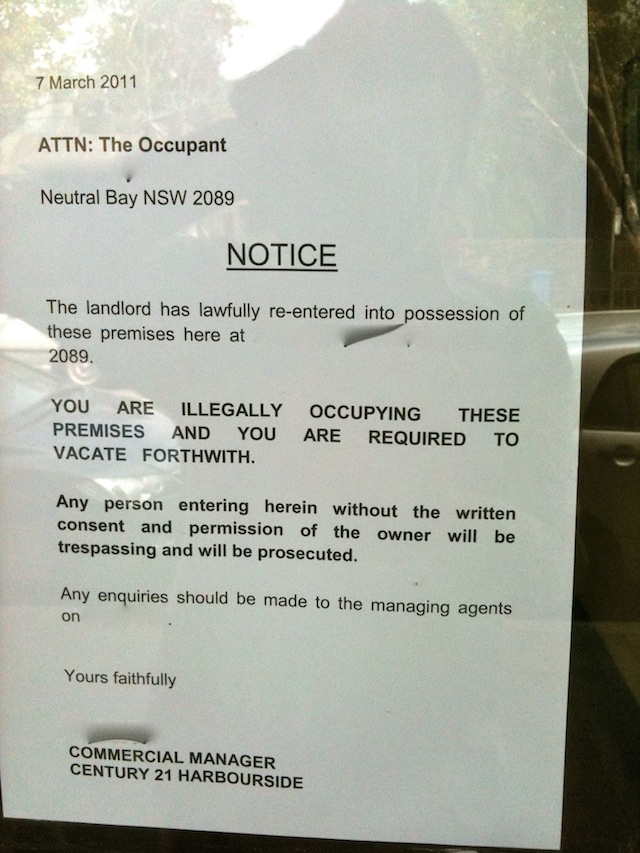
    The sign on an abandoned business announcing “Landlord taken possession” usually hides a pile of pain and distress.

    It’s not cheap or easy for a landlord to take possession of a business premises and for most to do so it’s usually the end of long period of unpaid bills and broken promises.

    Behind that sign is usually months, if not years, of stress and despair as a business owner has held onto a failing enterprise, bluffing their landlord, their suppliers, their staff, their own families and often themselves.

    Almost every one of those signs has a story of failed relationships, destroyed friendships and ruined marriages.

    Often they didn’t understand the cost of doing business and in many cases because they hadn’t consulted a bookkeeper or accountant earlier they didn’t understand their venture was always loss making despite what appeared to be a healthy cashflow.

    When the truth about the businesses becomes obvious, life for the honest owner of a failing enterprise tries to bluff themselves and those around them that things will be okay, that the dream is still alive.

    This is what worries me about many of the businesses that participate in group buying deals, they are desperate to keep their business afloat and believe the cashflow or publicity will save their failing venture. Even worse, many don’t understand how that “50% off” deal will affect their ability to pay staff and the landlord.

    Even where the failed proprietor has been one the “two percenters” – the 2% of our society that runs their affairs with no regard for the pain and suffering of those they hurt – many people, particularly the smaller suppliers and low paid workers, have taken a hit as bills went unpaid and promises were not kept.

    Most business owners though believe in their idea or vision and work long and hard in an attempt to achieve it. The majority of those who end up with the landlord taking possession are often those who ignored the signs and believed things would come good next season, next month or next week.

    I’m always saddened when I see a “landlord taken possession” sign like the one near me in the window of what was an Italian restaurant until recently. What’s the saddest business sign you see?

    Similar posts: