Category: business advice

  • Counting the cost of investors

    Counting the cost of investors

    Israeli tech startup Waze was always an interesting business; the idea of combining crowdsourcing and social media to provide traffic reports was fascinating concept that seemed to work well.

    When Google bought the company two years ago, it was seen as one of the success stories for Israel’s vibrant tech startup scene, but a LinkedIn post by Waze’s founder Noam Bardin suggests the acquisition was not what the founders wanted.

    One of Waze’s mistakes was the valuation of its A round which significantly diluted the founders. Perhaps, had we held control of the company, as the Founders of Facebook, Google, Oracle or Microsoft had, Waze might still be an independent company today.

    Not being an independent company is also a weakness for Waze, as Google have shown in the past they are ruthless in shutting down businesses they’ve acquired and there’s no guarantee that Bardin’s creation won’t meet the same fate.

    Google though are not alone in this, Yahoo! is notorious for neglecting companies they’ve acquired and today Microsoft announced it’s closing the Farecast travel price prediction service it bought for $115 million six years ago.

    Oren Etzioni who founded Farecast in 2004 isn’t happy about this according to Geekwire, however that’s the downside of selling your baby to another business – its destiny is now in the buyer’s hands and their vision may not be the same as the founders’.

    A good example of a company controlling its destiny is Atlassian, the Australian founded collaboration tool service, which the Wall Street Journal describes as being “one of the world’s most valuable venture-backed companies.”

    In many respects Atlassian is the opposite of the Silicon Valley business model with an emphasis on engineering and product development over sales and marketing. Atlassian’s founders aren’t focused on hyping the business with the aim of selling to a deep pocketed greater fool.

    For founders, the tricky balance in raising enough money to achieve their objectives while not giving away a controlling interest. Get it wrong and a founder ends up being forced into a course of action they didn’t want to do, as Noam Bardin found.

    Bardin’s post on the Israeli business community and startup scene is an interesting perspective into the strengths and weaknesses of the country’s entrepreneurial culture, much of which would be familiar to many outside of Silicon Valley.

    One big lesson though for founders, Israeli or otherwise, is don’t give away too much equity too early, or the investors make take you to places you didn’t want to got to.

    Similar posts:

  • Context and the digital divide

    Context and the digital divide

    “This is the most difficult time in history to be a wine maker, declares Paul Mabray, Chief Strategy Office and founder of Vintank.

    “Never has the wine industry been as competitive as it is today.”

    Update: The Wine Communicators of Australia, who sponsored Mabray’s visit, have posted Paul’s presentation that covers this post’s theme in more detail.

    Mabray’s business monitors social media for wineries and collects information on wine enthusiasts. Since Vintank’s founding in 2008 the service has collected information on over thirteen million people and their tastes in wine.

    Rewriting the rule book

    Social media, or social Customer Relationship Management (sCRM), is what Mabray sees as being part of the future of the wine industry that’s evolving from a model developed in the 1970s which started to break down with the financial crisis of 2009.

    “In the old days there was a playbook originating with Robert Mondavi in the 1970s which is create amazing wine, you get amazing reviews and you go find wholesalers who bring this wine to the market.”

    “As a result of the global proliferation of brands the increase of awareness and consumption patterns where people like wine more, those playbooks didn’t work in 2009 when the crisis started.”

    With the old marketing playbook not working, wineries had to find other methods to connect to their markets and social media has become one of the key channels.

    Now the challenge in the wine industry, like all sectors, is dealing with the massive amount of data coming in though social media and other channels.

    The cacophony of data

    “If you rewind to when social media came out, everyone had these stream based things and the noise factor was so heavy,” says Mabray.

    “For small businesses this creates an ‘analysis to paralysis’ where they’d rather not do anything.”

    Mabray sees paralysis as a problem for all organisations, particularly for big brands who are being overwhelmed by data.

    “The cacophony of data at a brand level is just too much,” he says.

    “It’s as noisy as all get go and I think the transition is to break Big Data down into small bite size pieces for businesses to digest is the future, it shouldn’t be the businesses problem, it should be the software companies’.”

    A growing digital divide

    Mabray sees a divide developing between the producers who are embracing technology and those who aren’t, “the efficiencies attributed to technology are obvious whether they’re using CRM, business intelligence or other components.”

    “The people who are doing this are recognising the growth and saying ‘hey, this stuff actually works! If I feed the horse it runs.”

    While Mabray is focused on digital media and the wine industry, similar factors are work in other industries and technology sectors; whether it’s data collected by farm sensors to posts on Instagram or Facebook.

    Facebook blues

    Mabray is less than impressed with Facebook and sees businesses concentrating on the social media service as making a mistake.

    “I think that every social media platform that’s been developed had such a strong emphasis on consumer to consumer interaction that they’ve left the business behind, despite thinking that business will pay the bills.”

    “As a result almost every single business application that’s come from these social media companies has met with hiccups. That’s because it wasn’t part of the original plan.”

    Facebook in particular is problematic in his view, “it’s like setting up a kiosk in the supermall of the world.”

    The business anger towards Facebook’s recent changes is due to the effort companies have put into the platform, Mabray believes; “everyone’s angry about Facebook because we put so much into getting the data there.”

    “We said ‘go meet us on Facebook’, we spent money collecting the items and manufacturing the content to attract people and now we have to spend money to get the attention of the people we attracted to the service in the first place.”

    Despite the downsides of social media Mabray sees customer support as one of the key areas the services. “It’s easy to do in 140 characters.”

    Context is king

    “Everything come back to context. There’s this phrase that ‘content is king’,” Mabray says. “Context is king.”

    “Anyone can produce content. It’s a bull market for free content. We have content pollution – there’s so much junk to wade through.

    Mabray’s advice to business is to listen to the market: “Customers are in control more than they have ever been in human history: Google flattens the world and social media amplifies it.”

    For wineries, like most other industries, the opportunity is to deal with that flat, amplified world.

    Similar posts:

    • No Related Posts
  • Furthering the startup conceit

    Furthering the startup conceit

    I’ve ranted before about the romantic views corporate executives have about the lives of startup founders.

    “News Corp today has the energy and sensibility of a start-up,” Lachlan is quoted in the company’s media announcement.

    Let’s see how that goes.

    Similar posts:

    • No Related Posts
  • Kickstarter and ownership

    Kickstarter and ownership

    The purchase of virtual reality headset designer Oculus by Facebook has raised some interesting questions about crowdfunding sites.

    As the Wall Street Journal reports, many of those who contributed to the Kickstarter campaign that Oculus ran now feel betrayed by the company selling out to the social media giant.

    Founder Palmer Luckey explained the companies sale to the WSJ as a quest for more funds; “a lot of people don’t understand how much money it takes to build things — especially to build hardware.”

    Crowdfunding is tough

    That ties into what founders have told Decoding the New Economy about crowdfunding startups; it’s tough and it easy to underestimate the capital required to launch a project.

    Ninja Blocks’ Daniel Friedman told Decoding the New Economy last February that the main thing the company had learned from its successful Kickstarter campaign is that crowdfunding is a good way to raise funds for specific projects but a lousy way to fund a business.

    Moore’s Cloud wasn’t as successful as Ninja Blocks and in his Decoding the New Economy interview, founder Mark Pesce described how he’d “rather eat bullets” than crowdfund a hardware startup again.

    Startups are always hard, but it’s difficult not see how the high moral purpose often citing from Kickstarter project founders clashes with the ruthless moneymaking of Silicon Valley.

    Discrediting crowdfunding

    The criticism of Oculus also illustrates how crowdfunding lies between traditional investment and sales; those contributing to crowdfunding projects are true believers, not just customers and certainly not investors in a legal sense.

    In recent times Kickstarter has been discouraging hardware startups from using their service; mainly because of the high risk of failure and disaffected contributors. The unhappiness with Oculus vindicates that move.

    Oculus’ sale to Facebook may make many Kickstarter contributors doubly wary of Silicon Valley style startups trying to raise funds through crowdsourcing campaigns.

    Lords of the Digital Manor

    Looking at Oculus’ move, it’s hard not to conclude we’re seeing another cynical version of the Lords of the Digital Manor business model where enthusiasts are exploited by entrepreneurs looking for the big Silicon Valley pay off.

    For Kickstarter and the other crowdfunding platforms, this is a problem as cynicism about the motives of those posting projects is probably a greater risk than the fear of being ripped off.

    It may well be that Oculus marks a big change in the types of projects that get successfully funded, certainly the next hot hardware startup that tries crowdfunding is going to find things much harder.

    Similar posts:

    • No Related Posts
  • Tomorrow Starts Here

    Tomorrow Starts Here

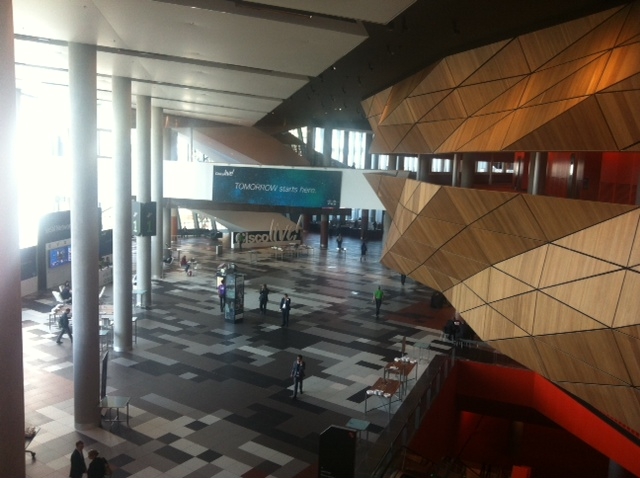
    Today was the main day of the Melbourne Cisco Live Conference; the company’s annual Australian event.

    Much of the talk was around the Internet of Everything — which will be the basis of subsequent  posts — with a constant theme around the explosion of data.

    A favourite statistic was that of Cisco’s Executive Vice President who pointed out that US Department store Walmart collects 2.5 Petabytes of customers data every hour.

    The reason for this was pointed out by GE’s Australia and New Zealand CIO, Mark Sheppard, who pointed out that twenty years ago jet engines had few sensors while today they have hundreds, a point also made by Team Lotus’ Engineering Director Nick Chester to Networked Globe.

    Chester observes that when he started in Formula One racing two decades ago, there were four or five sensors on a racing car; today Lotus’ vehicles have over two hundred.

    All of these sensors are creating massive amounts of data and the big challenge for businesses is to manage all of this information, something we’ll be exploring over the next few weeks.

    Similar posts:

    • No Related Posts