Category: business advice

  • Trapped in orbit – the founder’s dilemma

    Trapped in orbit – the founder’s dilemma

    Earlier this week Microsoft co-founder Paul Allen celebrated his Seattle Hawks winning the Super Bowl while his former business partner, Bill Gates, still struggles to escape the clutches of the software giant they founded forty years ago.

    After a long drawn out process, software giant Microsoft has finally chosen its replacement for CEO Steve Ballmer however founder Bill Gates finds himself firmly trapped in the company’s orbit.

    Hoodie wearing Satya Nadella‘s ascension to Microsoft CEO was probably the poorest held secret in the tech industry having been openly reported for several weeks.

    Nadella has a massive task ahead of him as the industry that’s been so lucrative for Microsoft over the past thirty years evolves to deal with the post-PC era.

    Microsoft CEO Satya Nadella
    Microsoft CEO Satya Nadella

    How Nadella manages Microsoft’s transition will define his business career and tenure at the top job, it will also determine the company’s position in a marketplace where PCs running Windows are no longer relevant.

    The biggest news from Microsoft’s announcement though was that Bill Gates will step down as Chairman of the Board and take a new position as ‘founder and technology advisor’.

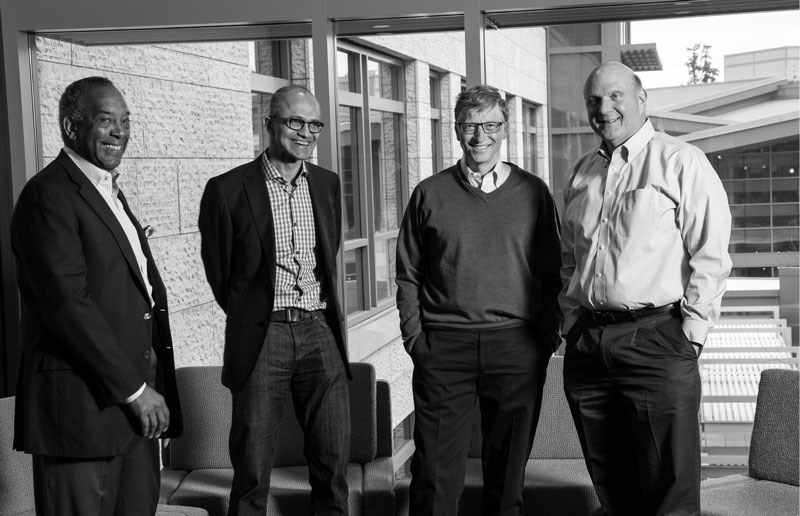
    Microsoft also announced that Bill Gates, previously Chairman of the Board of Directors, will assume a new role on the Board as Founder and Technology Advisor, and will devote more time to the company, supporting Nadella in shaping technology and product direction. John Thompson, lead independent director for the Board of Directors, will assume the role of Chairman of the Board of Directors and remain an independent director on the Board.

    Despite leaving the CEO role over a decade ago, Gates finds himself back in a hands on role at the company.

    The value of Bill Gates

    It’s questionable what value Gates is going to add in the role of ‘Technology Advisor’ as Microsoft’s markets are very different to those the company was founded in and came to dominate in the 1980s and 90s.

    For Nadella, it’s not exactly a vote of confidence from the board in appointing the company’s founder to hover over his shoulder offering helpful advice.

    On a personal level this must be disappointing for the founder and former CEO as well in that his mind is on far greater topics such as eliminating malaria through the Bill and Melinda Gates Foundation.

    Trapped by Microsoft’s gravity

    Gates’ situation though is a classic example of a business founder who’s never been able to get out of the orbit of their business. Despite their best efforts, they keep being dragged back to give a helping hand.

    At least though Gates has at least been able to step away to some degree, many baby boomers with smaller businesses are going to be locked into their companies as GenX or Y entrepreneurs don’t have the funds to pay what the proprietors need to retire.

    Those boomer entrepreneurs are going to work in their businesses until either they or their venture is put to rest.

    Bill Gates’ dilemma though shows how tough it is for business founders to escape the gravitational pull of their creations, even when it’s as big a business as Microsoft.

    Paul Allen showed how to step away from a business and is enjoying life, Bill Gates’ story though is much more typical for business founders trapped in the enterprises they built.


    Similar posts:

    • No Related Posts
  • Little Boxes, big data and modern management

    Little Boxes, big data and modern management

    Yesterday’s passing of folk singer Pete Seeger at age 94 is a chance to think about old age, the Twentieth Century and how we use technology might be restricting us from seeing the opportunities around us.

    One of Seeger’s best known hits of the 1960s was Malvina Reynold’s song ‘Little Boxes’ that described middle class conformity in the middle of the Twentieth Century, which had a renaissance in recent years as different contemporary singers did a take of the song for the TV series ‘Weeds’ .

    As the ‘Weeds’ opening credits imply, we are probably more conformist today than our grandparents were in the 1960s.

    In business, that conformity is born out of modern management practices that insist employees be put into their own ‘little boxes’ – if you don’t tick the right boxes then the HR department can’t put you in the right box.

    With big data and social media expanding, increasing computer algorithms are used to decide which box you will fit into. One of the boxes that managers and HR people love ticking is the age box.

    Little Boxes’ writer Malvina Reynolds would never have fitted into one of the modern HR practioners’ little boxes as she only entered the folk music community in her late forties.

    Despite being a late bloomers, Malvina wrote dozens of folk and protest songs through the 1960s and 70s – The Seekers’ Morningtown Ride was another of hits – before passing away at age 77 in 1977.

    Were Malvina Reynolds born 60 years later, she would expect to live to at least Pete Seeger’s age and expect to switch careers several time during her working life.

    Modern age expectancy means the modern workplace’s age discrimination and the box ticking of HR managers is unsustainable; there’s too much talent being wasted while individuals, business and governments can’t afford to fund a society where the average person spends the last thirty years of their life in retirement.

    With technology there’s no reason why a forty year old air pilot can’t retrain to be an accountant or a sixty year old farmer get the skills to become a nurse, the very tools that are being used to keep workers in boxes are the ones that enable them to break out of those boxes.

    Similarly modern technology allows an accountant, farmer or young kid in an obscure developing nation to create a new business or industry that puts the box ticking HR managers in downtown high rises out of work.

    Just as today’s box ticking manager might be confronted by a threats they barely know exist, so too is the business that spends all its time looking at data that confirms its owners’ and executives’ prejudices.
    Life, and data, doesn’t always neatly fit into little boxes.

    Filing box image courtesy of ralev_com through sxc.hu

    Similar posts:

  • Revisiting the Lipstick effect

    Revisiting the Lipstick effect

    During the recession much was made about the ‘lipstick effect’ – the idea some businesses and products would survive because they’re little luxuries that cash strapped consumers will spend on while scrimping and saving in other areas.

    Some of those areas are ladies’ cosmetics (lipstick), chocolate, movies and coffee shops. All of them offering small pleasures for a few dollars.

    It’s a theory I’ve always been sceptical of and an episode of the BBC’s World Of Business where Peter Day travels to Cork to see how Ireland’s second city is recovering from the great recession illustrates the reality is a lot more complex than the theory suggests.

    “We really struggled to keep alive,” Claire Nash of Nash 19 restaurant says in her interview with Day on her business experience during the recession.

    “My turnover just absolutely took a spiralling tumble and it wasn’t that the customer weren’t coming in – those that had lost their jobs weren’t coming in – but those that hadn’t lost their jobs were really hurting and they were very careful with their spend.

    “So they started using us as a treat, which was a model I never wanted to enter into but we weathered the storm.”

    It can be argued that Claire survived because of the lipstick effect – she kept enough customers to survive – but it was tough and had she taken out the loans offered to her during the boom it’s unlikely her restaurant would have survived.

    The key point though is the lipstick effect turned out to be a very different, and much less lucrative business, for Claire and other businesses in Cork.

    So assuming a business will remained unscathed because of the assumption the lipstick effect is a big risk, if that’s the plan then Sequoia Capital’s infamous Powerpoint of Doom comes to mind.

    While the presentation was aimed at tech companies and investors, it’s a good overview of how the Global Financial Crisis happened and Slide 49 – Survival of the Quickest – is probably the best lesson for any business: Act fast to adapt.

    The lipstick theory is a nice way to justify unsustainable business models, particularly those that rely on consumer spending, in the face of a recession but the assumption spending will remain the same as customers will seek little luxuries is deeply flawed.

    A business that doesn’t respond quickly to changed circumstances and reduced spending is one that might not survive a downturn.

    Peter Day’s Cork story is a good listen on how Ireland and Cork have weathered the global financial crisis, the main question from the piece is how much have the Irish and the rest of the world learned from the mistakes of the boom years at the start of the 21st Century.

    Similar posts:

  • When Marissa met Mark

    When Marissa met Mark

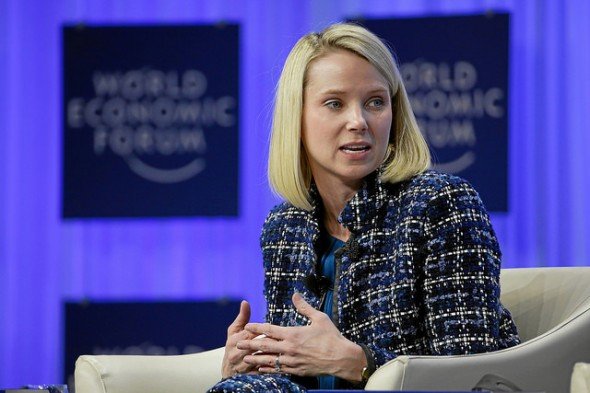
    Not unexpectedly, last week’s World Economic Forum featured some high profile panels. One particularly heavy hitting group was the New Digital Context session featuring some of the tech industry top CEOs.

    Featuring Yahoo’s Marissa Mayer, Salesforce’s Marc Benioff, Cisco’s John Chambers, BT’s Gavin Patterson and AT&T’s Randall L. Stephenson the panel looked at the rate of disruption and change to global business.

    A  key point in the discussion is Benioff and Mayer disagreeing with the host, Forrester CEO George Colony, about the rate of change and how businesses should be managing disruption.

    Mayer’s view was Yahoo!’s is evolving to changes markets while Benioff feels the rate of change is so great that most corporations’ fundamental business models being changed.

    It’s an interesting point and something we’ll look at a bit closer tomorrow.

    Similar posts:

    • No Related Posts
  • On looking foolish

    On looking foolish

    Looking foolish is one of the biggest risks when taking chances in business. It’s something every innovator and entrepreneur has to consider.

    Venture Capital investor Mark Suster explains why he doesn’t mind looking foolish with his choice of investors on his blog today.

    One of the toughest things in life is taking the risk of looking foolish in front of your peers yet that’s what the real high risk inventors, innovators and entrepreneurs do with their ventures.

    Light bulbs and the telephone looked ridiculous to many at the time they were invented and no doubt the inventor of the wheel or the Neanderthal who came up with the idea of cooking meat in a fire both probably received a far bit of scorn when they told the others in their tribe about their idea.

    While Suster is talking about ‘moonshot investments’, even the most modest venture is going to attract scorn.

    There would be few people who decided to buy a doughnut franchise, establish a cafe or set up a lawn mowing service who weren’t told by some of their relatives, friends or colleagues that they are doing the wrong thing and they should stick to their safe job in their cosy cubicle.

    Should someone want to change the way doughnuts are made or lawns mowed, then they can expect even more naysayers laughing at them.

    In this current craze about ‘entrepreneurship’ it’s easy to overlook the real costs and risks of running any sort of business. Looking foolish is another of those risks.

    Having a thick hide is another useful attribute when you’re investing, running a business or changing an industry.

    Similar posts: