Category: business advice

  • Google, Facebook and the Silicon Valley paradox

    Google, Facebook and the Silicon Valley paradox

    One of the great advertising campaigns of the 1980s featured entrepreneur and Remington Shaver CEO Victor Kiam telling the world “I liked the product so much I bought the company”.

    The modern equivalent of Victor Kiam’s slogan is “eating your own dogfood” where businesses use their own products in day to day operations. It’s a great way of discovering weaknesses in your offerings.

    One of the paradoxes of modern tech companies is how they don’t always eat their own dogfood when it comes to their business philosphies – they expect their customers to take risks and do things they deem unacceptable in their own businesses and social lives.

    The best example of this are the social media services where founders and senior executives take great pains to hide their personal information, a phenomenon well illustrated by Mark Zuckerberg buying his neighbours’ houses to guarantee his privacy.

    Just as noteworthy  are the policies of Google’s IT department, for past five years most tech evangelists – including myself – have been expounding the benefits of business trends like cloud computing and Bring Your Own Device (BYOD) policies.

    Now it turns out that Google doesn’t trust BYOD, Windows computers or the Cloud, as the company’s Chief Information Officer, Ben Fried tells All Things D of his reasoning of banning file storage service Dropbox;

    The important thing to understand about Dropbox,” Fried said, “is that when your users use it in a corporate context, your corporate data is being held in someone else’s data center.”

    This is exactly the objection made by IT departments around the world about using Google’s services. It certainly doesn’t help those Google resellers trying to sell cloud based applications.

    Fried’s view of BYOD also echoes that of many conservative IT managers;

    “We still want to buy you a corporate laptop, get the benefits of our corporate discounts, and so on. But even more importantly: Control,” Fried said. “We make sure we know how secure that machine is that we know and control, when it was patched, who else is using that computer, things like that that’s really important to us. I don’t believe in BYOD when it comes to the laptop yet.”

    Despite these restrictions on Google’s users, Fried doesn’t see himself or his department as being controlling types.

    “But the important part,” Fried said, “is that we view our role as empowerment, and not standard-setting or constraining or dictating or something like that. We define our role as an IT department in helping people get their work done better than they could without us. Empowerment means allowing people to develop the ways in which they can work best.”

    Fine words indeed when you don’t let people use their own equipment or ask for a business case before you can use Microsoft Office or Apple iWork.

    That Google doesn’t give its staff access to many cloud services while Facebook’s managers restrict their information on social media shows the paradox of Silicon Valley – they want us to use the products they won’t use themselves.

    Back in the 1980s, Victor Kiam liked what he saw so much that he bought the company. You’d have to wonder if Victor would buy Google or Facebook today.


    Similar posts:

    • No Related Posts
  • Building a business culture

    Building a business culture

    “How can you create a great organisation of people and be that mean a person?” Asks funds manager Julian Robertson about Apple founder Steve Jobs.

    Robertson, who based the decision to sell his Apple shares on the details in Walter Isaacson’s biography of Steve Jobs, was largely ridiculed for his decision but the veteran investor has a very good point.

    A company’s culture develops from the top – if the senior management are paranoid, rogues or thieves then those attributes will eventually percolate through the company.

    The Tyco Lesson

    During the 1990s I had the unfortunate experience of working for Tyco International at the time it was led by Dennis Kozlowski, a man listed by Time Magazine as one of the ten most crooked CEOs of all time, senior management’s attitude of treating the company’s funds as their own piggy bank was copied throughout the organisation.

    Tyco suffered badly during that period and subsequent management has had to work hard to undo the influence of Kozlowski and his cronies’ poor leadership.

    One organisation I’ve watched closely over the last few years has been Australia’s NBNCo, the state owned company set up to build the nation’s National Broadband Network.

    In under four years of operation the company has developed a dysfunctional management culture that saw the project miss its targets by over 70%.

    For the NBN, a hands off attitude by senior management allowed bureaucratic silos to develop in a relatively small and young organisation. Those silos then started perpetuating bad habits as managers hired their friends and ignored good management processes. A lack of process and management accountability have been the main reasons the company has failed to meet its targets.

    Apple’s challenge

    In Apple’s case, Jobs created a culture of fear and secrecy with the company going as far as creating its own secret police designed to intimidate staff. The entire company was beholden to, and evolved around, one man’s vision, ego and quirks.

    While Jobs was ahead of the game, all was good for Apple shareholders but the risk was always that Jobs would make a major mistake or leave the company. It turned out to be the latter when Jobs passed away.

    As with any company built in the image of its founder, Apple now struggles to adapting to life without Steve Jobs and his successors have to reinvent the company’s culture around a more collegiate management structure than an often not-so-benign dictatorship.

    Microsoft are facing a similar transition as Steve Ballmer leaves the company. Like Apple, Microsoft is an immensely profitable facing a changing market at the very time they are transitioning to a new generation of leaders.

    Leaders such as Steve Cook at Apple and Ballmer’s successors at Microsoft have a massive task in changing their company’s culture as they try to undo a generation of management habits and this is why Robertson’s reasoning about selling his stake makes sense.

    Culture matters in an organisation. While a positive culture doesn’t guarantee success, it does make it more likely a company will survive its founders.

    Similar posts:

  • Intel and the upgrade cycle

    Intel and the upgrade cycle

    Once dominant PC industry duo Microsoft and Intel have had their positions shaken with the rise of cloud computing and smartphones. Can the PC upgrade cycle help them reclaim their fortunes?

    In the early days of the PC industry, chips mattered. Twenty years ago the release of the Intel 486 CPU was big news and careers rose or fell depending on whether an IT manager chose DX-33 or SX-66 chips for the company’s fleet of desktops.

    Today few people care enough to get passionate about what’s driving their smartphone or tablet computer.

    Intel, who are currently promoting their new range of Central Processing Units, and Microsoft are in an interesting position as their traditional dominance in server, desktop and laptop computers is being challenged by the rise of smartphones and tablet devices.

    For most of the 1990s and 2000s the two companies dominated the PC market so completely that the generic term for the sector was ‘Wintel’ – the combination of Windows and Intel.

    A core part of the old Wintel business model was the four year upgrade cycle, that most computers would be replaced every three to five years giving Microsoft, Intel and the rest of the IT industry a ready made market for new equipment.

    That business model was broken by Microsoft’s disastrous Vista operating system and never recovered as non Wintel portable devices and cloud computing services took away the need to upgrade a server, desktop or laptop computer every four years.

    For Intel, matters weren’t helped by their powerful but energy hungry chips not being suitable for tablet computers and smartphones which further eroded their sales as the market moved to portable devices.

    Despite those changes to the marketplace, Intel continue to focus on that four year cycle, at their media lunch in Sydney yesterday they emphasised the costs of running older technology.

    They do have a point with their claims that servers older than four years deliver four percent of the computing power but consume 65% of the energy, making those antiquated systems far less efficient than newer equipment.

    Unfortunately for Intel many businesses will be looking at outsourcing their servers to the cloud when the next technology refresh comes along, so the energy and efficiency arguments are a different matter.

    On the desktop, things are somewhat different as most workers still prefer to work at a PC and Intel do have a case for upgrading both business and home systems.

    Probably the biggest opportunity will be Microsoft’s pending retirement of Windows XP which will see a wave of business and home users who’ve been content with decade old computers looking at moving off systems that are no longer supported.

    Another feature going for Intel and Microsoft are newer computer technologies such as touchscreens and Intel’s own wireless display technology, branded as Wi-Di, which older systems can’t support.

    Whether this is enough to entice technology addled consumers and businesses across to new systems remains to be seen, but it’s a challenge for both Microsoft and Intel to reclaim their once dominant market positions.

    Similar posts:

    • No Related Posts
  • Solomon Lew and Australia’s perfect storm

    Solomon Lew and Australia’s perfect storm

    One of Australia’s leading retailers, Solomon Lew, joined the conga line of business whiners this week with complaints that the recently departed Labor government had been bad for his industry.

    Yesterday I posted an interview with Susan Olivier of Dassault Systemes about how the retail and fashion industries – Solomon Lew’s businesses – are being radically changed by technology and changing consumer behaviour.

    Lew, along with most Australian retailers, has completely missed these changes and instead remained focused on their 1980s model of screwing down suppliers while charging customers high prices for poor goods and substandard service.

    Now that 1980s business model has come to an end Lew and his other retailers like David Jones’ Paul Zahra, Myer’s Bernie Brookes and, most vocal of all, Gerry Harvey bleat about government taxes, high labour rates and almost anything else apart from the obvious factors they can fix themselves.

    Bigger storms ahead

    Along with the two factors Olivier identified, there’s two much bigger factors threatening Australian retail – the tapping out of the credit boom and the aging population.

    The aging population is simple, consumer tastes are changing as the population ages and the need for conspicuous consumption and the latest fashions tapers off as one gets older. The demographic boom of the late Twentieth Century is over.

    More immediate though is the tapping out of the credit boom, since the Global Financial Crisis Australians have swung around to be net savers which immediately pulls a large chunk out of the discretionary consumer spending pie which had kept the retail industry ticking along through the 1980s and 90s.

    Another aspect is the end of the home ATM – while Australian Exceptionalists deny this happened down under, it certainly did as banks sought to ‘liberate’ the equity householder had locked in their properties. This too fuelled the credit boom.

    Perversely we may be seeing the home ATM receiving a reprieve as Australian property prices accelerate from their already bubble-like levels, however that short term sugar hit for retailers and the economy is only creating bigger problems for the country’s merchants.

    Funding an uncompetitive economy

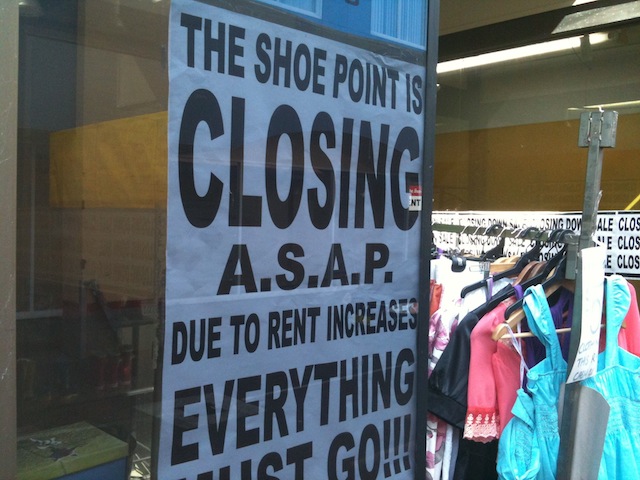
    Contrary to the bleating of Australian retailers, the biggest problem facing the sector is the nation’s high rents and property prices.

    For consumers, those huge rents and huge mortgages take money that could otherwise be buying more consumer goods, at the same time retailers are being slugged by some of the highest rents in the world, pushing up their costs and reducing competitiveness.

    That lack of competitiveness is affecting all parts of the Australian economy, particularly tourism, and the retail industry isn’t immune to those forces.

    Anyone who visits an Australian eating establishment will have experienced this, personally I had another experience last night at a pub that charged $4 (3.70 US) for a soda water.

    This wasn’t a trendy downtown bar but a pub in a lower middle class suburb with two overworked and under trained young bar staff. During the three hours there, our table of six was cleared once.

    no-table-service-in-australian-business.jpg

    Swiss prices coupled with service that would be barely acceptable in a 1970s outback Queensland roadhouse is not the formula for a successful economy.

    The business challenge

    Which brings us back to Solomon Lew’s whinge about the government, Sol handily overlooks the previous government’s  stimulus packages which kept the nation out of recession and put money straight into his and other retailers’ pockets.

    There’s a lesson there for the Australian Labor Party that the tweedle-dum, tweedle-dumber strategy of offering near identical corporate and middle class welfare policies to the Liberal Party is not going to win you friends with the nation’s business sector and its entitled leaders.

    For the incoming Liberal government, it is faced with the challenge of making Australia a competitive, high-cost economy along the lines of Japan, Switzerland or Germany.

    It’s hard to be optimistic about the Abbott government meeting this challenge given the bulk of its ministers are holdovers from the previous Howard Liberal government that was largely responsible for Australia flunking the transition to being a high cost economy along with institutionalising a middle class welfare culture into Australian society.

    Even if Abbott does genuinely attempt to address Australia’s lack of competitiveness, he can be sure he will get absolutely no help from the whingeing captains of the nation’s industries, as Solomon Lew has shown.

    While Solomon Lew and the Australian managerial class struggle with their perfect storms of economic, demographic and technological change, the nation also faces those headwinds.

    Hopefully for Australia there are capable leaders who can navigate those storm waiting to take the helm.

    Similar posts:

  • Fashion’s move to digital commerce

    Fashion’s move to digital commerce

    How does 3D design change the fashion industry? Susan Olivier of Dassault Systemes sees ‘digital commerce’ driving fundamental changes to fashion and retail businesses.

    For slower retailers and fashion houses, this move to digital commerce threatens their very existence.

    ‘Digital commerce’ is more than just e-commerce in the view of Olivier, Vice President of Consumer Goods and Retail of the French 3D design software house, it’s a bringing together of technologies that alter the relationship between customers, retailers and designers along with the manufacturing and logistics companies that bring the products to market.

    Retail’s two big challenges

    Olivier sees the two biggest challenges to the retail industry as being the 2009 downturn of the global economy and the rise of the connected consumer.

    The downturn forced manufacturers and retailers to examine their supply chains, product design and manufacturing to squeeze out inefficiencies along with understanding consumer sentiment better.

    Designing for inner beauty

    “They found they could work differently with suppliers, how do I design for cost?” Asks Olivier, “how do I work on designing for what we call for ‘inner beauty’ and maybe change the inner design to take out costs without hurting performance or visual performance?” Olivier asked.

    “Those brands who survived are those who learned to do both things very well – work better with consumers and work better with their supplier base.”

    Who has the power?

    “Consumers on the other hand found ‘we have the power’ coming out of the down global economy,” says Olivier. “When consumers buy on price then brand loyalty gets strained.”

    The connected consumer also adds further risks for retailers as customers are now better informed than ever before.

    “If retailers aren’t careful, she knows more about the product than the poor staff on the floor does and she knows which stores have it in inventory than the poor staff on the floor does.”

    Bringing together the digital continuum

    One of Olivier’s areas of expertise is in Product Lifecycle Management (PLM) – planning the design, manufacturing, marketing and retirement of various products.

    A notable feature of modern the modern consumer goods industry is the compressed life cycle of products, “it used to be a life cycle was 18 months,” says Olivier. “The goal was to get it below 12 months, for many brands it’s now 12 weeks.”

    A scenario Olivier gives is the design process where a rapid virtual prototype can be shared across manufacturers, store managers and focus group.

    “I can create models in 3D and look at different options,” says Olivier. “How’s the outsoul of this shoe going to perform with this upper? Is it comfortable if I make changes? I might send a sample to a 3D printer before I make the mould.”

    “I can share it with my visual display teams and my store managers and I can share it before I commit to production and get feedback from my stores and I can share it with my consumer focus groups. ”

    “Now I have the power to do that weeks or months in advance before having to put the knife to the goods.” States Olivier, “that’s a completely different way of connecting the way companies think about product, bring it to life and bring it to market.”

    “Those are the kinds of things we’re enabling when I talk about bringing together the different points of the digital continuum.”

    “Now I’m in store I want to take the same images to educate my sales staff. I want them to take a tablet device and show the consumer what is in inventory, not just in this store, and I can have it shipped to their home within 24 hours.”

    “So that’s why I’m saying ‘digital commerce’,” says Olivier. “It could be online, it could be a kiosk in the store, it could be an iPad the sales assistant has in front of them.”

    Susan Olivier’s digital commerce model is the present day reality of retail – today’s merchant has to be across consumers’ sentiment along with working closely with suppliers to get products to get products to the customer quickly. The old ways of selling goods, particularly fashion, are over.

    Similar posts:

    • No Related Posts