Category: business advice

  • Navigating the future of accounting and business with the cloud

    Navigating the future of accounting and business with the cloud

    Steph Hinds of Newcastle accounting firm Growthwise  is one of the new breed of business advisers using cloud and mobile technologies to change her profession.

    At the recent Sydney Xero Conference I had the opportunity to speak to her about some of the ways her business is changing.

    The interview with Steph as part of the Decoding the New Economy YouTube channel covers how the accounting profession is changing, what industries are being the most affected and where she sees the growth opportunities for her businesses.

    Like many other professional services industries, the big change Steph sees is how accounting is moving from being based upon client transactions to requiring much deeper relationships with clients.

    “The transactional model has been commodified completely,” says Steph. ” I started as a trainee accountant and we had those big ledger books and I was coding things and I’d go through cheque butts to enter them into the system.”

    “Now all of that work is done for you.”

    Like Xero founder and CEO Rod Drury, Steph doesn’t see this change as being generation based with older accountants adopting technologies as quickly as their younger counterparts.

    However legacy systems do hobble existing businesses with both Xero and Growthwise finding 40% of their clients are new, startup businesses.

    “We’re finding a lot of new businesses are starting up now,” says Steph. “it is so easy to setup in business, we’ve advised a lot of accountants that rather than spending five hundred thousand dollars to buy into a practice, you can spend ten thousand dollars on licenses and a laptop and all of a sudden you’re really in business.”

    Changing the building industry

    Steph sees the opportunities being in retail, hospitality and trades where being are struggling with paperwork and need fast responses in a customer driven market. The building trades are one of the big areas Steph sees for growth.

    “Guys not having to drive to the office to get their instructions and their things for the day, not having to drop off timesheets, getting paid on the spot and billing on the spot.”

    “We see traditionally see trades, particularly in the building industry as having cashflow issues and people go bust,” says Steph. “I think this is a huge opportunity to change things.”

    Having information is at managers’ and proprietors’ fingertips is one of the benefits of cloud services and Steph also sees the app ecosystem, providing plugins like mobile job management are very powerful.

    “The big data angle, for benchmarking – we have real time access to our clients’ data and how they are doing against industry benchmarks and being able to help clients,” says Steph.

    Steph Hinds and Growthwise are examples of how the business world undergoing a dramatic change as the information and systems that were once only available to big business can now be accessed by anyone.

    The real digital divide lies between the business who are prepared to grab the opportunities and those who are happy doing things the way they’re done today.


    Similar posts:

  • Bernie Brookes’ Blues – the inability of managers to learn from failure

    Bernie Brookes’ Blues – the inability of managers to learn from failure

    One of the notable aspects of modern corporations is the inability of executives to identify failure.

    A good example of this is the Australian department store industry. Like most Aussie industries it’s dominated by two major players, Myer and David Jones,  both of whom have struggled with the realities of modern retailing.

    David Jones is notable for deciding the web was too much hard work in 2001 while Myer’s management whines about sales taxes despite struggling with antiquated point of sales systems and an inadequate online presence that still lags its international competitors.

    This week illustrates both companies’ state of executive denial, yesterday Myer’s CEO Bernie Brookes blamed falling profits and escalating costs on the GST and labour rates – the idea that management should take some of the blame for increased overheads didn’t seem to occur to Bernie.

    One telling comment of Brookes’ are his comments about productivity and global competitiveness.

    “The sector would benefit from reform to help drive productivity and become more competitive in an increasingly global marketplace,” said Brookes.

    Brookes’ comment illustrates just how the Australian corporate sector has flubbed the transition to operating in a high cost economy.

    At the same time Bernie Brooks was bemoaning the state of the world, David Jones CEO Paul Zahra was opening a new small format store and – like all champions of free enterprise – blamed the government for slow sales.

    David Jones’ new store is interesting in itself, notably this comment in the Sydney Morning Herald story;

    Mr Zahra said the store had been especially catered to the wealthy demographics of the Malvern area with a focus on high margin items.

    “Higher margin categories are what we have focused on and low margin categories are available in store but in the online system so we can get it shipped directly to people’s homes.

    “And we get a better gross profit per square metre as a result.”

    Welcome to the Twenty-First Century, Mr Zahra.

    Both Zahra and Brookes’ statements show they learn nothing from failure, indeed they don’t even seem to acknowledge they have failed.

    It’s understandable in modern corporate life not to acknowledge failure, in the alpha-male environment of the executive suite admitting failure is a form of professional suicide.

    However not learning from mistakes is a recipe for making more errors – “those who fail to learn from history are condemned to repeat it.”

    And that’s exactly what the hapless Myer and David Jones shareholders are condemned to, as are all the other businesses whose management doesn’t see its failures.

    Similar posts:

    • No Related Posts
  • Death of a typewriter repairer

    Death of a typewriter repairer

    Despite owing his longevity to cheap scotch and strong tobacco, the US’ oldest typewriter repairman passed away two weeks ago. The fate of his shop is one that many other small businesses will share.

    Manson Whitlock of New Haven, Connecticut had run his typewriter shop from the early 1930s until shortly before his death. Needless to say, he didn’t like computers.

    “I don’t even know what a computer is,” Mr. Whitlock told The Yale Daily News, the student paper, in 2010. “I’ve heard about them a lot, but I don’t own one, and I don’t want one to own me.”

    While Manson’s shop had six staff at its peak, in recent years he ran the operation on his own and the business died with him.

    Many Baby Boomer business owners face the same fate as Manson Whitlock as their businesses decline in the face of changing technology and shifting change.

    Some of the boomers will suffer because they are undercapitalised and, as the next generation of entrepreneurs can’t afford to buy these existing business, most of those will work way wall past the date they planned to retireme.

    A good example of this is a radio shop near my office which has been run by an old gentleman for many years. When I went into it in 1997 for something – I forget what – the proprietor was almost shocked to see a customer and he couldn’t help me.

    It wasn’t surprising as it was rare to see a customer and the none of the stock behind the cluttered counter seemed to date beyond 1980.

    The only reason the shop survived was because the proprietor owned the premises as there’s no way the place could have paid the modern rents with the non-existent turnover.

    A few weeks ago the shop closed. I don’t know whether the owner retired or passed away, but the business closed with him.

    Both the Neutral Bay electrical shop and the New Haven typewriter repairer show how businesses can be left behind by technology.

    While both stores had plenty of time to react during the rise of computers during the 1980s and 90s, their proprietors chose not to and by the 2000s it was too late.

    Today, technology and business is changing even faster and there’s many more big and small enterprises that risk being left behind by change.

    It’s not only the changing market place that risks the future of these business, the failure to invest in things as simple as modern Point of Sale systems or even a basic website will leave many exposed.

    The time to invest in new systems and products is now and if you can’t invest in the future, then it’s time to get out.

    neutral-bay-radio-shop

    Similar posts:

  • Why do executives see romance in the startup culture?

    Why do executives see romance in the startup culture?

    One of the fascinating phenomenons of the modern era is how corporate managers have appropriated the startup culture.

    At the announcement of the Australian Centre for Broadband Innovation’s Apps For Broadband prizes, Foxtel’s CIO Robyn Elliot described her experience of working in a startup.

    “Foxtel was once in the category of startup itself,” said Elliot at the start of her speech.

    Apples and Oranges

    Comparing Foxtel to a scrabbling startup in the modern sense is bizarre given the company was a well funded joint venture between News Limited and Telstra – the company being a good example of modern Australian crony corporatism rather than a risky undertaking by daring entrepreneurs.

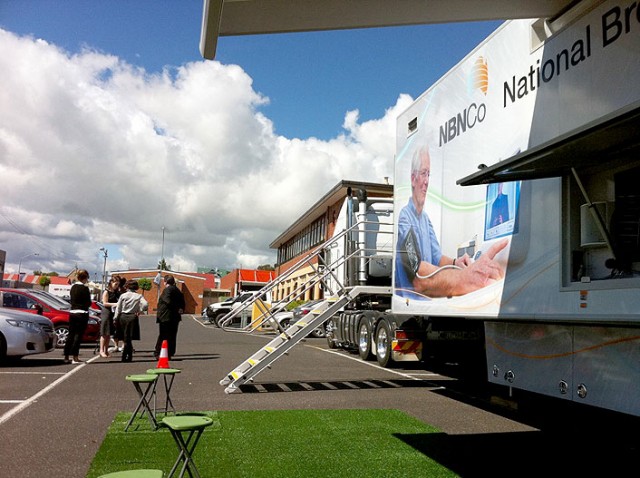
    This conceit about startups isn’t unusual among corporate executives, in the early days of Australia’s National Broadband Network it was quite common to hear NBNCo managers talk about their startup ethos – this from a company backed by around 30 billion dollars of government funding.

    At one stage I interviewed for a job at NBNCo and I struggled not to start giggling when the “startup ethos of the organisation” was earnestly emphasised to me several times during the meeting.

    Not surprisingly the job went to an ex-telco staffer, as did most of the team’s roles. No doubt their corporate experience was far more suited to the company’s ‘startup ethos’  than that of actually having worked in four startups. Giggling in the interview probably didn’t help either.

    The romantic dreams of executives

    Given most corporate staffers would curl into the fetal position and weep after two weeks of working in a real startup, why do executives indulge in the conceit that their business is ‘just like a startup’?

    The answer could lie in “The Consequences to the Banks of the Collapse in Money Values” written by John Maynard Keynes in 1931.

    A sound banker, alas, is not one who foresees danger and avoids it, but one who, when he is ruined, is ruined in a conventional and orthodox way along with his fellows, so that no one can really blame him. It is necessarily part of the business of a banker to maintain appearances, and to confess a conventional respectability, which is more than human. Life-long practices of this kind make them the most romantic and the least realistic of men.

    So it is for the modern corporate executive who has spent their working lives fighting for the corner office having met their KPIs and spending years cultivating their network of like minded managers.

    After two decades spent writing stern memos on the use of paper clips and climbing the corporate ladder, it must be tempting for a middle aged executive to look at those funky youngsters getting billion dollar payouts after a couple of years grabbing three hours sleep a night among the pizza boxes under the desk and get pangs of what might have been…..

    A harmless startup fantasy

    In some many ways the executive startup fantasy is touching and largely harmless, even if it does attract sniggers and giggles from the unwashed and underpaid who’ve actually been there.

    The real risk is when a senior executive tries to shoehorn a Silicon Valley startup culture into an organisation.

    While most large companies could do with some of the hunger and flexibility found in smaller businesses, there’s many ways that could go terribly wrong – particularly when driven by a starry eyed romantic manager.

    For most executives though, the dreams of being in a startup will remain a fantasy – and that’s probably best for everybody.

    Similar posts:

  • A startup’s journey – what businesses can and can’t learn from Silicon Valley

    A startup’s journey – what businesses can and can’t learn from Silicon Valley

    Tech Crunch has a fascinating story on the journey of failed startup, Los Angeles based Flowtab that hoped to create an bar tab smartphone app.

    In many ways Flowtab is a story of our bubble economy times – a cheap, easily built service that addresses what is, at best, a minor first world problem.

    Flowtab failed when it turned out solving that problem was a lot harder than just writing an app, which is something often overlooked in the current startup hype.

    However had the timing of Flowtab’s founders been a bit luckier they could have hit the jackpot.

    Dave Winer describes the herd mentality of venture capital investors and had the hot trend of the time been bar ordering apps then the Flowtab team could have been one of the beneficiaries of the Silicon Valley business model.

    Along with being a historical insight into today’s investment mania, Flowtab’s story is an illustration of how a new business needs to pivot when the original idea turns out not to be as compelling as the founders first thought.

    Even when a business does a pivot, it’s not guaranteed the company will survive, but that’s part of the risks in starting a new enterprise, particularly when it’s undercapitalised as Flowtab was.

    There’s many lessons from Flowtab’s failure, but not all of them apply to every business.

    Similar posts: