Category: business advice

  • Doing social media right

    Doing social media right

    After last week’s Associated Press hack and the stock exchange fallout, regulators are struggling with implications of social media and informed markets.

    In a speech delivered last week the Australian Securities and Investments Commission’s Deputy Chair Belinda Gibson and Commissioner John Price gave some refreshing commonsense views on how businesses should handle public information.

    The continuous disclosure advice given by Price and Gibson is aimed at meeting the requirements of Australian corporate law, but it’s actually good social media advice.

    • Having delegations in place for who has authority to speak on behalf of the company – whether in response to an ASX ‘price query’ or ‘aware’ letter, or when they become aware of information that needs to be released to the market, perhaps in response to speculation.
    • Ensuring that there is a designated contact person to liaise with the ASX, who has the requisite organisational knowledge and is contactable by ASX.
    • Have a clear rapid response plan and ensure all board members and senior executives are fully appraised of it. Give it a practice run every so often – a stress test of sorts.
    • Have a plan for when you will consider a trading halt appropriate.
    • Have a ‘Request for trading halt’ letter template ready for use.
    • Have guidelines for determining what is ‘material’ information for disclosure, tailored to your company.
    • Prepare a draft announcement where you are doing a deal that will
    • likely require an announcement at some time, and a stop-gap one in case of a leak

    Having a nominated contact person with requisite organisational knowledge is possibly the most important point for any organisation.

    Even if you think social media is just people posting what they had for lunch or sharing cute cat pictures, it isn’t going away and those Twitter feeds and Facebook pages are now considered official communications channels.

    The intern running your social media is now your company’s official spokesperson. Are you comfortable with this?

    A good example of where this can go wrong is the Australian Prime Minister’s Press Office where an immature staff member has been put in charge of posting messages. The results aren’t pretty.

    prime-ministers-office-twitter-feed

    The funny thing is the Prime Minister’s office would never dream of some dill getting up and saying this sort of thing on her behalf, yet allows an inexperienced, loose cannon put this sort of material in writing on the public internet.

    Here’s Twenty Rules for Politicians using the Internet.

    On a more mature level, the ASIC executives also have some good advice on writing for social media.

    Don’t assume that the reader is sophisticated or leave readers to read between the lines. Companies need to highlight key information and tell it plainly.
    While the ASIC speech is aimed at the specific problems of complying with company law and listing requirements, it’s a worthwhile guide for any organisation needing to manage its online presence.
    Don’t be like the Prime Minister’s office, understand that an organisation’s social media presence is an official channel and treat it with the respect it deserves.

    Similar posts:

  • Starbucks Coffee as a digital innovator

    Starbucks Coffee as a digital innovator

    USA Today has an interesting interview with Starbucks CEO and founder Howard Schultz.

    It’s worth watching as he maps out where the coffee chain is heading and the importance of innovation and relevancy to his business.

    Schultz’s view about the coffee store of the future is intriguing – he knows it will be different but he doesn’t know in what way and that’s why his business is experimenting with different ways of doing things.

    “Sure, we’re doing work now on the store of the future,” says Schultz. “It is not only linked to the physical but the digital experience.”

    It’s not only the use of digital tools, social media and mobile payments that Schultz is exploring, it’s how does such a huge chain remain relevant to its customers.

    “We have to answer the question in the affirmative about how to maintain relevancy. Relevancy can’t only be in the four walls of our stores, we have to be as relevant with our customers where they work, play and even on their phones.”

    Relevancy is something that can’t be taken for granted by any business – becoming irrelevant to customers is a death-knell for most enterprises. This is something that challenging the media industry as its struggles to find its role in changed society.

    On the same day that story was posted, IBM’s CEO Virginia Rometty made a pointed address to her 434,000 employees on where the company has fallen behind.

    “Where we haven’t transformed rapidly enough, we struggled,” The Wall Street Journal reports. “We have to step up with that and deal with that, and that is on all levels.”

    “Our performance reminds us that there are profound shifts under way in our industry.”

    That the world’s biggest coffee chain is dealing with those profound shifts better than one of the biggest technology companies is a notable point about the times we live in.

    Similar posts:

  • Lessons from the Associated Press Twitter hack

    Lessons from the Associated Press Twitter hack

    Today’s hack of the Associated Press Twitter account that sent out a fake report about the White House being attacked raises a number of issues about how business and the media industry use social media.

    Attracting most of the attention is the stock market ‘flash crash’ triggered by the fake report where automated programs responded to unexpected selling on the exchanges.

    This in itself is an example of a risky over reliance on technology by well paid people who should know better. There are a number of other risks that everybody, particularly business people should learn from the Associated Press hijack.

    Twitter as a news channel

    Without any verification, people started selling stocks based on a report spread through Twitter. This is understandable as Twitter has become the modern news ticker tape.

    Also understandable is how news organisations could pick it up, most newsrooms are under resourced and journalists are under pressure to break news. This opens opportunities for misinformation to spread.

    The real risk with the fake report was if it had been picked up by a mainstream media outlet or found its way onto the wire services. Fortunately this time it didn’t.

    One clear lesson from this is social media postings are not a source of truth, they have to be checked and verified. This is something advocates for using social media as a disaster management tool need to keep in mind.

    Think before you tweet

    During the search for the Boston bombers, social media users went feral and it shows how false information can spread very fast.

    For those of us using Twitter – or any other social media channel – we have to be careful about what we post and who we identify as lives can be damaged and misinformation spread.

    Thinking before we tweet or post makes it harder for rumours and misinformation to spread.

    Introduce strong social media policies

    Almost certainly the Associated Press Twitter account was hijacked because the single person in charge of the @AP account clicked on a spam link and gave away the account’s password.

    Social media sites don’t do a good job with their security which makes it difficult for businesses to monitor and control access to accounts.

    While the services have to tighten their acts, companies need to be sure that they have security procedures in place and the right people maintaining their business accounts.

    Hire the right people

    Competing wire service Reuters discovered the importance of having the right person running their social media presence having fired its deputy social media editor for inappropriate tweets during the Boston Bombing scare.

    Putting the intern or the youngest person in the office in charge of social media is a beginner’s mistake, a more serious error is to put a loose cannon in charge of the company’s online presence.

    Given the potential business risks involved with social media, it’s necessary to put someone trusted and responsible in charge of what appears under the company’s name.

    At the very least management has to do proper due diligence on the person they put in charge of their social media accounts.

    Securing your business

    Associated Press’ problem is typical of many businesses that don’t have tight security policies, the UK Department for Business, Innovation and Skills recently released a report finding that over 85% of British business have had some sort of security breach in the previous year.

    Given the risks posed by poor computer security, managers have to take the integrity of their systems seriously.

    Those who caught out by Associated Press’ hijacked Twitter stream learned  important lessons about computer security, online trust and verifying information. All of us should be aware we can be caught out in the same way.

    Similar posts:

    • No Related Posts
  • Cheap coffee and the changing service sector

    Cheap coffee and the changing service sector

    I noticed the queues one morning when calling into the local service station to grab a carton of milk at 5am.

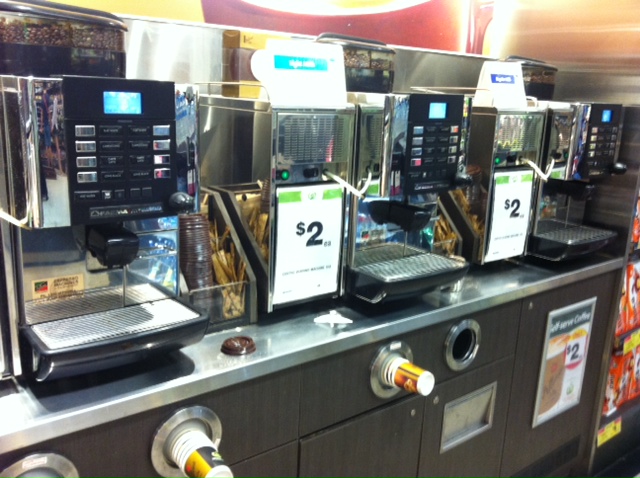
    There was a line of tradesmen out the door waiting to buy a $1 self serve coffee. Freshly ground with your choice of espresso, latte or cappuccino.

    No messing around, no being patronised by snobby barista – just a cheap, decent quality cup of coffee.

    For the last few years these machines have been popping up in convenience stores and service stations, freshly grinding beans to order and delivering a reasonable cup of coffee for a dollar or two.

    7-11-cheap-coffee.jpg
    Cheap coffee at the local convenience store

    None of the machine made cups will beat a coffee made by a good barista, but are half or a third of the price being charged by many cafes whose product often isn’t much better (and sometimes worse) than that made by the machines.

    With the rise of the service economy in the 1970s it was assumed employment would move from factories to jobs like baristas and serving in cafes, now we’re seeing automation taking over those jobs as well.

    The 1970s assumption that the service industries would become the mainstay of the economy turned out to be true with over two thirds of the workforces in countries like the US, UK and Australian employed in them them by the end of the Twentieth Century.

    Now industries are restructuring again and the assumptions that worked well for the last fifty years are being challenged by automation and increased outsourcing.

    The idea we could build an economy based upon us all making coffee and waiting tables for each other was always problematic and so it is proving to be.

    It’s worth thinking about the opportunities this presents for your business.

    Similar posts:

  • Moving to a subscription economy

    Moving to a subscription economy

    One of the biggest changes in business is the move to subscription based services rather than selling one-off, lump sum products. This is affecting industries ranging from the motor industry to software.

    Business Spectator has a good interview with Tien Zhou of Zuora on the subscription economy and how it’s changing the business world.

    We’re pretty passionate in our belief that every company will be a subscription business in the next five, 10, 20 years. That’s certainly what we’re seeing with digital companies, whether they are technology firms (software, hardware), media and publishing firms, or telecom companies. The ideas of content and access are starting to blend together and we are seeing more and more commerce companies dip their feet as well. So we’re really see this as an across the board phenomenon.

    Probably the industry most focused on the subscription model right now are newspapers – subscribers have always been an important revenue stream for the print media and the loss of their advertising rivers of gold means they are looking at ways to get more money from readers.

    As Tien Zhou points out, businesses moving to subscription services is an across the board phenomenon.

    Yesterday I mentioned the Google Maps connected treadmill, that is a subscription model where the treadmill seller gets money from the initial purchase, but also a revenue stream from the services attached to it.

    The same business model applies to connected motor cars or the social media enabled jet engine. The aim is to replace lump sum purchases with lifetime subscriptions.

    Getting customers onto lifetime subscriptions has been one of Microsoft’s aims for the past decade as the company realised that software users, particularly those using Microsoft Office, hung onto their CDs for years and increasingly decades.

    Perversely it took Google and Apple to show Microsoft how to wean customers onto subscription services.

    That Microsoft Office is a good example of the evolution of subscription software, or Software-as-a-Service (SaaS), isn’t an accident. The enterprise computing sector is currently the most profoundly affected as companies like Google and Salesforce threaten high cost incumbents.

    A good example of the changing economics of software is the supermarket chain Woolworths moving onto Google Docs.

    With 26,000 seats, the reseller can expect to make $260,000 a year in commissions based on Google’s standard terms of $10 per seat per year.

    That total sum is less than the commission a salesperson would have earned for a similar sized IBM, Oracle or Microsoft installation.

    A whole generation of IT salespeople who’ve grown fat and comfortable on their generous commissions now find their incomes being dramatically reduced.

    Similar things are happening in industries like call centres with Zendesk, point of sale systems and event ticketing with Eventbrite – incumbents are finding their incomes steadily being eroded away by online services.

    At the same time agricultural and mining equipment suppliers are introducing big data services for their customers where the information gathered by the sensors built into modern tractors and bulldozers are providing valuable intelligence about the crop and ore being gathered.

    The subscription business model is nothing new, King Camp Gillette perfected the strategy with the safety razor at the beginning of the Twentieth Century. The razors were cheap but the blades were where the money was.

    Microsoft and the rest of the software industry tried to introduce subscriptions in the late 1990s with Software as a Service, but failed because the internet wasn’t mature enough to support the model. Today it is.

    Like many things in today’s economy, the subscription model is going to change a lot of markets. It’s a great opportunity for disruptive businesses.

    Subscription envelope image courtesy of jaylopez through sxc.hu

    Similar posts: