Category: business advice

  • Firing your customers

    Firing your customers

    Running your own business can be tough, but one of the therapeutic advantages of dealing with the stresses of self-employment is the ability to fire stroppy customers.

    Steve Cody, the proprietor of marketing agency Peppercom, gives a list of five types of clients worth sacking in Inc Magazine.

    It’s a good list although it misses the general “pain in the ass” client who demands a solid gold level of service for a pittance. These are particularly common if you pitch to the lowest end of the market.

    Lists like Steve’s are good reminder of Pareto’s Law, or the 80/20 rule which is usually put in terms of 80% of business revenues come from 20% of customers.

    The converse is also true, 80% of business hassles come from just 20% of customers and they are almost certainly not the most profitable ones.

    Pandering too much to the bad customers can hurt your health as well – running your own business is stressful enough without dealing with troublesome clients.

    So sacking bad clients is good, not only is it therapeutic but it also helps the bank account. It’s worthwhile doing whenever a customer drives you too far.

    Go on, you know you want to.

    Similar posts:

  • Proudly designed in Gyeonggi

    Proudly designed in Gyeonggi

    “Designed by Apple in California ” is the boast on the box of every new iPad or Macbook. That the slogan says ‘designed’ rather than ‘made’ says everything about how manufacturing has fled the United States.

    Last year the New York Times looked at Apple’s overseas manufacturing operations, pointing out that even if Apple wanted to make their product in the the US many of the necessary skills and infrastructure have been lost.

    Now the US is facing the problem that Asian countries are looking at moving up the intellectual property food chain and doing their own designs.

    In some ways this is expected as it’s exactly what Japan did with both the consumer electronics and car industries during the 1960s and 70s.

    The big difference is that Japanese manufacturers travelled to the US and Europe to study the design and manufacturing methods of the world’s leading companies. In the 1990s and 2000s, the world’s leading companies gave their future competitors the skills through outsourcing and offshoring.

    In the next decade we’ll see the latest consumer products coming with labels reading “Designed by Lenovo in Fujian” or “Developed by Samsung in Gyeonggi”.

    For western countries, the question is what do we want to be proudly be putting our names to?

    Image from Kristajo via SXC.HU

    Similar posts:

  • Saving Hewlett Packard

    Saving Hewlett Packard

    This site has previously looked at the massive task facing Meg Whitman as she tries to rebuild Hewlett Packard and undo the mis-steps of the company’s previous managerial failures.

    Bloomberg Businessweek goes further with a deep analysis of what went wrong for HP over the last two and Whitman’s challenges in rebuilding the business.

    HP’s decline starts with the biggest mis-step of Carly Fiorina, one of Whitman’s predecessors, in selling off HPs instrumentation business in 1999.

    Power in the instruments

    Industrial instruments were the core of HPs business, generations of engineers and scientists knew and trusted the HP brand which was synonymous with high quality, cutting edge technology.

    The proof of the instrument arm’s strength is in the subsequent share performance of the spun off company – today Agilent trades at $43 while HP wallows at $15, half of what it was worth in 1999.

    Making matters worse for HP was buying into the personal computer industry just as Dell and Gateway were commodifying the market. Fiorina’s high spending ways left Hewlett Packard incapable of competing against the lean operations of their nimbler competitors.

    In many respects Fiorina’s successor Mark Hurd is the IT sales guy from central casting; aggressive, an excellent eye for numbers, intolerant of (other peoples’) wasteful spending and an ego the size of Uranus.

    For HP he had some good points, making executives directly responsible for their division’s performance and cutting out management consultants. Anyone who shows Bain & Co or McKinsey’s the door, is not a wholly bad guy.

    Cutting costs in the driver business

    In cutting costs Hurd was ruthless – the Bloomberg story tells of how he cut HP’s driver division from over 700 to 64 staff. This in itself was not a bad thing.

    Those who worked on HP products remember that period well. The software that came with Hewlett Packard equipment was buggy and overblown and Hurd’s reforms bought in a real improvement as drivers went back to being simple and effective.

    Cost measures though also showed in HPs products and after sales support – increasingly the company resembled Dell during the dark days of Dell Hell where buyers of shoddy equipment found themselves dealing with poorly trained support desks over low quality phone lines. Customers started to flee HP products.

    The perils of stack ranking

    At the same time Hurd was using the crudest management technique of all – stack ranking, the practice of culling the bottom ten percent of workers each year.

    Vanity Fair’s 2012 expose of Microsoft’s decline infamously blamed stack ranking for much of that company’s woes. The problem being that defining the bottom 10% of a team invariably involves politics and staff become more obsessed with currying favour with their managers than shipping good products.

    People like Steve Ballmer and Mark Hurd like stack ranking because they thrive in that environment. The paradox is that characters like Steve Jobs, Bill Gates and Mark Zuckerberg tend to be culled.

    HP, and Microsoft, needed more geeks focused on shipping new products than political animals like Hurd and Ballmer but that’s not what they got.

    While Hurd met his financial targets, HP’s position was becoming more fragile as cranking up margins on services and printer cartridges while slashing costs on PCs and hardware can only go so far. His implosion over his royal lifestyle was probably one of the best timed exits in corporate history.

    It’s worth reflecting on Hurd’s management excesses as he slashed expenses for the lesser beings in his company, you can browse a list of his expenses at The Street. In this respect alone, Hurd personified the entitled managerial culture of modern western society.

    Replacing Hurd with the quiet Leo Apotheker made sense in that the new CEO was the opposite to his predecessor, but just as he didn’t have Hurd’s ego he was also a dud who made strategic mistakes and let costs begin to slip.

    In replacing Apotheker Meg Whitman has massive job ahead of her, an important part of getting HP on track is slimming down management ranks to make the company more nimble. That in itself is a big task.

    The biggest task of all though is to recapture HPs position as being an innovative leader with high quality products. Over the Fiorina and Hurd years that position was squandered and replaced by companies like Cisco and Apple.

    Right now it’s hard to see where HP can re-establish itself in the marketplace but the goodwill towards the company from a generation of engineers who were bought up believing Hewlett Packard means quality means the company has a chance.

    Hopefully Meg Whitman is the right person to seize those chances and undo fifteen years of bad management.

    Similar posts:

  • Uber’s New Year’s test

    Uber’s New Year’s test

    Update: It appears Uber passed the New Year’s Eve test without problems. There were almost no complaints at all.

    New Years Eve 2011 was a tough night for customers of the Uber hire car booking service in New York City when fares surged as partygoers headed home.

    This year, Uber hopes to overcome problems by making sure customers are aware with big warnings of prices and even a sobriety test so users can confirm they know what they are doing when they agree to catch a cab.

    Uber’s dynamic pricing matches supply with demand, which means a more reliable service but also opens the company to allegations of price gouging during busy periods.

    Those allegations are exactly what happened in New York last year and in 2012 Uber’s risks of bad publicity are far higher as the service is now international with operations in cities like London, Paris and Sydney.

    Sydney will be the first city to encounter the effects of surge pricing and big risks lie in the Harbour City as Sydneysiders are used to fixed cab fares and enjoy a good whinge when things don’t work in their favour.

    Over a million people are expected on the shores of Sydney Harbour to watch the New Year’s Eve fireworks which means cabs and hire cars are at a premium.

    If Sydney has the triple fares expected in New York then Uber’s fare from Circular Quay to Bondi Beach will be around $150. This compares to the standard cab fare of around $30.

    Those markups will be exploited by the incumbent taxi companies and booking networks. We can expect a wave of stories over the next few days from tame journalists regurgitating the incumbents’ media releases.

    How Uber’s Australian management deals with this will be worth watching. One hopes they are prepared a tough week and don’t enjoy the festivities too far past midnight.

    Another problem for Uber is going to be Sydney’s mobile data networks which are horribly unreliable during peak periods. It may well be that Uber’s customers and drivers never get a fare anyway.

    Last year I was near the Habour Bridge and didn’t have a Vodafone signal from 8pm onwards. I’ll be comparing the performance of all three Aussie networks from the same place tonight.

    Similar posts:

  • Yelp’s problem with activists

    Yelp’s problem with activists

    It’s been a bad couple of years for James Knight, a dentist in Fort Dodge, Iowa.

    First his wife found some text messages he’d exchanged with Melissa, his attractive assistant who’d been with his practice for ten years.

    Then James’ spouse demands Melissa is fired.

    James then has what was no doubt a difficult conversation with Melissa’s husband explaining why she’s been sacked.

    Then Melissa sues him for discrimination. He wins the case.

    Melissa appeals to the state’s Supreme Court and loses there as well however the case now has national attention.

    This attracts the ire of the Internet mob, who start posting bad reviews about James on Yelp despite most of them not even living in Fort Dodge, let alone using his service.

    For Yelp, the rabble descending on James Knight’s review page is as much their problem as it is his.

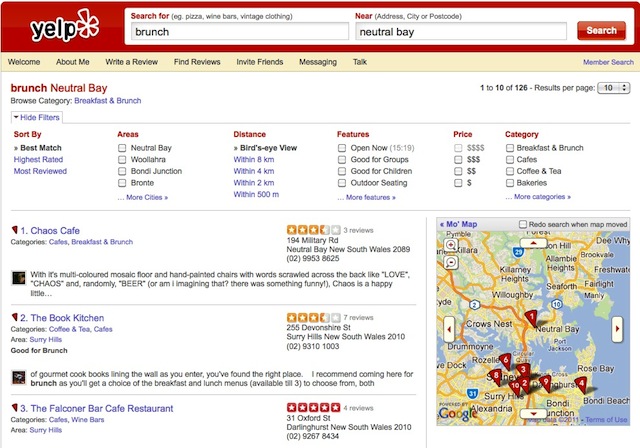
    Yelp is one of the leading customer review sites which are changing the way small business operates and getting “smashed on Yelp” isn’t good for one’s reputation.

    Recently a builder also attracted the ire of the online lynch mob when he threatened to sue a customer over a poor Yelp review.

    As consequence, his Yelp page was overwhelmed with negative reviews by people who’d never used his business. The service had to delete 65 of those reviews which clearly had nothing to do with the quality of service the builder provided.

    The problem for Yelp, an other online review sites like Tripadvisor, is that for their sites to be trusted the reviews have to be reasonably accurate – self righteous internet mob skewing results is going to damage the service’s credibility as much as the targeted businesses.

    What this means for Yelp is that the low cost online business model doesn’t work, for the site to be relevant and credible there has to be administrators checking reviews and dealing with these situations.

    There’s also a lesson for all of us using the web – mindlessly joining online lynch mobs creates more damage than it fixes.

    Picking on a mid-Western dentist because he appears to be a pussy whipped jerk isn’t really solving humanity’s problems – we can all find causes that are a better use of our time.

    Similar posts: