Category: cloud computing

  • Microsoft’s business fightback

    Microsoft’s business fightback

    Yesterday a series of vendor briefings showed how Microsoft is fighting back in the enterprise computing market and taking on upstarts like Salesforce in the CRM and business analytics markets.

    Microsoft’s briefing presented a series of happy customers – including Colliers International, Servcorp and Metricon Homes – describing how they had deployed the Microsoft Dynamics product.

    All the businesses at the Microsoft event said how it fitted into their existing business IT infrastructure. All were Windows shops running Exchange and Sharepoint.

    This installed base illustrates Microsoft’s strength in the Enterprise marketplace along with its partner network of resellers and integrators.

    Microsoft’s partner network was illustrated at HP’s Next Generation of Information Workers briefing where the company’s workplace of the future vision is very much a Windows service, even the layout is a replica of the Window 8 tiled layout.

    The Next Generation of Information Workers product is largely built over Microsoft’s Sharepoint and HP’s own Trim product which again shows how legacy providers are leveraging their established technology.

    Whether this is enough to hold off the likes of Salesforce and other cloud based services remains to be seen. Being Windows-centric is particularly tough at a time when many employees bringing their own Apple iPads and Android smartphones to work.

    Microsoft’s awareness of its position was shown in the billing of the briefing where the invite billed the session as showing how Microsoft competes with Salesforce.

    That competition is manifesting itself with both Salesforce and Microsoft aggressively acquiring social, analytics and marketing platforms to compliment their CRM products.

    If the competition was just a matter of size there would be little contest as Microsoft’s $290 billion stock market capitalisation is more than ten times bigger that of Salesforce’s.

    But it isn’t just a matter of size. Microsoft are have a legacy business to protect while disruptors like Salesforce aren’t encumbered by older desktop and server products.

    What is clear though is that Microsoft is gearing to fight for these markets.
    Similar posts:

  • Steve Ballmer’s big platform change

    Steve Ballmer’s big platform change

    All Things D today reports that Microsoft is considering a major restructure to reflect changed computing markets.

    One of the big messages from The State Of The Internet report is we are seeing three simultaneous changes to the computer industry – the shift from personal computers to smartphones, tablet computers and wearable systems – and Microsoft is at the centre of these transformations.

    One graph, first released by Aysmco and expanded in the Meeker presentation, illustrates how fundamental these shifts are to Microsoft’s business.

    mary meeker computingmarketshare-640x480

    Microsoft’s domination of the computer industry was almost total at the beginning of the century and remained so until the iPhone was released in 2007. Then suddenly things changed.

    With the success of Android and the iPad, the market shifted dramatically against Microsoft and the WinTel market share is now back to 1985 levels when the Commodore 64 was a credible competitor.

    The change that Microsoft faces shouldn’t be understated, although the company’s strengths with products like Office, Azure and Hotmail (or whatever this year’s name for their online mail product is) give the once untouchable incumbent some opportunities, particularly in the cloud.

    At the end of Mary Meeker’s presentation at the D11 conference, Walt Mossberg asked her about Microsoft’s view that tablets and smartphones are just new computing platforms. Meeker dismisses that with the observation that the data is clear, the market has shifted to Apple and Google.

    “Google and Apple are driving innovation,” says Meeker. “Microsoft is not.”

    The numbers aren’t lying for Microsoft. That’s why Steve Ballmer has to move fast and think creatively about the company’s future.

    Similar posts:

  • ABC 702 mornings – Storage and your computer

    ABC 702 mornings – Storage and your computer

    This morning on 702 Sydney I’m talking to Linda Mottram on the decidedly unsexy topic of storage – hard drives, cloud computing and the struggle to keep up with ever expanding file sizes of documents, photos and downloads.

    It’s an opportunity to revisit the How Much Data Does The Internet Need topic which I covered for Radio National last year, although almost certainly that needs updating.

    Earlier this year networking vendor Cisco released its 2013 Virtual Networking Index which forecast global data traffic growing fourteen fold over the next five years.

    Those bytes slopping around the internet have to come to rest on someone’s hard drive and this is what’s driving the storage crisis.

    Yesterday US business site Venture Beat had an op-ed by an executive from Seagate, the world’s biggest hard drive manufacturer where he discussed the storage challenges with a claim from industry consultants IDC that worldwide computer storage is 2.7 zettabytes.

    A zettabyte is a trillion gigabytes, or ten followed by twenty zeros – it’s the equivalent of a billion one terabyte hard drives that are standard on most cheap desktop computers.

    Where those hard drives are located is the big challenge, is it on your laptop, smartphone or on a somewhere on a cloud service?

    The other big challenge is what do you do with all this information – which is where the Big Data discussion comes in.

    While data storage is a mundane topic, it’s a big one that matters. I hope you can tune in.

    We’d love to hear your views so join the conversation with your on-air questions, ideas or comments; phone in on 1300 222 702 or post a question on ABC702 Sydney’s Facebook page.

    If you’re a social media users, you can also follow the show through twitter to @paulwallbank and @702Sydney.

    Similar posts:

  • Take ten engineers and the internet of everything

    Take ten engineers and the internet of everything

    It seems a far jump from running a gaming platform to a remote access software company with a focus on the internet of machines, but that’s the journey remote access company LogMeIn and its CEO Michael Simon has travelled.

    “Anything that could be connected will be connected in the next decade.” Micheal told me in Sydney last week and it’s where he sees the next step for the company he has led since its founding in 2003.

    LogMeIn grew out of a team that formerly worked for uproar.com, an online gaming company sold to a division of Vivendi Universal for $140 million in 2001.

    Two years after the sale Michael, who had been CEO of Uproar, and a team of ten engineers who formerly worked for the company thought they could solve the complexities of accessing computers remotely.

    For geeks and big business, accessing your computer across the internet in 2003 wasn’t much a problem however it involved configuring software, punching holes in firewalls and configuring routers.

    The LogMeIn team wanted to find a way to make this technology cheap and easy for small businesses and homes to use.

    A decade later they employ 650 staff, half of whom are engineers, and have twenty million users of their product.

    Building the freemium model

    The vast majority of those users are using LogMeIn’s free services – Simon estimates that over 95% of users are using the free version.

    In this, LogMeIn is one of the leading examples of the freemium business model – offering a free version of a software product and premium paid for edition with more advanced features.

    One leader of the freemium movement was the Zone Alarm firewall, a product which earned its stripes in the early 2000s at the peak of the Windows malware epidemic.

    Today one of Zone Alarm’s veterans, Irfan Salim, sits on the LogMeIn board along with two former executives of Symantec, the company whose PC Anywhere and Norton Internet Security products competed with both Zone Alarm and LogMeIn.

    While LogMeIn has done well over the last ten years, the market today is very different to that of a decade ago with cloud computing technologies taking much of the need for remote access software

    Mike Simon sees these changes as an opportunity with the computer industry having gone through three phases – the PC centric era, the mobile wave and now we’re entering the internet of things.

    To cater for the mobile wave LogMeIn has released Cubby, a cloud based storage system that competes with Dropbox, Google Drive and Microsoft’s Skydrive, but Simon has his eye on the next major shift.

    Controlling the internet of machines

    The internet of things is a crowded market, but Simon believes companies like LogMeIn have an advantage over the telco and networking vendors as businesses with freemium and startup cultures look for ‘pennies per year’ rather than the ‘dollars per device’ larger corporation hope to make.

    It’s a big brave call, but with the market promises to be huge – General Electric claimed last year nearly half the global economy or $32.3 trillion in global output can benefit from the Industrial Internet.

    That’s a pretty big ticket to clip.

    Whether Michael Simon and LogMeIn can achieve their vision of being integral part of the Internet of things remains to be seen, but so far they do have success on their side.

    Similar posts:

  • Is there a tablet to cure the reality distortion field?

    Is there a tablet to cure the reality distortion field?

    It’s hard not to be impressed by the calibre of guests CNBC’s Squawk Box when they’re able to get Warren Buffett and Bill Gates on together for an interview.

    During the interview Bill Gates made an interesting assertion about Apple’s iPad, ““A lot of those users are frustrated, they can’t type, they can’t create documents, they don’t have Office there.”

    Bill’s undoubtedly right, some iPad users are frustrated by the device’s limitations. However for every irritated iPad user there are a dozen baffled by the lack of a Start button on Windows 8.

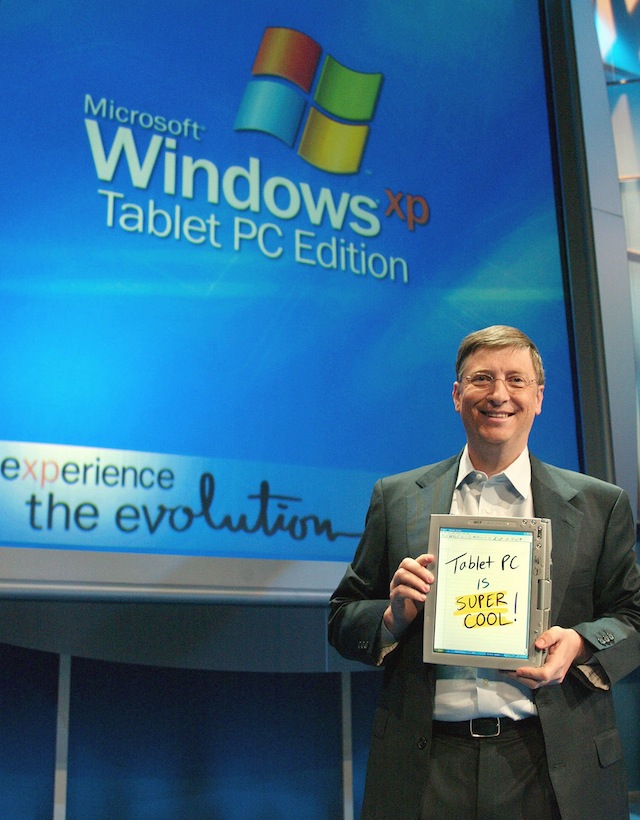
    The reality distortion field though is strong, “Windows 8 really is revolutionary,” says Bill. “It takes the benefits of the tablet and the benefits of the PC and it’s able to support both of those.”

    The Microsoft founder is enthusiastic about the company’s Windows tablet, “you have the portability of the tablet but the richness, in terms of the keyboard and Microsoft Office, of the PC.”

    It’s notable Gates mentioned Microsoft Office, particularly given the question was about the cloud. It’s clear one of Microsoft’s priorities is to maintain their strength with productivity applications and move with their customers onto the cloud.

    The problem though for Microsoft is that Apple’s iOS and Google’s Android are dominating the cloud focused operating systems, leaving Windows behind.

    Making matters worse for Microsoft is it’s clear Windows 8 tablets are never going to catch their competitors. Consulting group Gartner last year predicted the global market for tablet computers will double over the next three years, but Microsoft will capture barely 10% of the sales.

     OS

    2011

    2012

    2013

    2016

    iOS

    39,998

    72,988

    99,553

    169,652

    Android

    17,292

    37,878

    61,684

    137,657

    Microsoft

    0

    4,863

    14,547

    43,648

    QNX

    807

    2,643

    6,036

    17,836

    Other Operating Systems

    1,919

    510

    637

    464

    Total Market

    60,017

    118,883

    182,457

    369,258

    Sitting in a reality distortion field is fine when things are going well and you dominate your world, but Microsoft – despite still being insanely profitable – no longer dominates the markets that made it into one of the world’s leading companies.

    The challenge for Bill Gates and Microsoft’s management is adapting to those changes, projecting your own frustrations onto the users of a competitor’s product, isn’t a recipe for success.

    Similar posts: