Category: cloud computing

  • Today’s business Neanderthals

    Today’s business Neanderthals

    “Bringing a knife to a gunfight” describes showing up hopelessly ill-equipped for the task at hand.

    Two recent conferences, the massive Dreamforce in San Francisco and the smaller, but still fascinating, Australian Xerocon in Melbourne illustrate just how radically the commercial world is changing and how many business leaders are poorly equipped for today’s times.

    In July, the Melbourne Xero Convention bought together 400 Australian partners of the cloud accounting service which showed how how one New Zealand based company is building it’s business through engaging other suppliers who add features to the basic service.

    Vend, a Point Of Sale cloud service provider, was one of the companies exhibiting at XeroCon. In the past POS systems have been a pain for retail businesses with most suppliers’ business models being about locking customers into expensive contracts.

    With cloud services, the old vendor lock in model dies as stores can use any device they like such as a PC, tablet computer or a smartphone so a business is no longer locked into using an overpriced and often antiquated piece of equipment.

    Making the cloud offering even more attractive is that Vend, and many of their competitors, also take advantage of APIs – Application Program Interfaces – built into other services so they can seamlessly change records.

    So a shop can make a sale in their physical store and inventory levels will automatically change in the online stores and on services like eBay. If an item is now of stock, the websites are automatically updated to reflect this.

    This business automation makes it easier and cheaper to run a business. It’s everything that computer have promised for the last thirty years and is now being delivered through cloud computing services.

    At Dreamforce in San Francisco last week, Salesforce.com CEO Marc Benioff showed the 90,000 attendees how these services work on a corporate level with demonstrations from companies as diverse as General Electricski company Rossignol, and Australia’s own Commonwealth Bank.

    What really stood out with all of these presentations was how each business had made major technology investments that in turn allowed them to deploy modern tools.

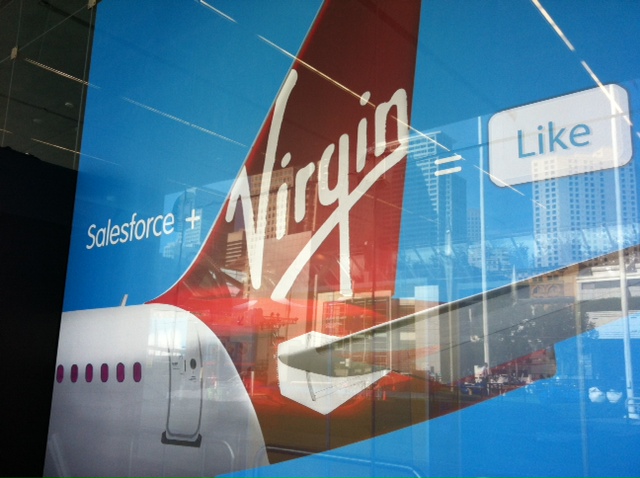
    The Virgin America Dreamforce presentation was particularly telling. Having just endured a 13 hour United Airlines flight in a plane that had been barely refurbished since 1988 it was clear that the older airline simply didn’t have the hardware to compete with the upstart even if management and staff wanted to.

    From both Dreamforce and XeroCon the message has been clear, those legacy managers who won’t invest in new technologies or re-organise their businesses to meet the realities of the 21st Century are simply doomed.

    In Australia this sense of doom in the business community is confirmed when MYOB and Google missed their target of giving away 50,000 free business websites as part of their Getting Aussie Business Online program.

    Depending on whose figures you use, between 50 and 65 percent of Australia’s 1.7 million small businesses don’t have a website – and websites are last decade’s technology.

    Business has moved onto mobile and social platforms, those 800,000 businesses who are yet to move into the new century are roadkill – the competition are just going to run over them.

    If you are still struggling with the idea of a website – let alone a mobile site, mobile phone app or social media strategy – then you haven’t bought a knife to a gunfight, you’ve bought a sharpened stick. It’s time to figure out whether you still want to be in business.

    Disclaimer: Paul travelled to XeroCon in Melbourne courtesy of Xero and to Dreamforce in San Francisco as a guest of Salesforce.com

    Similar posts:

  • Towards the social media enabled jet engine

    Towards the social media enabled jet engine

    “What if my jet engine could talk to me and what would it say?” Asked Beth Comstock, General Electric’s Chief Marketing Officer, at the Dreamforce 2012 conference.

    The idea of social media connected jet engine is strange, but the idea that a key piece of technology can talk to engineers, pilots, salespeople and management makes sense.

    At the Dreamforce conference, Salesforce.com were showing how their Chatter social communications tool can be applied to more than just salesteams, in GE’s case by giving their new GEnx engine the opportunity to talk to its support teams.

    In flight telemetry is nothing new to the aviation industry, ACARS – Aircraft Communications Addressing and Reporting Systems – have allowed airlines to monitor the performance of their aircraft over high frequency radio or satellite links during flight since 1978.

    The difference today is the sheer amount of data that can be collected and who it can be shared with. If relevant data is being shared with the right people it makes managing these complex systems far easier.

    More importantly, it helps teams collaborate. The GEnx engine is a new design that’s fitted to Boeing’s latest airlines including the troubled and late Dreamliner 787 so streamlining the design process of a new, high performance piece of technology pays dividends quickly.

    Although things can still go wrong – one wonders what the final tweet from this engine would have been.

    We’ve been talking for a long time about how social media and cloud computing services improve collaboration in a work place, the GEnx jet engine illustrates just how fundamental the changes these technologies are bringing to organisations.

    If an industrial jet engine can be using social media it begs the question why service based companies and workforces aren’t. It’s where the customers and staff are.

    These tools are radically changing the way we work right now – the question is are we, and the organisations we work for, prepared for these changes?

    Paul travelled to Dreamforce 2012 courtesy of Salesforce.com

    Similar posts:

  • Meeting the solid state Woz

    Meeting the solid state Woz

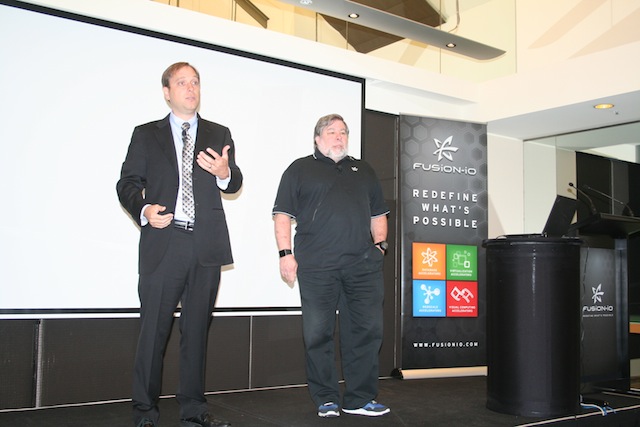
    When the opportunity comes to meet co-founder of Apple computer Steve Wozniak you jump at it, despite being jet lagged from the previous day’s flight.

    One of the tough things when writing about Steve Wozniak is that he is a fast talker. You have to be quick to keep up with his ideas and words.

    Steve was in town to show off the range of solid state computer memory cards manufactured by Fusion-iO, a company based in Salt Lake City.

    Wozniak liked the idea so much he became Fusion-iO’s chief scientist in 2009. “When I first saw the iO drive, it was so beautiful I had to buy one from the company and put it in a frame just to frame it at home.”

    What enthused Woz were Fusion-iO‘s range of NAND flash memory cards that speed up servers while reducing their power and cooling requirements.

    Those power savings are important for data centres when hundreds of thousands of servers might be in one building, Fusion-iO’s CEO and co-founder David Flynn estimates this could save up the industry a $250 billion a year in operating costs.

    Probably the biggest benefits though are in the corporate space, one Flynn’s boasts is how one movie studio used Fusion-iO’s products to reduce transcoding between formats from two hours to 39 seconds.

    Another case study they show off is how grocery chain Woolworths were able to reduce the 17 hours to run their weekly trading reports to three hours meaning they were able to capture weekend figures for their weekly Monday morning board meetings.

    For smaller businesses, the biggest benefit is these products can turn fairly basic desktop computers into workstations with the $2,500 ioFX card promising some serious post production capabilities for a system although one would expect an entry level box wouldn’t have the data connection, hard drive or – most importantly – power supply to cope with the demands of such a device would put on the typical cheap components in a basic desktop system.

    All of these changes though are heralding some pretty big changes for big and small businesses.

    Where Steve Wozniak sees the greatest application of moving data faster is in Artificial Intelligence applications like voice recognition. Apple’s Siri is a good example of this.

    The barrier to effective voice recognition is the sheer amount of data processing required to effectively understand voice commands. Doing this on cloud services is a far more efficient and effective way of doing this.

    As we saw at Dreamforce last week, the sheer amount of data pouring into companies is changing how they manage information. Getting access quickly to relevant information is an important part of managing it.

    “I’ve never gotten so excited about or fell in love with a technology like this since Apple.” Says Wozniak.

    Having a chance to speak to Steve Wozniak up close shows that fast talking enthusiasm is for real. The Woz is a real geek.

    Like all true geeks Wozniak is passionate about what he believes in – whether it’s about NAND flash cards or becoming an Australian resident he bubbles with enthusiasm. Just don’t try writing notes down while he’s in full flight.

    Similar posts:

  • Legacy people

    Legacy people

    “The problem with legacy businesses is legacy people” said David Cush, the CEO of Virgin America at the Dreamforce conference.

    For many organisations this is indeed the problem; that managements, workforces and shareholders are locked into a way of doing business that has worked for them in the past, so when change arrives they are ill-equipped to deal with it.

    One of the key take aways from the Dreamforce conference is that the rate of business change is accelerating as technologies like cloud computing and the Internet mature.

    For the legacy businesses locked into old ways this means they are going backwards faster than they could imagine.

    A good example of this is when Virgin America showed their vision of how customer service works in a connected, social world.

    The problem for companies like United and the other legacy carriers with their older aircraft and lumbering IT systems is they simply don’t have the infrastructure to provide these services if they wanted to.

    One of the characteristics of 1980s management thinking is under-investing in equipment. ‘working your assets’ by flogging them way past their replacement dates is a handy way to increase profits and management bonuses, but it leaves a business exposed when newer technologies come along.

    That’s the problem the legacy businesses, whether they are airlines, banks, telcos or in any other sector. Those who are nimble and those who have invested in new systems can take advantage of the change.

    For some of these businesses even if they had the wits, and cash, to make those investments it’s dubious whether they could make the tools work properly.

    ‘Getting it’ is more than just understanding how to turn on an iPhone or send a tweet, it’s about how these tools can be used in a business.

    If you don’t know how to use these tools, or understand the consequences of using them, then the investment is wasted.

    For those organisations who are falling behind, they have to start moving quickly or their legacy is the only trace there will be of their existence.

    Similar posts:

  • Salesforce’s place in the web’s walled gardens

    Salesforce’s place in the web’s walled gardens

    “Did he just say we’re at the half-way mark?” Whispered the ashen faced journalist beside me as Mark Benioff’s Dreamforce keynote reached the 90 minute mark.

    Benioff did and the presentation did indeed go three hours because Salesforce.com had a lot to announce with launches of new mobile apps, customer service programs and HR services.

    At the press conference later in the day, Benioff said “we are interested in collaboration and the customer. the reason we’re in marketing is because our customers want us to be in marketing.”

    An interesting part of this is the Facebook relationship, with the Buddy Media acquisition 10% of Facebook’s advertising revenue comes through  Salesforce. This in itself makes Salesforce a key Facebook partner.

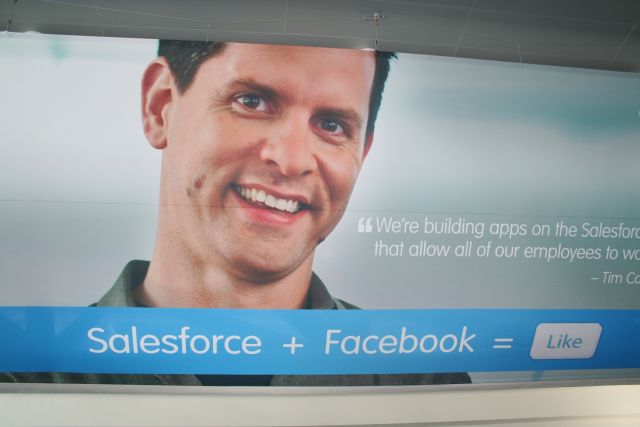
    Facebook’s relationship goes deeper with Salesforce, at the media conference Marc Benioff mentioned that the company’s purchase of Rypple came about because of urging from Tim Capos, Facebook’s CIO.

    That deep relationship was on show in the opening keynote where Facebook were one of the strategic partners showcased by Benioff.

    Of the products showcased, one of the important points that kept being raised was Salesforce’s role as the enterprise social media identity service.

    A partnership between Salesforce and Facebook to provide online identity validation would effectively kill  Eric Schmidt’s aim of Google being the Internet’s identity service although Benioff was at pains in the media conference to emphasise there was room for more than one player.

    Google are also being challenged by Benioff’s announcement of Chatterbox, a secure online file storage and sharing service.

    While the focus with the Chatterbox announcement was on the threat this presents to Dropbox and Box.net, the bigger targets are Google Drive, Apple iCloud and Microsoft’s SkyDrive.

    Salesforce’s move into the various fields of HR, marketing, file storage and collaboration are part of the company staking its own position among the various web empires.

    With a strong enterprise position, it’s quite possible Salesforce could establish itself as the fifth of the Internet’s great empires.

    Every empire needs an army and a particularly strong claim Salesforce would have are the ranks of developers and supporters gathering around the service’s open APIs.

    The move to establish an independent position on the web would also explain Benioff’s commitment to HTML5 as this avoids locking the company into an Apple, Google or Microsoft dominated app environment.

    We’ll see over time how Salesforce establishes their position among the internet empires, right now though their range of services, customer base and partner ecosystem means they are well placed to compete with the big four currently dominating the web.

    Paul travelled to the San Francisco Dreamforce conference courtesy of Salesforce.com

    Similar posts: