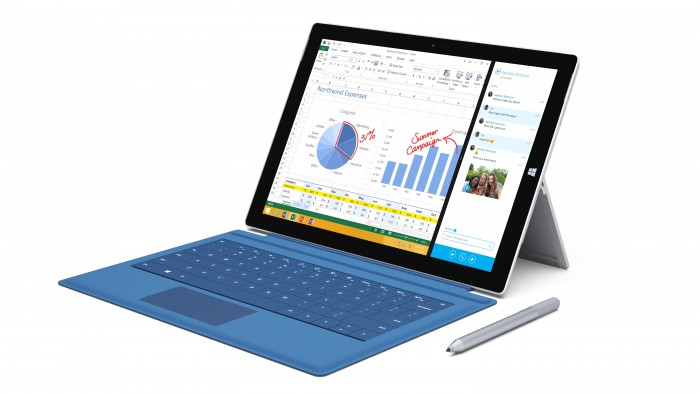
At the time Microsoft launched the second version of its Surface tablet, I suggested the company was hobbled by its reputation for taking three attempts to get things right.
This morning I had the opportunity to interview designer of the Fitbit, Gadi Amit, ahead of his visit to Sydney next month.
I’ll have the full interview written up in the next couple of days, but Gadi made an interesting point about not being in a ‘four screen world’ anymore, but in one where there’s infinite screens ranging from wearable glasses and watches through to smartphones and intelligent signage.
A few years ago the concept of the ‘third screen’ came into use when we started talking about the smartphone supplementing the PC and the TV, it quickly morphed into four screens as the tablet computer appeared.
Now the five year old idea of limiting ourselves to three screens seems quaint when there doesn’t seem to be any limits in the way we can view information.
The end of the three screen theory is an interesting illustration on how quickly technology is moving, it also shows how rapidly business is changing.
The idea of tying the product into the company’s Office 365 and Microsoft’s cloud services make sense although it might be a matter of too little, too late.
Perversely, if Office for the iPad is successful, it could remove one of the last barriers for business and power home users moving off PCs.
Microsoft’s move also shows cloud services are now the main focus of the company; Satya and his team have given up any attempt to shore up the traditional – and immensely profitable – box software business.
That is going to mean Microsoft’s financial statements are going to look very different in the near future.
Regardless of the success of Office for the iPad, what were Microsoft’s core businesses are deeply affected as the company evolves to the post-PC computer marketplace. The challenge is for Satya and his management team to manage that change.
Earlier this week Microsoft co-founder Paul Allen celebrated his Seattle Hawks winning the Super Bowl while his former business partner, Bill Gates, still struggles to escape the clutches of the software giant they founded forty years ago.
After a long drawn out process, software giant Microsoft has finally chosen its replacement for CEO Steve Ballmer however founder Bill Gates finds himself firmly trapped in the company’s orbit.
Hoodie wearing Satya Nadella‘s ascension to Microsoft CEO was probably the poorest held secret in the tech industry having been openly reported for several weeks.
Nadella has a massive task ahead of him as the industry that’s been so lucrative for Microsoft over the past thirty years evolves to deal with the post-PC era.
Microsoft CEO Satya Nadella
How Nadella manages Microsoft’s transition will define his business career and tenure at the top job, it will also determine the company’s position in a marketplace where PCs running Windows are no longer relevant.
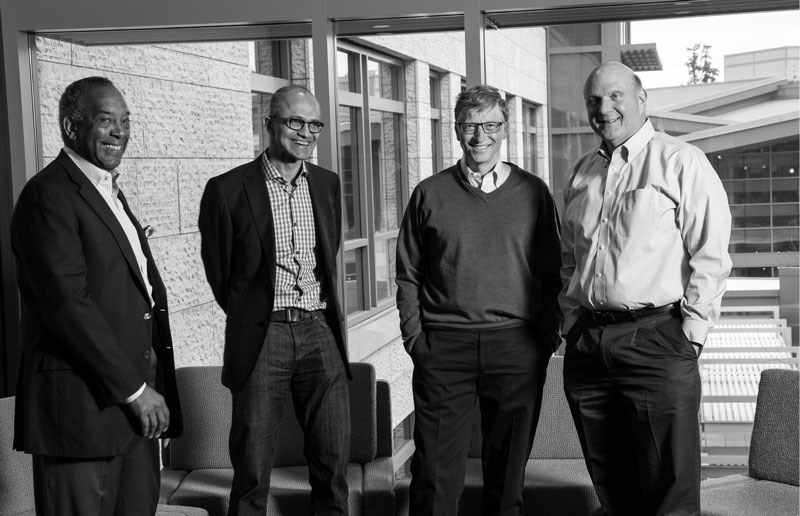
The biggest news from Microsoft’s announcement though was that Bill Gates will step down as Chairman of the Board and take a new position as ‘founder and technology advisor’.
Microsoft also announced that Bill Gates, previously Chairman of the Board of Directors, will assume a new role on the Board as Founder and Technology Advisor, and will devote more time to the company, supporting Nadella in shaping technology and product direction. John Thompson, lead independent director for the Board of Directors, will assume the role of Chairman of the Board of Directors and remain an independent director on the Board.
Despite leaving the CEO role over a decade ago, Gates finds himself back in a hands on role at the company.
The value of Bill Gates
It’s questionable what value Gates is going to add in the role of ‘Technology Advisor’ as Microsoft’s markets are very different to those the company was founded in and came to dominate in the 1980s and 90s.
For Nadella, it’s not exactly a vote of confidence from the board in appointing the company’s founder to hover over his shoulder offering helpful advice.
On a personal level this must be disappointing for the founder and former CEO as well in that his mind is on far greater topics such as eliminating malaria through the Bill and Melinda Gates Foundation.
Trapped by Microsoft’s gravity
Gates’ situation though is a classic example of a business founder who’s never been able to get out of the orbit of their business. Despite their best efforts, they keep being dragged back to give a helping hand.
Bill Gates’ dilemma though shows how tough it is for business founders to escape the gravitational pull of their creations, even when it’s as big a business as Microsoft.
Paul Allen showed how to step away from a business and is enjoying life, Bill Gates’ story though is much more typical for business founders trapped in the enterprises they built.
Jobs at the time was announcing the third breakthrough – the Apple Mac – which turned 30 last week.
Looking back over the four decades of the PC industry, Jobs’ claim that the Apple Mac was the sector’s third milestone stands up to scrutiny, however the greatest milestone of all for the PC was the launch of Window 3.0 in 1990.
The rise of Windows
Windows 3.0 changed the business model of the industry, it established software vendors – particularly Microsoft – as being dominant over hardware manufacturers, that shift nearly killed Apple and eventually sent most PC builders to the wall.
Microsoft’s advantage over Apple, IBM, Atari and dozens of other systems, was that users weren’t locked into one vendor’s products. It was possible
The Windows 3.0 milestone was even more important in that it forced a shakeout in the software industry as well, many of the incumbent vendors – most notably WordPerfect – though the Windows Graphic User Interface (GUI) was a flash in the pan and that most office workers would prefer to use keyboard instructions rather than mouse clicks.
WordPerfect was horribly, horribly wrong in judging the market and by the time they released the Windows versions of their product Microsoft had captured key market share for Word and the bundled Office suite that dominates the business world today.
Going mobile
So things were good for Microsoft until the next milestone, which again was marked by Steve Jobs, the launch of the iPhone genuinely did change the smartphone industry and was the first inkling of mobile would eventually destabilise the PC sector.
It’s interesting comparing Jobs’ iconic 2007 iPhone which sets the standard for product launches with the somewhat rough at the edges 1984 Boston presentation although both show how Steve Jobs was a master salesperson and a passionate believer in his products.
The PC’s final milestone
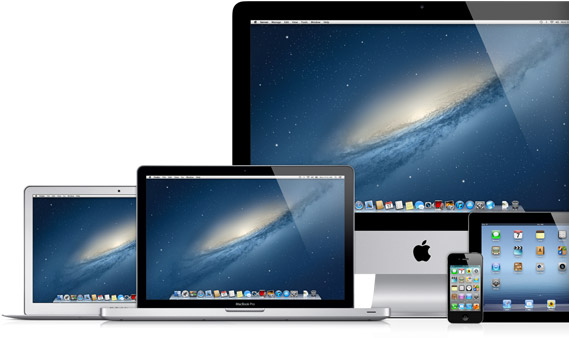
Three years later Steve Jobs delivered the milestone product that marked the beginning of the end for the PC industry, the iPad finally delivered a mobile computing device that businesses and consumers wanted.
Apple’s iPad also marked a fundamental shift in the computer industry – no longer did the software companies control the market, power had shifted back to the manufacturers.
From that moment on the PC, and Microsoft’s Windows business, started a terminal decline.
The rise and fall of the personal computer is a great illustration of a transition technology. That Steve Jobs bookmarked the beginning and the end of the PC industry is an interesting note about a technology that changed the home and workplace.