Category: Disruption

  • A tale of two business models

    A tale of two business models

    The stunning quarterly results of Apple announced yesterday compared to Microsoft’s indifferent performance illustrate how the fortunes of two different business cultures have changed.

    Apple yesterday announced a spectacular result for its quarter finishing at the end of last year with  revenues up 30%, profits by 38% and Earnings Per Share just short of fifty percent.

    The announcement was an emphatic vindication for Tim Cook and his management team who made some big bets on the larger form factor iPhone 6 which paid off spectacularly with shipments growing 46% to 74.5 million and revenue reaching $51.2 billion, over two thirds of the company’s total sales.

    One notable aspect of Apple’s success is the difference with Microsoft’s and this shows how different business cultures come in and out of fashion.

    The Triumph of the MBA

    For two decades Microsoft’s licensing business model was dominant and this confirmed the MBA view that companies should do everything they can to move design, research, manufacturing and distribution out of their operations – the virtual corporation where there was no inventory, few costs and even fewer risks was the ultimate aim of the modern manager at the turn of the century.

    Microsoft encapsulated this philosophy with its licensing model, while the company made massive sales with huge margins – as it still does – all the business risks in the computer market were carried by resellers and equipment manufacturers. For many years the markets loved this.

    Apple tinkered with the licensing model under John Sculley in the mid 1990s during Steve Jobs’ exile but was never really serious about giving away its hardware capabilities and in 2001 moved into retail with the opening of the first Apple Store.

    Coupled with the App Store, Apple have come to control the entire customer journey from marketing, design, purchase and ongoing revenue after the product is bought.

    King of the new Millennium

    While the 1980s and 90s were the time of triumph for the Microsoft model, the 2000s have been good to Apple as shown by the revenue and profit figures.

    Apple and Microsoft Revenues 2000-2014
    Apple and Microsoft Revenues 2000-2014
    Apple and Microsoft Profits 2000-2014
    Apple and Microsoft Profits 2000-2014

    The key inflection point in these charts is, of course, the iPhone’s release in 2007. Apple caught the wave of change as computer use switched from personal computers to smartphones and is now the dominant vendor.

    For Microsoft the success of Apple is bittersweet; the company had a smartphone operating system in Windows CE but it was too early to the market and the devices vendors went to market with were, at best, substandard.

    Microsoft’s failure with the smartphone was also echoed with tablet computers and exposed the licensing model’s reliance on vendors to supply and support decent products, even today Microsoft’s hardware partners struggle to release decent tablet systems.

    Cloudy on the web

    Another problem that exposed Microsoft’s weaknesses was the rise of the web where hardware and operating systems really did matter so much any more. Along with pushing out personal computer lifecycles it also had the consequence of allowing other systems into the marketplace, notably Linux and Google Android.

    With OS X, Android and Linux systems no longer hampered with the compatibility issues that irritated non-Windows users in the 1990s the market was open to adopting those systems. While the PC market has remained quite loyal to Windows, although the Apple Macs are showing serious growth as well, Microsoft’s system has barely any marketshare in other device segments except servers which are also declining as business increasingly move to cloud services.

    Apple have shown in the computing and smartphone business that controlling the hardware products is as important as supplying the software, a lesson that Microsoft now acknowledges with its restructure into a ‘Devices and Services’ company under former CEO Steve Ballmer.

    The problem for Microsoft is its margins for hardware are a fraction of its own licensing operations and weak compared to Apple’s returns. Microsoft makes 14% profit on its phone operations while the iPhone is estimated to deliver over 60%.

    Under current CEO Satya Nadella Microsoft is focusing on cloud services which also aren’t as profitable as its legacy operations but see it competing with companies like Amazon and Google who don’t boast the profits from their online operations that Apple makes from its hardware.

    Microsoft aside, the lesson Apple gives the technology is pertinent for its competitors in the smartphone space as well; companies like Samsung, LG and the army of Chinese handset vendors are going to find their markets tough unless they can take control of their software development and distribution channels – relying on Google for Android and telcos to get their phones to customers leaves them exposed in similar ways to Microsoft’s partners in the last decade.

    In the battle between business models, Apple is the current winner and shows throwing all of your business operations over the fence to partners and licensees is a risky strategy. How those lessons are applied in other sectors will test the limits of both management philosophies.

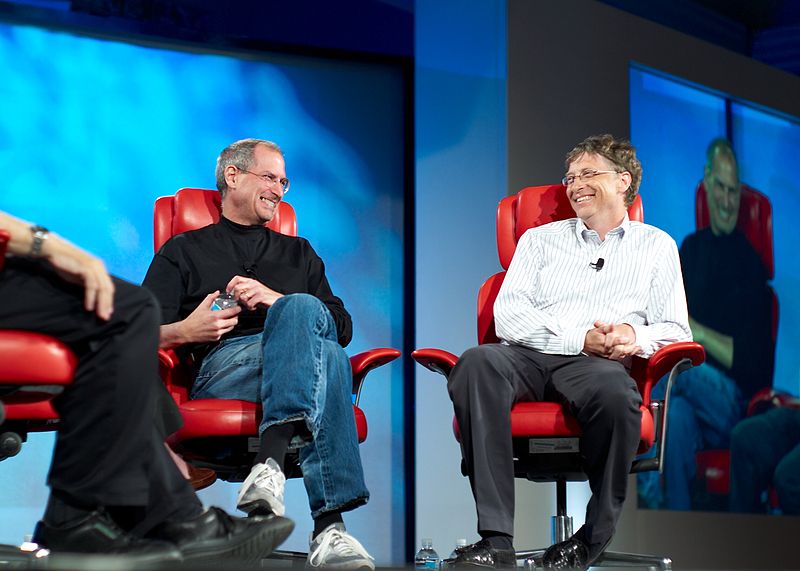
    Photo of Steve Jobs and Bill Gates by Joi Ito through Flickr

    Similar posts:

  • You can’t wait for government to lead digital change

    You can’t wait for government to lead digital change

    Last week’s events in Canberra shows business can’t wait for the government to lead industry change. If you want to keep up with technology, you’re going to have to do it yourself.

    In the wake of the Global Financial Crisis many of my business clients were in trouble as banks tightened their lines of credit and consumers slammed their wallets shut. After a decade of running businesses, it was time to get a job.

    The job I found was with the small business division of the New South Wales Government’s then Department of State and Regional Development where I quickly discovered how many companies and ‘entrepreneurs’ came looking to the government for money and leadership.

    While there were some state government support programs available for exporting, high-tech and biotech businesses almost all of those approaching the Department were hopelessly unqualified for the assistance that was at best only involved marginal amounts of money.

    The toughest part of my job was gently turning those people away without upsetting them too much. Often I failed and part of the reason for that was that many of those believed the government would take leadership in a changing digital world and fund ideas that would help the state’s and nation’s competitiveness.

    I was reminded of my brief period as a public servant and the futile attempt for  with last week’s disasters for the Australian tech sector; the Prime Minister’s claim that social media is little more than digital graffiti and the still born announcement of a Chief Transformation Officer.

    Last week’s announcement of Chief Transformation Officer who happens to have no budget – the UK office the local initiative is based upon received more than a hundred million dollars in the Brits’ last budget –  is probably the best indication of how far behind the ball Australian governments, particularly the Federal level, are in dealing with a changing economy.

    A Chief Transformation, or Digital, Officer can be an important catalyst for change but to achieve that they have to have the support of the organisation’s leadership; if the CEO or minister isn’t on board then the CTO or CDO is doomed to irrelevance.

    The Prime Minister’s blithe dismissal of social media as being digital graffiti over the weekend shows just how little support an office charged with managing the Australian government’s transition to digital services will get from the executive. The sad thing is none of the likely alternatives – on either side of politics – to the current Prime Minister seem to be any more across the changes facing governments in a connected century.

    One good example of the profound changes we’re seeing is in agriculture; this feature on farming robots shows just how technology and automation is changing life on the land. These applications of robotics are going to affect every industry, including government.

    As we’ve discussed before, if you want digital leadership then you’re going to have to provide it yourself . If you’re going to wait for the government, then times are going to overtake you. How are you facing the changes to your business and marketplace?

    Similar posts:

  • Making Chief Transformation Officers work

    Making Chief Transformation Officers work

    As the scale of technological change facing organisations becomes apparent, managements are appointing Chief Digital Officers to deal with the adjustment. Is this a good idea or just window dressing?

    Last week the Australian Federal government became the latest  administration to announce they will appoint an executive to manage the process.

    Communications Minister Malcolm Turnbull said the Digital Transformation Office will be charged to co-ordinate the adoption of online services across agencies and state governments.

    “The DTO will comprise a small team of developers, designers, researchers and content specialists working across government to develop and coordinate the delivery of digital services,” the Minister’s announcement stated. “The DTO will operate more like a start-up than a traditional government agency, focussing on end-user needs in developing digital services. ”

    Minister Turnbull hopes to emulate the UK Office of the Chief Technology Officer which was launched with the intention of delivering streamlined sign ons, simplified government websites and easier access to online services in Britain; although the experience has not been a great success so far.

    What’s notable about the UK experience is the CTO came with high level support within cabinet, which gave the agency a mandate within the public service to drive change.

    A job without a budget

    That the Australian CTO has no budget – its UK equivalent has over £58 million this year – indicates it will not have a similar mandate and will struggle to be little more than a letterhead.

    When Digital Officer do have the support of senior executives and ministers, it’s possible to achieve substantial returns. Vivek Kundra, former Chief Information Officer in the Obama administration described to me in an interview two years ago how his office had created a dashboard to monitor government IT projects.

    Kundra learned this lesson from his time as the US Government’s CIO where he built an IT Dashboard that gave projects a green, yellow or red light depending upon their status.

    Some of these government projects were ten years late and way over budget, the dashboard gave the Obama administration the information required to identify and cut over $3 billion worth of poorly performing contracts in six months.

    This is low hanging fruit that a well resourced group with the support of senior management can drive.

    Looking beyond end users

    A concern though with these CIO positions is they are only looking at part of the problem with the UK, US and Australian teams all focusing on end-users.

    While no-one should discount the need for easy to use online services for customers or government users; digital transformation has far greater effects on private and public sector organisations with all aspects of business being dramatically changed.

    In Germany a survey last year by management consultants PwC found eighty percent of manufacturers expected their supply chains would be fully digitised by the end of the decade, almost every industry can expect a similar degree of change.

    The risk for CTOs focused on how well websites work is they may find the digital transformation within their organisations turns out to be the greater challenge.

    Indeed it may well be the whole concept of Chief Transformation, or Digital, Officers is flawed as digital transformation is pervasive; it affects all aspect of business through HR and procurement to management itself.

    Passing the buck

    The great risk for organisations appointing a CTO or CDO is that other c-level executives may then believe those individuals are responsible for the effects of digital transformation on their divisions.

    While Chief Digital, or Transformation, Officers can have an important role in keeping an organisation’s board or a government aware of the opportunities and challenges in a rapidly changing world, they can’t assume the responsibilities of adapting diverse businesses or government agencies to a digital economy.

    Done well with proper resources and management buy in, a good CTO could genuinely transform a business and be a catalyst for change.

    Regardless of the responsibilities a CTO or CDO assumes within an organisation, for the role to be effective the position needs the full support of senior management and adequate resources.

    If a company or government wants to pay more than lip service to digital transformation then a poorly resourced figurehead is needed to drive change.

    Similar posts:

  • Yahoo! Directory comes to an early end

    Yahoo! Directory comes to an early end

    After twenty years the Yahoo! Directory closed down five days early reports Search Engine Land.

    The rise and and fall of Yahoo!’s core product illustrates both the volatility of the web and how the underlying dynamics of the internet has changed; at the time Yahoo! Directory was launched, we were struggling the task of keeping track of all the information being posted online.

    Even in those early days it was clear that task was becoming unmanageable and this was the problem Google set out to solve and its success destroyed the directory business along with a whole range of other industries.

    Yahoo! Directories’ demise needs to be noted by today’s web and social media giants; just as these technologies are disrupting old industries, new businesses aren’t immune to those changes.


    Similar posts:

    • No Related Posts
  • Kodak and the smartphone

    Kodak and the smartphone

    On reading the Verge’s story that UK tough smartphone company Bullitt would realease a Kodak branded phone in the new year my first though was “Aren’t Kodak out of business?”

    As it turns out Kodak are still in business having come out of Chapter 11 administration last year with the company focusing on commercial printing, cinematography and the odd bit of revenue from licensing out their name.

    Bullitt on the other hand does that licensing with their main product being a range of tough smartphones marketed under the Caterpillar name which doesn’t seem to be a bad niche given the importance of connectivity to farmers, miners and construction workers.

    It’s difficult though to see exactly what the Kodak name is going to bring to smartphones; the brand has long fallen out of favour and is irrelevant to today’s digital photographers, the only way conceivable way the Kodak name could be a selling point is if the devices offer something additional in the way of processing digital photographs or offers some advanced camera features.

    From the media release that doesn’t seem to the be the case, however in a marketplace increasingly dominated by cheap Android phones having an additional selling point is useful in locking in higher margins.

    Both Bullitt and Kodak though will both be happy for the publicity, in one way it’s good to know the brand is still around.

    Similar posts:

    • No Related Posts