Category: economy

  • How to reinvigorate a stale economy

    How to reinvigorate a stale economy

    What has gone wrong with Australian innovation? For a nation so wealthy, it’s remarkable how poorly the country performs globally in terms of bringing new products or technologies to market.

    At Ad:Tech Sydney yesterday, The Great Australian Innovation Fail panel discussed what has gone wrong and what can be done to get the nation back to a position more in line with its comparative affluence.

    Boasting a range of digital media veterans and startup founders, the panel was far from a group of muttering naysayers. Although all but Fleet Systems’ Flavia Tata Nardini were distressed at the failure of Australia’s innovation agenda and the country’s general disdain for new businesses and technologies.

    Michael Priddis, the CEO of research and development consultancy, Faethm,  pointed out that automation and artificial intelligence are not the future but the present and the job losses are happening now across industries.

    Caitlin Iles, founder of XChange, added that she believes the estimates of nearly fifty percent of Australian jobs being lost to automation are actually understating the effects and it’s more like 90% – “a doomsday statistic” – which is something that Priddis endorsed in observing how the mining industry has automated in the past decade.

    The employment shifts are being ignored by governments, says Beanstalk Factory’s Peter Bradd. “They have to get their heads out of the sand. We need to be supporting workers in threatened jobs to reskill. That’s just not happening at the moment.”

    Australia’s underperformance is stunning when you consider tech startup exits, says the Information Industry Association’s Tony Surtees. Unsurprisingly Silicon Valley dominates the global statistics with over 47% of the global value with London, Los Angeles and Tel Aviv following. Sydney was at the bottom of the table with only .01% of value.

    The value of exits is a problem, but that is more about the capitalisation of startups and may be changing. A bigger problem lies in how Australia’s corporate sector innovates and engages with new technologies.

    Corporate Australia’s failure to engage is shown in the OECD ranking the country at 81st globally in ‘innovation efficiency’, while the nation is tenth in inputs it fails dismally in applying those inputs into outputs.

    This is reflected in corporate Australia’s failure to compete globally outside the mining sector. Basically Australian executives have little desire in international markets and most have no interest in engaging with researchers, universities, innovators or entrepreneurs.

    “People don’t like to collaborate,” says Peter. “They want to keep everything to themselves.”

    “The CEOs of Australia’s top twenty companies need to get together with CSIRO and the universities and fix this problem. There’s money on the table.”

    Whether Australia’s business leaders are prepared to pick up that money, or they’re happy and comfortable with their lot is probably the question of whether Australia can start to pull its weight in the innovation stakes.

    “In ten or fifteen years we’ll be screwed if we don’t,” concludes Michael.

    Similar posts:

  • Building digital communities

    Building digital communities

    “When is the government going to build a startup hub in the Hills District?” Asked one of the audience following the Meeting The Future Head-on panel.

    The question was directed at Karen Borg, the head of Jobs for New South Wales, whose marquee program is the establishment of a startup hub in central Sydney.

    It’s not an unexpected question, placing a taxpayer funded project in the heart of the city risks raising the ire of suburban and regional voters who perceive the less advantaged areas being neglected while the rich are favoured.

    The limits of government

    Of those areas in Sydney and New South Wales, the Hills District is far from the poorest or disadvantaged at all so the question is how can an affluent community establish itself as an digital, or industry, hub.

    It’s likely the government won’t have much influence in what areas will become hubs, Silicon Valley’s success was largely an unintended by-product of massive cold war and space race spending while most other regions have been more due to the accessibility of suitable skills, raw materials and transport links.

    So the obvious answer to the question was ‘don’t wait for government’. Which leads to asking what can communities do when they want to create a digital community.

    Understand what you have

    The first step is to identify the strengths your community has. Which business are doing well and what does the region have in the way of education, major industries, logistics and communications?

    It’s hard, if not impossible, to build an industrial centre from scratch – and rather pointless if no-0ne in your community doesn’t have the skills or inclination – so knowing what you have is essential.

    Having mapped out the landscape and understood where your community’s strengths lie it’s time to start talking.

    Get everyone talking

    Once you understand who are the leaders, who has the skills and who has the capital in your community, it’s time to get them talking.

    A key lesson in setting up the Digital Sydney initiative was that many of the groups didn’t know of the others’ existence so one of the key aims of the project was to let the industry find out about each other.

    Stimulating the growth of local networks is probably the easiest things a community can do to build a local industry hub.

    Find a focal point

    Having a place to get together helps build that community, this is where local governments and chambers of commerce can come into play.

    Bringing the broader business community into the conversation has the benefit of widening the base and getting local services companies – the web designers, accountants, lawyers, etc – into the emerging sector which in turn grows the ecosystem.

    That focal point doesn’t have to be a massive startup or innovation hub like the Jobs for NSW project, it could be a regular event like a coffee morning, Friday drinks or a business drop in centre.

    Engage the stakeholders

    While governments can’t create these ecosystems, they can help. How San Francisco attracted the tech community into the city from Silicon Valley and London’s support of Silicon Roundabout are good examples.

    London’s startup renaissance is an interesting case study in itself with many attributing Google’s Campus as being the catalyst for the sector’s growth.

    At a local level providing an environment for collaboration and starting businesses – such as rate relief, space for events or resource centres – can help while at the the state and national level education and long term industry policies will help.

    The corporate and academic sectors are important too, both with investment, skills development and supporting growth sectors.

    Don’t wait for government

    By definition governments are risk averse, which is not a bad thing as they are spending taxpayers’ funds, which means they are unlikely to lead these projects. As a consequence it’s up to the business community to develop the local ecosystem.

    Once there are successes and a public profile, governments will follow. Often though that support will be late and misdirected.

    Ultimately, it comes down to the community itself being what it wants to be – it’s up to the community to create the environment that encourages growth in whatever sector they think is right.

    So stop waiting for government and start talking with your local business and community leaders about what they think are your region’s strength and vision.

    Similar posts:

  • Futureproofing your business

    Futureproofing your business

    As part of the Meeting the The Future Head-on event in Sydney tonight I thought it may be worthwhile to list down the key points I’ll be making about future proofing businesses in these times of change.

    Reading the Jobs for NSW report, it’s telling that 70% of the state’s jobs are in inward facing industries and for the main part they are losing competitiveness. That leaves them exposed to international competition and automation.

    It’s easy think that many domestic services business – which make up the bulk of Australia’s small business sector – are immune from competition but the example of how Uber has upended the taxi industry is an example of how even the most protected sectors are still vulnerable.

    Focus on the customer

    Over the last twenty years Australia has sleep-walked into becoming a high cost economy and most Australians still seem in denial about just cripplingly expensive the country has become.

    Four years ago this blog posted on how Sydney was only second to Zurich as the most costly place in the world to base a startup.

    There’s nothing wrong about being as expensive as Switzerland or Germany or Japan, but to compete globally it means offering high value goods and services. The easiest way for a smaller or high growth business to do that is to focus on providing stellar customer service.

    Being better than the bloke next door is not good enough, that service has to compare with the best in the world in your sector.

    Keep the business lean

    Yesterday’s post looked at how corporations are outsourcing, the same applies to smaller businesses. Anything that doesn’t directly involve customers should be outsourced or automated.

    For smaller businesses, shifting to modern payment, banking and accounting systems is relatively straightforward and setting up automation within those applications is easy.

    Similarly any employment should be virtual unless it is directly involved in serving, supporting or selling to customers.

    Adapt quickly

    Not only is it important to keep the business lean financially but also in mindset. In recent years the tech startup community has adopted the Lean methodology and adapted it to their much volatile world.

    That startup thinking is useful for non-tech businesses as it encourages a company to be far more responsive to market or economic shifts along with identifying product lines or ideas that aren’t performing.

    Invest in the business

    One of the biggest weakness for Australian businesses of all sizes is they are undercapitalised – even the biggest businesses tend not to retain profits and give them back as dividends to shareholders.

    From a small business perspective this is understandable as the high cost of living in Australia means proprietors have to pull out an income to pay their million dollar mortgages in Sydney and Melbourne.

    However what this does mean is that businesses are chronically undercapitalised resulting in them not spending enough on equipment, technology or staff training.

    If you’re making a profit, try to put as much back into the business as possible and if you need more find an investor who shares your vision for the venture.

    Looking global

    Probably the most depressing thing about Australia in 2017 is just how insular the nation’s economy has become in the last twenty years. In New South Wales export related jobs have fallen from 32% of the overall workforce to 29% and the slight growth in tradeable services is entirely due to the education sector.

    Even if there’s no intention to export, understanding the global trends and benchmarking performance against international leaders is one of the best safeguards for a business wanting to survive over the next twenty years.

    Similar posts:

  • Confessions of a corporate axe man

    Confessions of a corporate axe man

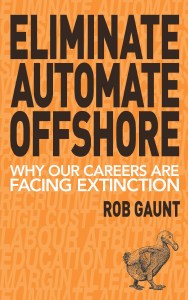
    What does the future of work really look like? Management consultant Rob Gaunt has some bad new for those looking forward to a future of leisure.

    In his book Eliminate, Automate, Offshore; Gaunt looks at how the modern workplace is changing and the priorities of managements and boards in a competitive, globalised world.

    Gaunt, who describes himself as a ‘corporate axe man’ warns the reader “you may not approve or like what I do, but that doesn’t mean it isn’t going to happen.”

    To start the book, Gaunt gives a potted history of automation in the workforce and how processes can be improved by better management and new technology. He cites his local council garbage collection service which not so long ago would have required eight or nine workers per truck now only needing two.

    This trend is coming to the rest of the workforce, Gaunt warns, adding that many of those jobs that can’t be automated can be outsourced.

    “When I walk into an open plan office, I look and listen to the activity; if the overwhelming noise is of keyboard strokes rather than human voices, it’s a good clue that much of the functions being performed aren’t location dependent.”

    Gaunt goes on to describe how effective outsourcing works with an emphasis on the client having to document their processes before shifting functions or departments to outside contractors as well as the importance of properly scoping and understanding an agreement.

    Towards the end of the book, Gaunt examines what roles are likely to survive in higher cost economies along with the skills today’s children are going to need if they are going to avoid being ‘digital roadkill’ in an automated society.

    Overall the book is a good read to understand the direction of today’s workforce and the factors driving it. It isn’t a pretty tale.

    If anything; Eliminate, Automate, Offshore may be somewhat optimistic about the effects on the skilled trades, professional and managerial sectors as Gaunt probably underestimates how robotics and artificial intelligence are advancing.

    Should you read the book, you may want to give your kids – and their teachers – a good talking too. The axe man is ruthless and he’s coming for many of our jobs.

    Similar posts:

  • Avoiding a neo-feudal future

    Avoiding a neo-feudal future

    “Neo liberalism is dead” was Paul Mason’s opening for his talk ‘Will Robots Kill Capitalism?’ At Sydney university on Monday night.

    Mason, who was promoting his book ‘Postcapitalism: A Guide to Our Future’ was exploring how we create an alternative to the failing neo-liberal world while avoiding the failings of the past.

    Describing the current ennui towards establishment politics as being “the biggest change since the fall of the wall in 1989,” Mason believes that the neo-Liberal, pro-markets, view of the world is now failing because the general population increasingly can’t afford the credit which powers the current system.

    Increasing voter hostility

    With increased insecurity the general population’s hostility towards the global elites is only going to increase, Mason says, as a low work future is traps people into low income ‘bullshit jobs’.

    Mason describes a bullshit job as being something like the hand car washes that have popped up around UK (and Australia) where workers are paid the absolute minimum to provide a service cheaper than any machine.

    With bullshit jobs, it’s hard not to consider the white collar equivalent – just yesterday The Guardian, which Mason writes for – described a report by UK think tank Reform which suggested 90% of British public service jobs could be replaced by chatbots and artificial intelligence.

    It’s easy to see those same technologies being employed in the private sector as well with middle management and occupations like Human Resources and internal communications being easily automated out by much flatter organisations.

    A low work future

    The result of that, which we’re already seeing, is increasingly profitable corporations that barely employ anyone.

    However for companies like Google, Facebook and Apple those business models also present risks as they are valued by the market far beyond any reasonable expectation of return – even if they do manage to eat each other.

    Another risk to today’s tech behemoths is the commoditization of many of their industries. “Not all of the high tech economy will be a high value economy.” Mason point out, going on to observe that Google may have recognised this in carrying out their Alphabet restructure.

    The neoliberal Anglos

    Not all countries though have followed the Anglo Saxon neo-liberal model over the past forty years though. In what Mason describes as “The yin and yang of globalIzation,” he point out China, Germany, Japan and South Korea Have focused on production and raising living standards while the English speaking nations enforced austerity on their populations with large groups being left behind both socially and economically.

    Which leads to Mason’s key question, “will the low work future see neoliberalism replaced by ‘neo-feudalism’ or something more enlightened?”

    To support the latter, Mason suggests a transition path into the ‘low work future with the following features;

    • automation
    • basic income
    • state provided cheap, basic goods
    • externalising the public good
    • attacking rent seeking
    • promoting the circular economy
    • investing in renewable energy

    That list seems problematic, and at best hopelessly idealistic, in today’s economies – particularly in the neoliberal Anglosphere.

    A need for new mechanisms

    Mason’s points though are important to consider if we are facing a ‘low work’ society as there has to be some mechanisms to allow citizens a decent standard of living even if the bulk of the population is unemployed.

    Even if we aren’t facing a low work future, the transition effects we’re currently experiencing where many of today’s jobs are going to be automated away threaten serious political and economic dislocation in the short to medium term.

    What Mason reminds us is that the political and economic status quos can’t be maintained in the face of dramatic technological change. We have to consider how we’re going to manage today’s transformations so we don’t end up in a neo-feudal society with the discontent that will entail.


    Similar posts: