Category: economy

  • InfoSec’s looming labor shortage

    InfoSec’s looming labor shortage

    For the last few days I’ve been reading Cisco’s 2014 annual security report and trying to decide exactly which parts are suitable for this site, Networked Globe and the various other outlets I write for.

    One of concerns Cisco raises in their study is the labor problem facing the information security (InfoSec) community with a shortage of a million workers this year.

    Even when budgets are generous, CISOs (Chief Information Security Officers) struggle to hire people with up-to-date security skills. It’s estimated that by 2014, the industry will still be short more than a million security professionals across the globe. Also in short supply are security professionals with data science skills—understanding and analyzing security data can help improve alignment with business objectives.

    “There are essential a million jobs across the globe that can be filled but we don’t have trained people to fill them,” Cisco’s Chief Security Officer John Stewart told a media conference yesterday. “We’ve got a dearth of talent and skills.”

    As governments tighten up laws on liability for data breaches and privacy lapses a lot of businesses will be fighting to find people with the right skills to fix their problems or help them manage various technology and security risks.

    So if you have a teenager moping around the house wondering what to do for a job, or you’re looking for a career change, becoming an IT security expert might be the answer.

    Just as we see many jobs disappear in the face of technological change, we see new ones appear. This is a good example.

    Similar posts:

  • Digital vagrancy

    Digital vagrancy

    One of the joys of writing on and analysing trends IT industry trends is the never ending source of buzzwords and phrases that vendors invent.

    Today is a good day with a release from security software vendor AVG coining the term ‘Digital Vagrant’.

    Underlying the idea of digital vagrancy is an abandoned underclass who, overwhelmed by technology, are ignored and neglected in a connected society. As the AVG media release describes;

    Users who are left behind to wander around in an online world that largely ignores them are nothing more than the digital equivalent of vagrants – people who are left to cope in a world that has become too overwhelming.

    ‘Digital Vagrant’ joins other wonderful ‘digital’ labels; digital immigrant, digital native and digital sharecropper come to mind.

    It’s tempting to think that digital vagrancy is what eventually happens to poor exploited digital sharecroppers – those who’ve donated their free labour to help the likes of Mia Freedman, Chris Anderson and Ariana Huffington to build their media empires.

    Should that be the case, there’s going to be many digital vagrants.

    On more serious note, AVG does have a point in that both individuals and businesses that scorn technology risk being left behind in society that’s becoming increasingly connected.

    Society and business are going through a change similar to that of a century ago where the motor car, trucks and tractors radically changed industries and the economy.

    Those farmers and businesspeople who stuck with horse drawn equipment slowly became irrelevant and went broke.

    A similar process is happening now as a new wave of technology is changing business and society.

    The question for all of us is do we want to be left behind in a connected society?

    Beggar image courtesy of apujol through sxc.hu

    Similar posts:

  • Peak employment and the political challenge

    Peak employment and the political challenge

    This week’s edition of The Economist asks about the Future of Employment and where the jobs are in a society where work is increasingly done by machines.

    For the Economist the conclusion is that the future of employment is ‘complex’ and observes economists and politicians haven’t given enough thought to the effects of the changing workplace and the dislocation of many workers.

    Much of the Economist’s story is based around the ideas of professors at MIT Erik Brynjolfsson and Andrew McAfee in their upcoming book “The Second Machine Age”.

    The race with the machines

    Professor Brynjolfsson gives his view at TED 2013 in the key to growth? Race with the machines, a presentation countered by Robert Gordon in the ‘death of innovation, the end of growth’ and followed by an excellent debate between the two.

    Brynjolfsson cites the dilemma of bookkeepers being displaced by software applications such as Intuit Turbotax as an example of where service sector staff are being displaced.

    “How can a skilled worker compete with a $39 piece of software?” Brynjolfsson asks.

    “She can’t. Today millions of Americans do have cheaper, faster, more accurate tax preparations and the founders of Intuit have done very well for themselves. But 17% of tax preparers no longer have jobs.

    “That is a microcosm of what’s happening not just in software and services, but in media and music, in finance, manufacturing, in retailing and trade. In short, in every industry.”

    The great decoupling

    Brynjolfsson’s key point is that workers’ wages have been decoupled from productivity and that the workforce isn’t sharing the rewards of improved practices and increased wealth.

    That is certainly true over the last forty years, however that may not be a technological effect, but the business consequences of liberalising the financial sector which has seen massive pay increases to the banking industry and managerial classes that has been way out of kilter with the rest of the workforce.

    It may well be the current golden era of high executive salaries is a transition effect of an evolving economy, albeit one where our grandchildren will puzzle over an era where a failed executive can receive a $100 million payout on being fired.

    As The Economist points out technological change itself tends to create new jobs that make up for those displaced in old industries, this is a view supported by GE’s Chief Economist Marco Annunziata.

    The main problem that Brynjolfsson identifies is the medium term issue of dislocated workers finding themselves out of work with superseded skills and, as The Economist point out, it’s clear the developed world’s political leaders haven’t though through the consequences of that transition.

    In almost every sense, the current crisis of confidence about employment prospects is more a political and social problem rather than technological.

    Helping displaced workers is going to be the greatest challenge for today’s generation of business and political leaders, the real question is are they up to that task?

    Similar posts:

  • Regional pains – what happens to communities when industries close?

    Regional pains – what happens to communities when industries close?

    Yesterday’s post on Chobani Yoghurt rescuing a town in Upper New York state raises some questions about what happens when a major industry leaves.

    For South Edemston, the question went unanswered as Hamdi Ulukaya and Chobani saved the day, but other towns haven’t been so lucky.

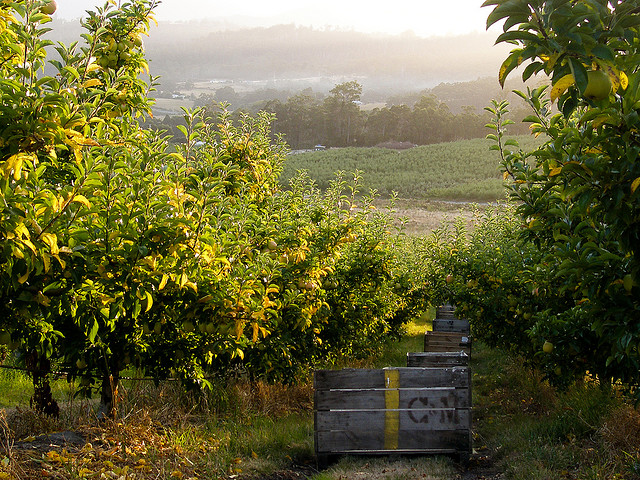
    Australia’s Goulburn Valley, about a hundred miles north east of Melbourne, may be about to find out as the main local fruit cannery will close down unless the state and Federal governments each contribute $25 million to an investment plan.

    Closing the region’s major cannery will have dire consequences for the local economy as the industry has been a major customer for the local fruit industry. Without the cannery, many of those peach, pear and apple growers have nowhere to sell their produce.

    Already farmers are bulldozing their trees and grubbing up the roots as the market works against them.

    So what happens to the Goulburn Valley if the canning industry leaves? Do the orchards get turned over to goats?

    There is a precedent in Australia for this, in Tasmania the ‘Apple Isle’ has seen its orchard industry steadily decline from the days of peak production in 1964.

    A touching story in The Griffith Review by Moya Fyfe, the daughter a former Tasmanian apple farmer, describes when her father’s orchards were ripped up.

    So in the winter of 1974, his life’s work, and that of his father, was bulldozed into windrows of gnarled stumps and roots. Acre after acre of once productive apple trees, captured in a photograph hanging on my parents’ dining room wall as picture-book hills awash with blossoms above North West Bay, were twisted and torn from the ground and left in undignified heaps to rot.

    Moya’s father was given an exit package – a cash payment to find something else to do – by the state government. Something that many agricultural communities around the world have become familiar with.

    The problem for Tasmanians was that there wasn’t really much else to do. At the time Moya’s farm was ripped up there was a belief the state would become an industrial powerhouse on the back of cheap hydroelectricity, but that never happened.

    Tasmania’s economy continues to struggle and Moya’s article was part of a Griffith Review edition focusing on the state’s struggles.

    The most pubilicised essay was a scathing analysis of the state’s culture by Professor Johnathan West, who identified the real problem for Tasmania as being a dependency mindset.

    These numbers suggest that as little as a quarter to a third of Tasmanian households derive their livelihood from the genuine private sector. Of them perhaps a third gain their income from wholesale and retail trade and associated logistics, another third from residential and commercial construction and maintenance. The clients of both these groups depend largely on public-sector incomes, leaving only about 10 per cent of all households making a living from the traded private sector.

    Interestingly both Johnathan West and Moya Fyfe are employed by the University of Tasmania, which probably proves the Professor’s point.

    Overall Tasmania relies upon Federal government funds to survive, receiving over $1.50 in payments for ever dollar remitted in taxes; in that it joins half of Australia’s states and territories in being economically dependent on the Federal taxpayer.

    That’s not a good sign for the Goulburn Valley or for the state of Victoria which increasingly is appearing to be to Australia what Spain was to the European Union circa 2007 or Miami to the US in 1927. When the Melbourne property market pops, the region could be in deep trouble.

    For much of regional Australia – like disadvantaged parts of the European Union or the United States – communities have become dependent on transfers from the central government, the sustainability of that is being tested now.

    It may well be that South Edmenson’s experience with Chobani illustrates the most sustainable way governments can support these regions, attracting entrepreneurs and new industries into communities that are being left behind is far better than leaving them on welfare.

    Image courtesy of elcapitain through Flickr

    Similar posts:
  • Chinese earthmovers move up the value chain

    Chinese earthmovers move up the value chain

    After yesterday’s post on the motor industry’s relevance in the 21st Century, a related article about Chinese construction equipment appeared in The Economist.

    According to CLSA – formerly Credit Lyonnais Securities Asia and itself now fully owned by Chinese investment house CITIC – the quality of Chinese construction plant is rapidly approaching that of the Japanese and US industry leaders.

    The Chinese have achieved this in a short period through a combination of joint ventures and strategic takeovers and that should worry its more established competitors.

    How the Chinese have moved up the value chain in construction plant is a small, but important example, of how the country is positioning itself as a higher level producer as its economy and workforce matures.

    For trading partners and competitors it’s worthwhile thinking how a more affluent and higher tech China is going to affect their businesses, thinking of China as just a cheap source of low quality labour isn’t going to cut it for much longer.

    Similar posts: