Category: economy

  • A geek’s tour of Barcelona

    A geek’s tour of Barcelona

    Spain and Barcelona have faced challenges in recent years as the economy was hit hard by the 2008 crisis. Now the city is looking to the internet for the next wave of prosperity.

    This quest for reinvention isn’t new for the city, “Barcelona used to be an industrial city, that was badly hit by the economic crisis of the seventies,” said Deputy Mayor Antoni Vives. “There were some guys in the city at the time that decided that we had to keep on being an important city.”

    “There’s a new generation of politicians, civil servants, of thinkers and people committed to the city that ten years ago started to work on a new phase of what the city was to become.”

    Antoni Vives - Deputy Mayor of Barcelona
    Antoni Vives – Deputy Mayor of Barcelona

    “We decided that Barcelona had to become the edgiest city in the world related to the new revolution and the new revolution was this one — the technology related to mobility, devices and mainly the internet.”

    That vision resulted in Barcelona starting to rewire the city which was one of the reasons for Cisco choosing the city as the venue for its inaugural Internet of Things World Forum.

    As part of the event, the City took delegates on tours of some of the connected infrastructure the city has installed. Here’s what we learned on the press tour.

    The digital bus stop

    Digital bus stop
    Digital bus stop

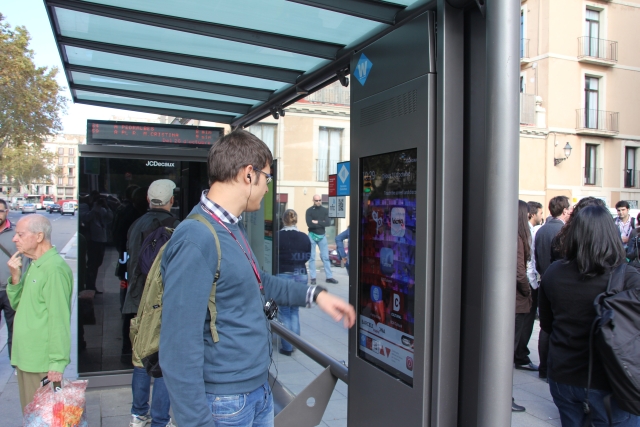
    The digital bus stop is one of the prides of Barcelona, not only does it display digital advertising and real time bus schedules it also offers tourist information, USB charging sockets and acts as a free WiFi base station.

    One of the barriers Barcelona has encountered has been the Spanish telecoms regulators objection to the city providing municipal WiFi so services are restricted to the city’s property, which happens to include bus stops.

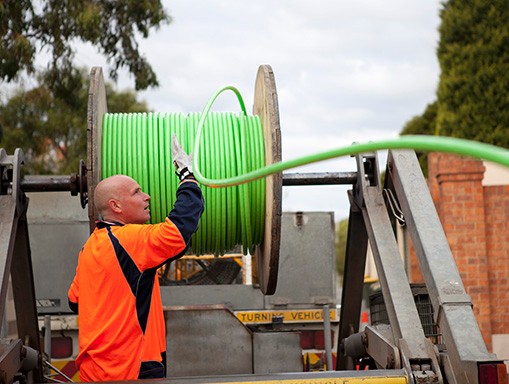
    The bus stops themselves are connected to the city’s fibre network that runs most of the backhaul and connects many of the fixed devices.

    Smart parking spots

    Smart parking space
    Smart parking space

    Connected to the city’s WiFi network are these smart parking spaces that detect the presence of cars through a combination of light and metal detectors.

    The city’s plan is that payment and monitoring of the smart parking spots will happen online and with smartphone apps.

    Powering the dot, which is a fairly dumb device, is a battery with an expected five to seven year lifespan. Interestingly, the dots don’t work with motorcycles.

    One of the reporters on the tour questioned the durability of these devices given Barcelona doesn’t get extreme temperatures, the response from the Cisco and city staff indicates that ice or hot weather may shorten the lifespan of these devices.

    Smart lighting and monitoring

    Smart lights and monitors
    Smart lights and monitors

    In the square outside the Born Cultural Centre, the city has installed a row of streetlights with multiple features including CCTV, air monitoring and Wifi. All of these lights are connected to the city’s 500Km long undeground fibre network.

    The fibre network itself is being installed progressively as the city carries out routine maintenance to roads and other underground services. By co-ordinating the work with other trades it reduces the installation cost dramatically.

    Smart censors in the street lights
    Smart censors in the street lights

    Smart rubbish bins


    Smart rubbish bins in Barcelona
    Smart rubbish bins in Barcelona

    The connected garbage bins are one of the showpieces of the city’s services. By monitoring trash levels, the council’s sanitation team can plot the optimal routes for collection services.

    Smart rubbish bins sensor
    Smart rubbish bins sensor

    Again the sensors on the bins are fairly dumb devices that connect wirelessly to a base station, shown on the pole above the bins in the earlier photo, these track rubbish levels and later versions are expected to detect the presence of obnoxious or hazardous materials that might be dumped in the bin.

    Single person operation of the connected garbage truck
    Single person operation of the connected garbage truck

    Operators of the garbage trucks get real time updates to their routes which optimises their productivity. It’s cost savings in the city’s operations which is one of the key drivers for the city’s investment in these technologies.

    Power savings

    Smart lighting systems
    Smart lighting systems

    One of the major cost savings identified by the Barcelona Council is in energy costs. Along with the expense of running garbage trucks unnecessarily are power bills.

    Part of the smart lighting system is that it will dim when there’s no motion detected in the streets and lighten when pedestrians are around. This is intended to save money and help the city meet it’s zero carbon emission targets.

    Barcelona and the future

    Every single one of the technologies being shown today in Barcelona will be commonplace in most developed cities in the near future.

    The problem for adopting these systems is going to be connectivity, in places where there aren’t the fibre optic services or easily deployed WiFi it will be difficult to install smart devices and monitor them.

    Every major city is going to be facing the question of how they deploy these devices over the next decade as their residents expect better and more efficient service. Barcelona has taken the first steps that most others will follow.

    Similar posts:

    • No Related Posts
  • Finding the smart money

    Finding the smart money

    Around the world startup communities are working to connect with local investors, in Sydney and London two groups are showing how it is done.

    “We’re looking at turning idle money into start money,” is the aim of Sydney AngelEd says one of its founders, Ian Gardner.

    Fitting startup companies’ capital needs into the established criteria of investment managers is an ongoing problem that AngelEd’s founders want to resolve. “We see startups becoming an asset class,” says Gardiner.

    AngelEd, to be held on November 7, aims to educate high wealth investors and asset managers on understand the risk, benefits and hype around angel investment, particularly in tech companies.

    The global search for funds

    Startups around the world are struggling to engage with investors – in London, the local tech community has set up City Meets Tech to introduce British investors to high growth companies.

    London should have an advantage in this field given its leading role in the global finance industry, however the challenge for the tech community is to find financiers who are prepared to accept higher levels of risk than mainstream investments.

    “The City is generally risk adverse and doesn’t understand tech and tech start-ups,” says the City Meets Tech website, “though really it’s about understanding the business and managing risk though unfortunately innovation requires at least some risk.”

    Australia’s trillion dollar superannuation system should similarly give Sydney an opportunity that to become a global centre however it suffers from a similar, if not worse, conservative investment culture to London’s.

    Turning Sydney into a global finance centre has been an objective successive state and Federal governments for twenty years but the sleepy, comfortable and risk averse culture of Australian fund managers offers little to attract foreign investors or companies.

    Much of Australia’s is problem is the insular nature of local fund managers with all but a tiny part of the nation’s retirement savings being put into the top local stocks, listed property funds or domestic infrastructure projects that are notable for their lousy returns and extortionate management fees.

    Breaking that mentality is going to be the key to both AngelEd and the Sydney’s success as a financial centre.’

    Competing with the world

    While London and Sydney are struggling with the challenges of encouraging investors into the high growth sectors, cities like Singapore and New York are developing investor communities that are attracting entrepreneurs to their cities.

    Many governments dream of being the next Silicon Valley and while it isn’t likely anyone can recreate the circumstances that led to Northern California becoming the computer industry’s world centre , a vibrant and accessible capital market will be necessary for any place hoping to be a global cnetre.

    For Sydney and London, the success of initiatives like AngelEd and City Meets Tech may be critical for both centres’ future in the global digital economy.

    Similar posts:

  • What if you built a broadband network and nobody used it?

    What if you built a broadband network and nobody used it?

    The assertion that internet connectivity drives economic growth is largely taken for granted although getting the maximum benefit from a broadband network investment may require more than stringing fibre cables or building wireless base stations.

    A key document that supports the link between economic growth and broadband penetration is the International Telecommunication Union’s 2012 Impact of Broadband on the Economy report.

    While the reports authors aren’t wholly convinced of the direct links between economic growth and broadband penetration, they do see a clear correlation between the two factors.

    ITU Impact of broadband on the economy report 2012
    ITU Impact of broadband on the economy report 2012

    One of the areas that disturbed the ITU report editors were the business, government and cultural attitudes towards innovation.

    The economic impact of broadband is higher when promotion of the technology is combined with stimulus of innovative businesses that are tied to new applications. In other words, the impact of broadband is neither automatic nor homogeneous across the economic system.

    For South Korea, internet innovation is a problem as the New York Times reports. Restrictions on mapping technologies, curfews on school age children and the requirement for all South Koreans to use their real names on the net are all cited as factors in stifling local innovation.

    In reading the New York Times article, it’s hard not to suspect the South Korean government is engaging in some digital protectionism, which is ironic seeing the benefits the country has reaped from globalised manufacturing over the last thirty years.

    The problem for South Korea is that rolling out high speed broadband networks are of little use if local laws, culture or business practices impede adoption of the services. It’s as if the US or Germany built their high speed roads but insisted that cars have a flag waver walking in front of them.

    Indeed it may well be that South Korea’s broadband networks are as useful to economic growth as Pyongyang’s broad boulevards just over the border.

    Similar problems face other countries with Google’s high speed broadband network in the US so far not attracting the expected business take up and innovation, although it is early days yet and there are some encouraging signs among the Kansas City startup community.

    In Australia, the troubled National Broadband Network has struggled to articulate the business uses for the service beyond 1990s mantras about remote workplaces and telehealth – much of the reason for that has been the failure of Australian businesses to think about how broadband can change their industries.

    Like Japan’s bridges to nowhere, big infrastructure projects look good but the poorly planned ones – particularly those no-one knows how to use – are a spectacular waste of money.

    Hopefully the fibre networks being rolled out won’t be a waste of money, but unless industries start using the web properly then much of the investment will be wasted.

    Similar posts:

    • No Related Posts
  • Finding a role for Hong Kong in the China story

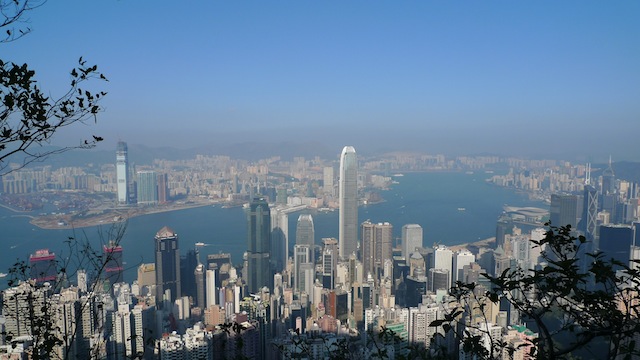
    Finding a role for Hong Kong in the China story

    The Chinese government’s declaration of a Shanghai Free Trade Zone recently made headlines with speculation the region might be exempt from the nation’s internet blocks.

    For Hong Kong, the Chinese government’s move is another blow to the territory’s already declining position as the main gateway to the People’s Republic.

    As part of the Decoding The New Economy series of interviews, I spoke to Brian Wong of Hong Kong’s Seacliffe Partners about the challenges facing the territory and the role the former British colony will play over the next few decades.

    “Hong Kong, I think, is the perfect bridge between East and West, ” says Brian. “But I think Hong Kong has been in search since the change over in 1997 as to where it really wants to focus itself.

    The territory is squeezed between Singapore that has established itself Asia’s leading financial hub and now is positioning itself as a creative centre and Shanghai which has become the new ‘Gateway to China’ with its domestic financial centre and deep water port.

    Despite the challenges facing the Territory, Brian sees opportunities in the city’s cultural and business environments.

    “One of the great things about Hong Kong still is its international community and its accessibility for creative types,” Brian says. “I think Hong Kong is starting to recognise this advantage.”

    “You have a large base of Chinese based manufacturers looking to beyond just low cost OEM manufacturing, what they need is creative design and innovation. If Hong Kong can be one of the big suppliers of that then they have a really good opportunity.”

    One area Brian sees Hong Kong has an advantage is in its developing a hardware hackers culture that fits in with the massive manufacturing hubs surrounding the territory along the southern Chinese coast.

    “I went to a talk where there was a fellow from Mountain View, California who does a lot of product invention,” Brian tells. “He’s set up a lab in Hong Kong to do product innovation because although he recognises China has a low cost manufacturing base, he doesn’t want to live in Shenzhen.”

    The challenge for Hong Kong is to encourage a more entrepreneurial mindset, Brian believes. He also sees Hong Kong having an opportunity in being a conduit for the Chinese diaspora looking at investing into the PRC.

    Probably the biggest advantage Brian sees Hong Kong having are in its mature legal and capital markets that Shanghai and other Chinese centres lack – “these are world class,” he asserts.

    Ultimately though it may be that Shanghai, Beijing, Taipei or Singapore aren’t threats to Hong Kong at all as each city becomes the centre of certain aspects of a diverse Chinese and East Asian economy.

    “I think much like in the United States there is not just one financial centre – you’ve got Chicago, New York and you’ve got different roles for different cities, LA for media and San Francisco as the gateway into the United States.”

    “There’s room for more than just one. The question is what does Hong Kong want to be and how does it want to be most valuable to the China story.”

    Similar posts:

  • Globalisation with Chinese Characteristics

    Globalisation with Chinese Characteristics

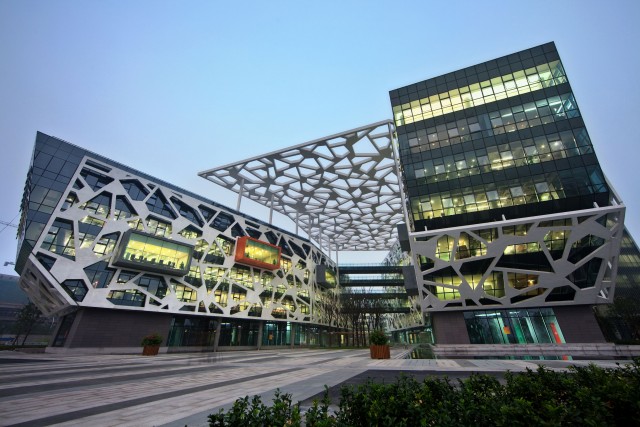
    “eBay is a shark in ocean, Alibaba is a crocodile in the Yangtze” film maker Porter Erisman quotes the founder of Alibaba, Jack Ma, in comparing the two online trading sites.

    In promoting his film Crocodile in the Yangtze, Porter spoke to Decoding the New Economy about the rise of the global Chinese internet giant.

    A key part in Alibaba’s success is taking on eBay on it’s own turf, “if you’re David fighting Goliath you can’t play by the big guy’s rules,” Porter says.

    This is exactly what the Chinese company did when eBay entered their market and today Alibaba and it’s subsidiary Taobao have sales exceeding eBay’s and Amazon’s.

    “Back in about 2003 Jack Ma came to me and told me about a secret project to overtake eBay,” Porter says. “When we looked at them they looked like a Goliath, they’d never really been beaten in a market they’d entered first and they had a huge war chest with a $150 million committed to the China market.”

    It turned out that eBay weren’t as powerful as they appeared, something other entrepreneurs have discovered when giants like Google have entered their markets.

    The Chinese Leapfrog

    Like many rapidly developing countries, China is leapfrogging various stages of development that Western economies went through with the retail industry and e-commerce being two examples.

    “Some people say cellphones will leapfrog landlines, actually the same is due with entire systems,” says Porter. “In China coming from so many years of a command economy there wasn’t a very developed retail culture or even a consumer culture.”

    “Taobao came along at a time when all of that was still in the early phases of development and the company basically leapfrogged that whole phase of building out shopfronts and building logistics.”

    “E-commerce in China is revolutionary while in the US, or Australia, it is evolutionary.” Porter says.

    Porter quotes Jack Ma as saying “e-commerce in the US would be a dessert, in China it is the main course.”

    China’s Global Challenge

    As companies like Lenovo computers, Hauwei telecommunications or Haier whitegoods have discovered, Chinese businesses face challenges when expanding overseas. Porter sees this as a matter of time and scale.

    “Like Japan in the 1970s and 80s there’s a whole wave of companies that have started going global. China’s such a big market that there’s a lot of companies that get big and develop scale before going international.”

    “I’d say the biggest challenge in the beginning is cultural,” states Porter. “China’s at a disadvantage because information and the media are so controlled that’s sometimes a rude awaking when a company goes global like a Hauwei and then faces a bunch of political issues it doesn’t understand.”

    “One of the reasons I made the film,” Porter says. “I wanted entrepreneurs in China to see it and understand these are the issues Alibaba faced when they went global and hopefully you can learn from some of those successes and mistakes.”

    Going to China

    Porter’s advice to westerners going into China is to shut up, listen and learn, “don’t assume that just because things are done a certain way in the US or Australia that it’s superior.” The country’s culture and ways of doing business are different to those of North America, Europe or Australia.

    “If you look at the way traffic moves in Shanghai it looks crazy. If you drove like that in Sydney it would be a disaster but there’s just different ways of through traffic, getting point A to B.”

    “It’s better not to judge, but just step back.”

    Regardless of our judgements, China’s move up the value chain means we will see more PRC founded companies going global.

    Over the next decade we’re going to see the globalised economy start to take on some recognisably Chinese characteristics.

    Similar posts:

    • No Related Posts