Category: economy

  • Australia’s entrepreneurial opportunity

    Australia’s entrepreneurial opportunity

    The recent PwC report Startup Economy – How to support tech startups and support Australian innovation focused, naturally enough, on the barriers to developing a Silicon Valley like business community in Australia.

    Unlike most coverage of the report, The Economist raised an interesting point from the findings, that entrepreneurial Australians are far more likely to start up businesses than many other nations.

    PWC-international-entrepreneur-funnell

    On one level this isn’t suprising as starting a business in Australia is easy compared to many other countries with the World Bank’s Doing Business survey rating the country second after New Zealand for the ease of setting up an enterprise.

    Interestingly though, the number of Australians setting up their own businesses is falling reports Smart Company, citing the Productivity Commission’s Forms of Work in Australia report.

    The Productivity Commission speculates this might be because the mining boom is encouraging workers to take resource contracts rather than set up their own businesses.

    No doubt there’s some truth there, as much of the nation’s investment has been directed into the mines and associated infrastructure in recent years however there’s probably some more mundane reasons.

    Top of the list would be the nation’s property obsession; it’s difficult to service a massive mortgage while running your own business.

    Fifty years of mainly increasing property prices has groomed Australians into believing that having a steady job and a brace of investment properties is a much easier path to success than taking a risk with your own business.

    Added to that is the increasing hostility towards businesses. As the nanny state grows, regulations that make it harder for business multiply, the latest example being a Sydney council that wants to charge professional dog walkers for using parks.

    Overwhelmingly these petty regulations hurt those starting new businesses rather than bigger corporations.

    The good news though is that people still want to start their own businesses. In an economy that’s increasingly concentrated in fewer hands, diversification is critical.

    In a world that’s becoming increasing automated, we need smart startups finding ways to use the new tools and create the jobs to run them. If Australia can get its policy mix right, kick the property and nanny state addictions then it might open some great opportunities.

    Similar posts:

  • Crying over spilt Chinese milk

    Crying over spilt Chinese milk

    East Asian based expats have many conceits – the greatest being that they understand Asia.

    For a high paid executive based in Hong Kong or Singapore sitting in a comfortable air conditioned CausewayBay or Beach Road highrise it’s easy to not to know what you don’t know.

    In Bangkok though the drinkers at Bangkok’s Cheap Charlies Bar are under no illusions about the complexity of Asia as every night brings another surprise.

    During the 1990s it was a regular drinking haunt of those working on the ground in South East Asia – aid workers from Cambodia, oil explorers from Vietnam. gem traders from Laos or builders in Myanmar all swapped stories about their trials and tribulations.

    One of the toughest jobs was setting up a diary industry in tropical Thailand, no trivial task in an environment that isn’t kind to soft, milk producing cattle.

    Through the late twentieth century the Australian government spent millions helping build the Thai industry with the intention of it helping the Aussie industry build markets and expertise.

    Sometime in the late 1990s, the Australian industry decided programs like these were all too hard and not only withdrew from the Thai and Malaysian markets but also let the Chinese opportunity slip through their fingers.

    Today, as Business Spectator reported last week, New Zealand’s Fonterra is not only beating the Aussies in China but also has substantial holdings in Australia as the company’s website describes;

    The company has NZ$11.8 billion in total assets and revenues of NZ$13 billion and employs more than 18,000 people worldwide. In Australia, Fonterra has revenues of $1.9 billion, processes 21 per cent of all Australian milk and employs over 2,000 people. This makes Fonterra very much an Australasian company.

    Fonterra’s story, both in China and Australia, illustrates how something went amiss in Australia’s business sector in the late 1990s.

    The point of Australia’s deregulations and industry consolidations through the 1980s and 90s was to make local businesses and industries more competitive. Instead those Australian conglomerates have been sold to overseas interests as domestic investors find they aren’t interested in investing.

    Instead Australian businesses decided that having being allowed to consolidate they could use their market power to clip the tickets of the industries they controlled rather than innovating or expanding internationally.

    At the same time, Australia’s compulsory savings scheme poured billions into the local share market leaving boards under no pressure to perform better than the index.

    The lazy investing philosophy forced internationally focused businesses to look for overseas investors and has created the steady flow of Australian business, farming and mining assets being sold onto overseas buyers.

    In the meantime, the shock jocks and populists whip up xenophobia rather than holding Australian business community to account for its failure to seek and build new markets.

    This doesn’t mean bad news for young Australians, there are opportunities for smart, innovative and hard working entrepreneurs to challenge the country’s staid duopolies.

    If we choose not to challenge the comfortable duopolies, it may be the next generation of Aussie expats find more opportunities at Cheap Charlies in Bangkok than at home.

    Similar posts:

  • Cheap coffee and the changing service sector

    Cheap coffee and the changing service sector

    I noticed the queues one morning when calling into the local service station to grab a carton of milk at 5am.

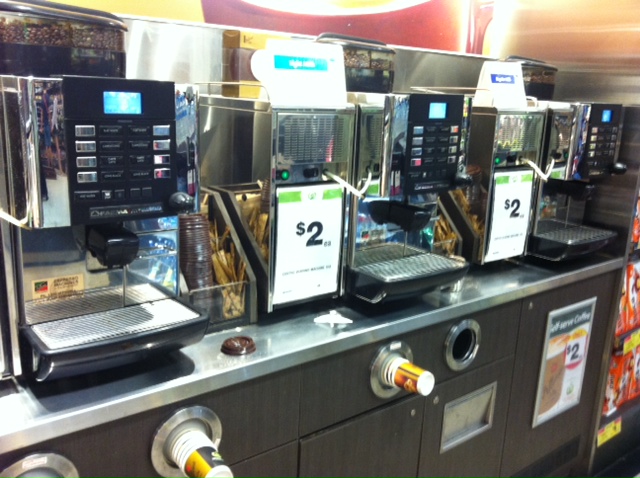
    There was a line of tradesmen out the door waiting to buy a $1 self serve coffee. Freshly ground with your choice of espresso, latte or cappuccino.

    No messing around, no being patronised by snobby barista – just a cheap, decent quality cup of coffee.

    For the last few years these machines have been popping up in convenience stores and service stations, freshly grinding beans to order and delivering a reasonable cup of coffee for a dollar or two.

    7-11-cheap-coffee.jpg
    Cheap coffee at the local convenience store

    None of the machine made cups will beat a coffee made by a good barista, but are half or a third of the price being charged by many cafes whose product often isn’t much better (and sometimes worse) than that made by the machines.

    With the rise of the service economy in the 1970s it was assumed employment would move from factories to jobs like baristas and serving in cafes, now we’re seeing automation taking over those jobs as well.

    The 1970s assumption that the service industries would become the mainstay of the economy turned out to be true with over two thirds of the workforces in countries like the US, UK and Australian employed in them them by the end of the Twentieth Century.

    Now industries are restructuring again and the assumptions that worked well for the last fifty years are being challenged by automation and increased outsourcing.

    The idea we could build an economy based upon us all making coffee and waiting tables for each other was always problematic and so it is proving to be.

    It’s worth thinking about the opportunities this presents for your business.

    Similar posts:

  • Why Australia needs foreign ownership

    Why Australia needs foreign ownership

    Such are the vagaries of radio that I’ve been asked to comment on ABC Radio South Australia about foreign ownership based on an article that was picked up by The Drum 14 months ago.

    That article was written shortly after Dick Smith came out grumbling about the prospect of Woolworths selling the electronics store chain named after him to foreign interests.

    My point at the time was that foreign owners would be preferable to some poorly managed, undercapitalised local buyer as the Australian retail industry – even in a declining market like consumer electronics – needs more innovation and original thinking.

    As it turned out, Dick Smith Electronics was sold to Anchorage Capital, a private equity turn around fund with an interesting portfolio of businesses.

    In the meantime, the argument about foreign ownership of property and businesses, particularly farms, has ratcheted up as opportunistic politicians and the shock jock peanut gallery that sets much of Australia’s media agenda have found a cheap, jingoistic issue to score points from.

    So why is foreign ownership of businesses like farms, mines and factories important for Australia?

    A fair price for hard work

    The main reason for supporting foreign buyers for Aussie businesses is it gives entrepreneurs a chance to get a fair price for their hard work.

    A farmer or factory owner who builds their business shouldn’t have to accept a lower price because Australians don’t want to pay for the asset.

    It’s not a matter of being able to pay Australians as have plenty of money to invest – a trillion dollars in superannuation funds and three billion dollars claimed for negative losses in 2009-10 show there’s plenty of money around – it’s just that Aussies don’t want to invest in farming, mining or other productive sectors.

    We’re already seeing this play out in the small business sector as baby boomer proprietors find they aren’t going to sell their ventures for what they need to fund their retirement.

    Access to capital

    Should the protectionists get their way then the businesses and farms will eventually be sold to undercapitalised Australian investors at knock down prices.

    This is the worse possible thing that could happen as not only do the entrepreneurs miss out, but also the factories and farms decline as they are starved of capital investment.

    Cubby Station

    A good example of both the lack of capital affecting investment and finding a fair price for ventures is Queensland’s Cubby Station.

    While I personally think Cubby Station is an example of the economic bastardry and environmental vandalism that are the hallmarks of the droolingly incompetent National Party and its corrupt cronies, the venture itself is a good example of why the agriculture sector needs foreign investment.

    Having been converted from cattle to cotton in the 1970s, Cubbie grew as successive owners acquired water licenses from surrounding properties.

    Eventually the company collapsed under the weight of its debts in 2009 and the property was allowed to run down by the administrators until it was bought by Chinese backed interests at the beginning of 2013.

    At the time of the acquisition, the company’s former chairman told The Australian,  “on reflection, I would go into those things with an even stronger balance sheet — in other words, with less gearing.”

    In other words, the company was under-capitalised.

    Competition concerns

    Another reason for encouraging foreign ownership is that Australia has become the Noah’s Ark of business with duopolies dominating most key sectors.

    Bringing in foreign owners at least offers the prospect of having alternatives to the comfortable two horse races that dominate most industries.

    The property market

    An aspect that has excited the peanut shock jocks has been the prospect of Chinese buyers purchasing all the country’s property.

    For those of us with memories longer than goldfish, today’s Chinese mania is almost identical to the Japanese buying frenzy of the late 1980s.

    Much of what we read about the Chinese buying homes is self serving tosh from property developers and real estate agents and what mania there is will peter out in a similar way to how the Japanese slowly withdrew.

    This isn’t to say there shouldn’t be concerns about foreign ownership – tax avoidance, loss of sovereignty and Australia’s small domestic market are all valid questions that should be raised about overseas buyers, but overall much of the hysteria about foreign ownership is misplaced.

    What Australians should be asking is why the locals aren’t investing in productive industries or buying mining and farming assets.

    The answer almost certainly is that we’d rather stick with the ‘safety’ of the ASX 200 or the residential property market.

    We’ve made our choices and we shouldn’t complain when Johnny Foreigner sees opportunities that beyond negative geared investment units or an tax advantaged superannuation fund.

    Similar posts:

  • Australia’s economic Hari-Kari

    Australia’s economic Hari-Kari

    The Golden Era of Credit is Now Over” writes Maximillian Walsh in the Australian Financial Review today.

    Max’s story relies mainly on the April edition of Bill Goss’ monthly newsletter where the founder of investment firm PIMCO writes about the talents of today’s market wizards;

    All of us, even the old guys like Buffett, Soros, Fuss, yeah – me too, have cut our teeth during perhaps a most advantageous period of time, the most attractive epoch, that an investor could experience.

    The credit boom of the last fifty years created many winners – investment bankers, property owners and those who sell things funded by easy finance.

    One of the best examples of a fortune made through easy credit is Australia’s Gerry Harvey. Here’s one of Gerry’s ads from 1979.

    Hurry into Norman Ross. You can use Bankcard or our easy credit system. You can even use cash!

    Three years later Gerry was sacked from the business he founded and he set up Harvey Norman, promising John Walton and Alan Bond “I’m going to beat you.” By the end of the 1980s he had.

    Gerry’s success is built on easy credit and the rise of the consumerist economy. From the hire purchase plans of the 1960s, the introduction of credit cards in the 1970s and the banking deregulations of the 1980s, Gerry was able to sell goods to eager consumers who could worry about paying later.

    In the 1990s and 2000s a happy coincidence of easy credit and cheap Asian manufacturing – note the prices of electrical goods in that 1979 commercial – saw businesses like Harvey Norman grow exponentially.

    Mao promised the Chinese a chicken in every pot, Gerry delivered a plasma TV in every Australian bedroom.

    Today, as Bill Goss says, the credit party is over. Last drinks were called with the failure of Lehman Brothers on September 16th, 2008.

    However this hasn’t stopped the Aussie economy, as the Sydney Morning Herald reports today Sales growth cheers Gerry Harvey.

    In the same edition the SMH reports the government science organisation, the CSIRO, is cutting hundreds of staff. Notable in that article is a comment from the organisation’s CEO;

    Dr Clark said more than 2000 companies collaborated with CSIRO but that industries were reducing the amount spent on research.

    So at a time when the Australian economy is struggling with the effects of a high currency and exhibiting all the symptoms of the Dutch Disease, consumers are spending more on TVs and sofas while business cuts investment in research and development.

    Karl Marx famously predicted that the last capitalist will be hanged with the rope they sold, Australians have a bunch of Harvey Norman branded credit cards for their financial seppuku.

    Similar posts: