Category: economy

  • Building Innovative Cities

    Building Innovative Cities

    The New Lunatick’s Newcastle as a Smart and Innovative City forum raised an interesting question; “how do you build an innovative city?”

    In putting together the Digital Sydney project, this was something we closely looked at – how does a city become a global hub of innovation in the creative, digital, financial industries?

    What leaps out when studying successful industry hubs is that all have developed without government intervention; most have been an accident of history where resources have come together and have driven by a small group of like minded entrepreneurs.

    Those entrepreneurs have been attracted to various regions by the area’s proximity to the natural resources, transport links and available land suited to their industry. While those requirements vary between industries, access to a skilled workforce is the common factor between all of them.

    In many respects this is how the current mining boom has worked for Newcastle. Unlike the rest of Australia’s mineral fields, the Hunter Valley has a major city with a skilled workforce that understands mining and engineering.

    The challenge for Newcastle – and indeed for Australia as a nation – is diversifying the economy from depending upon resource exports and domestic consumption into creating wealth from the newer, knowledge based industries.

    For hubs to develop in these industries, regions need the factors identified by Richard Florida in his Rise of the Creative Classes where he found these cities offered the “three T’s” – Talent, tolerance and technology.

    Australian cities like Newcastle score well on these measures but to create hubs you need a motivated group of entrepreneurs and while these exist there may not be the numbers to create a critical mass.

    The main reason for this is the domestic investment structure; most Australians invest in housing and aren’t particularly inclined to invest in comparatively risky businesses, particularly those in industries they don’t understand.

    Governments can help by opening their data and making procurement friendly to new and smaller businesses – on both scores Australian governments at both levels do poorly with data often being unnecessarily guarded and tendering processes tend to be skewed towards large, usually multinational, corporations.

    Assistance programs can also help on the fringes however it’s important not to repeat the mistakes of the film industry where several decades of government grants and funding has resulted in a generation of film makers more skilled at navigating bureaucracies and filling in application forms than telling stories.

    Where government assistance can do a good job is in bringing together the various industry groups which was the intention of Digital Sydney. Well targeted, low paperwork schemes like the Australian Technology Showcase and various trade programs can also help growing businesses.

    Overall though, the development of innovative cities lies in the hands of the residents, it’s up to the inhabitants of the city, town or region to bring build the hub.

    This is exactly what happened with the original Lunaticks society in 18th Century England that created the region that became known as Birmingham which was the heartland of the English economic powerhouse for over a hundred years.

    While we can wait for governments or investors, building industries is about innovators, entrepreneurs and workers. It’s time to get to work.
    Similar posts:

    • No Related Posts
  • Newcastle as a Smart and Innovative City

    In today’s modern world, success is determined by our ability to come up with unique, smart and innovative ideas. It has become the key economic driver for cities and regions as they increasingly compete with other places for attention, investment, visitors and talent.

    Newcastle City Council recently released their 2030 strategic plan to become a Smart and Innovation City to help Newcastle develop a healthy, diverse, creative and resilient economy.

    But, how do you create a culture of new ideas? How do you attract smart people? How do you turn an Old World City into one the World’s Smartest Cities?

    On June 29 2011, The Lunaticks Society of Newcastle will host some of the most creative minds in Newcastle from business leaders to content producers for an evening of thought provocative discussion, collaboration and lots of smart ideas on how to construct a Smart and Innovative City.

    Speakers/Panelists

    MC: Paul Wallbank – author, tech writer and radio presenter

    Featured speakers include: Greg Hall – writer and movie producer, Simon McArthur & Jill Gaynor -Newcastle City Council and Carol Velduizen – Senior Research Fellow, Hunter Valley Research Foundation. More speakers to be announced…

    Venue: Delany Hotel, 143 Darby Street, Newcastle

    Date: Wednesday, June 29 2011

    Time: Starts 6.30pm – Ends 10pm

    Don’t miss this event! Book at the New Lunaticks website.

    Similar posts:

    • No Related Posts
  • A tale of two conferences

    A tale of two conferences

    Two conferences about ideas took place in Sydney last Saturday, TEDx Sydney and Social Innovation BarCamp. While both involved exploring concepts and thoughts they could not have been more different.

    One was about exclusivity and elitism while the other was about a genuine exchange of ideas. Both the events tell us much about the new and old models of communication and learning.

    Welcome sign to SIBSyd
    The entrance to SIBSyd. Exit through the gift shop?

    At the Paddington College Of Fine Arts, Social Innovation Bar Camp ­– SIBSyd – was open to anyone with an idea or who just wanted to show up a throw some thoughts around. Across town at the Everleigh Carriageworks, the TEDx Sydney offshoot of the prestigious US TED event featured high profile speakers before an invitation only audience.

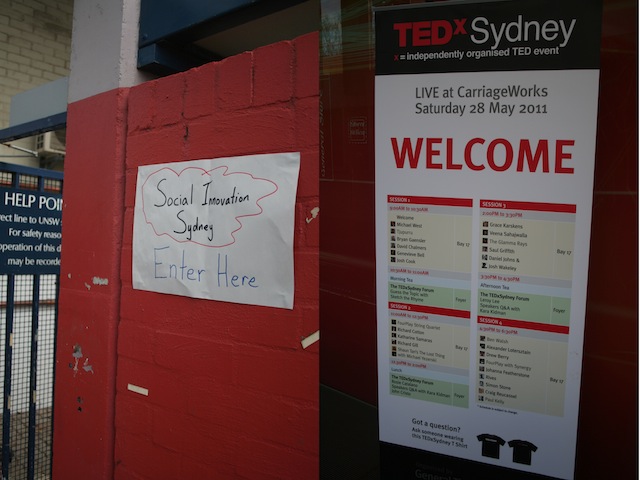
    Welcome sign to TEDx Sydney
    Welcome to TEDx Sydney. May I see your invitation, sir?

    Most TED events are exclusive and restricted you have to be qualified to attend, let alone speak and this showed in the way the audience were ushered into the auditorium and then asked to turn off their mobile phones unless they wanted to sit in the back two rows.

    The speakers at TED were slick, rehearsed and had their presentations timed exactly to the minute – as you’d expect at an event where the content is carefully chosen – while at SIBSyd any of the audience could choose to speak.

    Even with a speaker everybody at a SIBSyd is able to participate, with all the audience of giving their views. In the reforming education session I sat in on a quiet lady at the back of the room told her experiences of working with villagers in Chiapas, Mexico.

    It’s unlikely that lady would get an invite to TEDx, let alone have the opportunity to tell her story and that illustrates the fundamental difference between the two conferences.

    One is the formal, traditional one-to-many lecture from an expert imparting wisdom on an audience awed by the speaker’s knowledge while the other sees the speaker – who may be an expert – drawing out the collective wisdom of the room.

    TEDx Sydney stage setup
    TEDx stage ready for action

    The “unconference” structure of meetings like SIBSyd probably does a better job of developing new ideas as the traditional conference TED is based upon that assumes the expert on the stage already has the answers.

    Of the two types of conferences, it’s probably safe to say the collaborative “unconference” model works better in driving innovative solutions to problems. To work effectively though it needs the participants to be motivated by common issues.

    The traditional TED style conferences do a better job of getting big ideas across to a broader audience and that’s probably one of the reasons why the event’s videos have been such an Internet success.

    Some of the differences reminded me of British writer Paul Carr’s comments about the South By South West Conference in 2009 when he said “I really hope that next year one or two of those early adopters will organise – and I mean that in the loosest sense – a user-generated unofficial fringe conference to sit alongside the main event.” In many ways SIBSyd was the fringe festival to TEDx’s “establishment” status.

    SIB Syd session in progress
    SIB Syd session underway

    Both have their role and probably the most worrying thing at the two events was the lack of Australia’s corporate and political leadership, with the exception of Penny Sharpe, MLC who appeared to be the sole member of Parliament attending TEDx, there was little representation from either group.

    In a time of massive climate, technology and economic change that is challenging the assumptions and business models of previous generations, it’s a shame our business and political leaders aren’t engaging and listening to those outside their narrow circles.

    But ideas are one thing and action is another. As journalist and enfant terrible Stilgherrian said during the day, “completely over events about ‘ideas’. We have plenty of ideas. What we need is a bit of effort put into execution.”

    Hopefully out of both events we’ll see some of the ideas discussed turned into action

    Similar posts:

    • No Related Posts
  • Building business communities

    Building business communities

    Last night the NSW Government launched Digital Sydney, an initiative to bring together the various groups that make up the digital media and IT industries while raising the city’s profile as a global digital centre.

    This project was something close to me as I’d been involved in developing the concept through 2009 when working with the then NSW department of Industry and Investment.

    Originally the idea had been to create a digital hub around the Australian Technology Park to the south of the city. Over the decade of its operation, the ATP had attracted some high profile tenants and various high tech business start ups but there was a feeling it could be a more dynamic centre of the Sydney tech sector.

    Digital hub failures

    The setting up of “digital hubs” around the world has not been a great success – in Ireland an attempt to set one up in central Dublin’s disused Guinness brewery cost the European Union well over 100 million euro and subsequently collapsed amid acrimony between the various governments and businesses involved.

    Even if there was a track record of success it’s unlikely any Australian government, state or Federal, would be prepared to spend money on the European scale. So the idea of building a “hub” had to be kept within industry, particularly the IT and digital media sectors.

    Existing industry hubs

    In talking to the industry, it became apparent that Sydney already a digital hub spreading across the suburbs immediately to the south and west of the city centre and centred around Surry Hills with an vibrant community of developers, designers and entrepreneurs occupying the old factories and warehouses being vacated by the city’s rag trade.

    The proximity of competitors, clients and suppliers was why the hub had developed; exactly the reason why the fashion industry had previously concentrated around that district.

    This is consistent with history; the great industrial hubs such as the English midlands of the 18th Century, the US mid west of the 19th Century along with today’s Chinese coastal manufacturing centres and event Silicon Valley happened with little government forethought.

    Like-minded businesses clustered together because they could find the essential resources for their industry such as raw materials, labour, transport, markets and capital.

    A shortage of capital

    The access to capital is a problem for all smaller and innovative businesses in Australia, not just those trying to build digital businesses or hubs. Start up enterprises have been starved for capital and a few late stage Venture Capital investments like the recent ones in Atlassian or 99Designs are not on their own enough to build vibrant businesses of the future.

    In Australia, it’s difficult to see any government in the near future changing the tax and legal regimes which favour property and stock market speculation over investment in new businesses and technology so the best hope is initiatives like Digital Sydney, along with the profiles of similar industry hubs in Brisbane and Melbourne, can encourage investors to look at the start up and innovation sectors.

    Why big cities?

    The real question is though is why is this just the major cities? Why can’t we have hubs in Renmark, Esperance or Hobart?

    Access to skills and talent are the driving forces behind the local hubs and in that respect some smaller towns and regions do have the skilled workforces and businesses capable of building industrial centres and we’ve seen some regional hubs develop like the wine industry in various places.

    So it’s worthwhile considering where your business is located, maybe it would be better to set up next door to your competitor? For many organisations, being part of vibrant industry hub is part of their success.

    postscript;

    Joe Kelly, former Commercial Director of the Dublin Digital Hub Development Agency, takes me to task on the claim the Dublin Hub collapsed. His comment is as follows:

    As the former Director of Commercial Operations at The Digital Hub Development Agency, I felt compelled to correct you on your assertion that the Digital Hub in Dublin collapsed. That is incorrect. Media Lab Europe, an entirely seperate entity collapsed at a cost of over 100 million euro. The Digital Hub continues to thrive with over 100 companies located there. Please refer to www.thedigitalhub.com for further information.

    Similar posts:

    • No Related Posts
  • Skilling for the future

    Skilling for the future

    Tonight we see the first budget of the Gillard government and one of its stated priorities to get the long term unemployed, disabled and single parents back into the workforce.

    This is welcome in a society where we are facing skills shortages, the effects of an aging population and a developing global race for talent that is steadily making the old model of importing immigrants to cover workforce gaps no longer viable.

    For those who’ve been out of the workforce for a long period the biggest challenge is acquiring the skills they need for the modern economy, to work in most industries today means using technologies that weren’t around five or ten years ago.

    Like many ideas that come out of Canberra, the scale of this task seems to be underestimated by the public servants, politicians and the media reporting their plans. Training those currently excluded from the workforce is going to take more than a visit to Centrelink.

    To give these folk marketable skills is going to require rebuilding our adult education and TAFE systems that have been systemically allowed to run down by governments over the last thirty years. That in itself is a major task that neither the states nor Canberra seem to have the appetite to address.

    One of the big challenges with bringing disadvantaged groups back into education is transport, the colleges and teachers are often a long way from the students who usually face a convoluted and time consuming public transport journey to get the colleges and schools.

    This is where technology comes in with access to the internet and online learning tools. Developed sensibly, broadband access can create relevant community learning centres along with individual in-home training.

    We should be careful though treating technology as the only solution, one of the essentials for using computers and the Internet effectively is literacy and that’s a big challenge for many of these groups and something that is going to take a lot of investment in well trained and motivated teachers.

    Those education investments, along with the spending we’re committing to the National Broadband Network, need to be co-ordinated and this seems to be where the Federal and state governments really drop the ball with poorly thought out, short term schemes.

    For businesses, those last thirty years of government neglecting adult education have seen us neglect training as well. We’ve thrown much of the training burden onto reluctant governments or increasingly asked workers themselves to pay for training out of their pocket then moaning when new staff don’t have the skills we need.

    That indulgence is running out as we begin to face the inevitable consequences of failing to train young workers coupled with the demographic certainty of an aging workforce.

    We can hope our governments can deliver on their promises but we shouldn’t wait on them, even they get it right this is a project that will take years to bear fruit, we need to be starting right now with our own businesses and staff.

    Training all workers, managers and business owners is a great opportunity to build new industries and use the web to give people the skills that will make them valuable members of their community.

    Our days of complacently expecting workers to have the skills we need from the day we hire them are over, if they ever existed. We have the tools to fix the problems ourselves and we need to start now.

    Similar posts:

    • No Related Posts