Category: economy

  • Group buying sites explained

    Group buying sites explained

    Fancy half price seafood dinners, deeply discounted electrical goods or 80% off personal fitness training? Thousands of people who’ve signed up for group buying websites certainly do and hundreds of businesses are prepared to make big discounts to attract those customers.

    What are these services? Are they worthwhile and how do the businesses make money from them? Should customers be wary of advertised big savings and are merchants cutting their throats when they enter the world of deep discounting?

    What are group buying websites?

    The idea behind group buying sites is that merchants will offer cheap deals to take advantage of bulk sales, clear inventory or as loss leaders to attract new business. The products offered can be anything from a cheap haircut through to discounted whitegoods or a cheap meal.

    Customers subscribe to the group buying websites and receive a daily email detailing the deals in their areas. If they like an offer, they can choose to be part of it and if it goes ahead, their credit will be debited and they’ll receive a voucher for the deal.

    The group buying websites usually approach businesses to take part. For the privilege of having their businesses featured, the website takes between 20 and 100% of the offer price as commission.

    What are the consumer benefits?

    Naturally the main attraction for consumers are the cheap deals on offer. Some businesses are offering 80% off their list prices for products, so there can be substantial savings to be made.

    There’s also the opportunity to try out products or outlets you wouldn’t normally try for instance you might not usually be interested in Zumba classes, canoe hire or replacing your TV at normal prices but an 50% discount could tweak your attention.

    Are there risks for the consumer?

    There’s no such thing as a free lunch so there are a number of risks when using a group buying site.

    Impulse buying is probably the biggest risk, if you’re a sucker for a deal then these sites will love you. It’s an opportunity to sign up for a lot of things you don’t really need, probably will never have used and maybe can’t even afford, but fact you saved 80% makes you feel good.

    There’s also the risk you’re not really getting the full discount. A lot of canny merchants inflate the list price to make the amount off look greater. Many also reduce the size or quality of the discounted product to recover their margins.

    A big risk is that you may never get to use your voucher. Either you’ll forget about the voucher you received or the merchant is so overwhelmed by the offer’s response that they can never get around to catering for all their people who took them up.

    Finally there’s the spam factor. Many merchants see a group buying offer as an opportunity to build their mailing lists, so you may find yourself being spammed for fitness classes and restaurant offers for a long time after you take up a deal.

    Business Benefits

    These sites wouldn’t have taken off if there weren’t businesses to advertise on them and hundreds of merchants have taken up the opportunity. So there are clear benefits for the outlets that use these services.

    The most obvious one is they get to promote their businesses. All of these sites claim to have subscribers numbering in the hundreds of thousands, so it’s an opportunity to get your products in front of a large audience.

    Clearing excess capacity has been one of the main drivers for these sites in the United States where many businesses have found themselves with too much inventory or staff sitting around. These sites are a great way of clearing inventory or smoothing demand cycles.

    Business downsides

    The first problem is that excess stock. A business can’t afford to be carrying stock that requires big discounts to clear, if these offers become a regular feature then your business is in trouble.

    Even if your business isn’t in trouble, these offers risk devaluing your brand. As the major retailers have found, offering frequent discounts trains your customers to expect lower prices.

    Offering these bargains may alienate existing clients. Those customers who are prepared to pay full price aren’t only going to be irritated to find they could have got your products cheaper, but may also be unhappy with your business being overwhelmed by cheaper, price conscious clients.

    Those price sensitive shoppers aren’t really your customers either; they are loyal to the buying platform and cheap deals, so if your competitors have an offer later on another platform, those customers will go there. There’s a lot of work to be done converting these bargain hunters into repeat clients.

    One of the most misunderstood parts of group buying sites is the commission structure, most of the services charge a commission of between 20 and 50% – with some going up to 100% – on the advertised price, so that 50% discount to the customer is actually 60 to 75% off the merchant’s selling price. This can be a massive hit to a business’ profit.

    Is group buying for you?

    For businesses group buying sites can be a good idea if they are used as a part of a well thought out marketing strategy or to clear occasional excess stock. But they shouldn’t be seen as a quick way to attract new customers.

    Customers are the big winners from group buying sites, as it’s the opportunity to pick up some great deals. But users have to use a bit of judgement instead of just jumping for the best looking deals.

    It’s an old saying, but if anything looks to be too good to be true then it probably is. In the Internet age, that saying is probably truer than ever. Group buying sites can be good for both businesses and customers, but watch the wallet.

    Similar posts:

  • The tipping point

    The tipping point

    Late last year the Internet quietly entered a new stage in its development as smart phone sales surpassed those of personal computers. This represents a fundamental shift on how society uses the web and how it will affect markets and our businesses.

    The mobile workforce

    Our staff and suppliers are going to be increasingly mobile and available. Logistic programs similar to Red Laser – which we discussed last year – coupled with recognition systems, virtual reality and always on wireless broadband are going to enable business, whether it’s a multinational trucking company or a local plumber, to have shorter supply chains and faster response times than ever before.

    Going on the cloud

    For ourselves it means increasingly we are going to be using mobile platforms like iPads and smartphones. It means we’re going into the cloud as the cost of maintaining the back end of these services are too prohibitive for many businesses.

    As we discussed a few weeks ago there are a number of risks in the cloud that we need to understand and be aware of, but as the commenters to the Smart Company column pointed out, we can’t ignore the cloud.

    The pervasive customers

    Our customers are using the cloud on their smartphones as well, A presentation by silicon valley stock analyst Mary Meeker late last week emphasised the process that’s underway. Mary’s colleague, John Doerr calls this evolution of the mobile Internet SoLoMo – Social, Local, Mobile. People are using their mobile phones to quiz social networks to find local businesses.

    This is going to challenge all businesses, particularly those who’ve resisted going onto the web until now, as we have to make sure our presence on the web is more than just a pretty web site with a token Facebook Page and Twitter account

    Fancy a bowl of noodles, need your lawn mowed or toilet repaired? Increasingly we’re going to be using the mobile web and making note of what our friends say about these services. Even those business like the trades that have got away without going online are going to find it increasingly necessary to sign up to services like Google Places.

    Change has arrived

    The time for procrastinating about how our businesses are changing is over; the changes are happening now. Our customers are looking for us online and our competitors are reaping benefits from the various mobile and cloud technologies.

    You need to be across these changes, just as telephones, cars and computers revolutionized most of our industries through the 20th Century, the mobile web is the first big change of the 21st. If you want your business to be part of the next decade, you have to start thinking about how you can use these tools.

    Similar posts:

    • No Related Posts
  • Is Facebook worth $50 billon?

    Is Facebook worth $50 billon?

    Goldman Sachs’ recent $500 million investment in Facebook that values the entire business at fifty billion dollars raises the question, can a business that was founded in college dormitory seven years ago really be worth that sort of money?

    It is possible Facebook is worth that sort of money, but to figure out if it really is, we have to crunch some numbers. So here is a back of an envelope calculation.

    Learning from others

    The first thing we need to look at is similar examples, the closest comparison is Google who were launched on the stockmarket shortly after Facebook were founded and today have a market worth of $195  billion.

    So Facebook’s investors are valuing the business at about ¼ of Google’s size. Yahoo’s stock analysis of Google allows us to look at the rough numbers.

    Income

    Currently, Google is earning 29.3 Billion and making a profit of 8.5billion for a Price to Equity (P/E) of 23.26.

    To justify a 50 billion dollar valuation on similar rations, Facebook would have to make around 2 billions dollars profit on revenues of $8 billion .

    Facebook is reported to have made $1.2 billion in sales with $355 millon profit in the first nine months of 2010. If we extrapolate that, crudely assuming no revenue growth in the last 3 months, we come to 2020 earnings of $1.6 billion and roughly $450 million profit.

    So Facebook has to grow revenues and profit by a factor of five, based on the same ratios as Google, to achieve the $50bn valuation. Where could this come from?

    Advertising revenue

    The bulk of Facebook’s current revenue comes from advertising, according to Inside Facebook in 2009 all but $10million of their $660 million earnings came from one form of advertising or another.

    Online advertising is going to continue to grow spectacularly, a 2010 Morgan Stanley research paper illustrated (on slide 25 of the previous link) how advertisers will have to increase spending onling by $50 billion to match the Internet’s share of media consumption.

    It’s a fair assumption that Facebook, as the biggest social medial platform, will get a large slice of that $50 billion. If Facebook were to capture 10% of the market’s growth, they’d achieve their valuation easily.

    We should also consider that most of Facebook’s revenue is coming from the United States and they barely touched international markets, so there’s even more potential growth in their advertising revenue.

    Games revenue

    One of Facebook’s biggest growth opportunities comes from the games. Games like Farmville and Mafia Wars are proving popular with the user base; Zynga, the developer of Farmville, itself has a projected market capitalisation of $5.8 billion.

    The global games business is valued at $105 billion dollars and much of this market is moving to web based, online platforms. Should Facebook based games grab 10% of that market, the platform’s 30% cut would see another 3 billion go into Facebook’s revenue, most of which would be profit.

    The credits market

    Related to the games market is the sale of credits for purchases of games and other features like virtual, and real, gifts and products.

    It’s almost impossible to quantify what that market would be but already credits have gone on sale in US stores like WalMart and Best Buy and the virtual world site Habbo Hotel reports 2010 credit revenues of 4.5 million Euros on a user base that is a fraction of Facebook’s size.

    So is Facebook worth $50 Billion?

    Facebook’s fifty billion dollar valuation is feasible. That’s not to say there aren’t risks, it’s possible Facebook could turn out to be another fad like Myspace or that users might decide to value their privacy over Facebook’s benefits.

    While it’s not an investment you’d like to see your grandmother in as a safe source of retirement income, for risk tolerant Russian fund managers and high income clients of Goldman Sachs, it’s a punt worth taking.

    Similar posts:

  • Is there an entrepreneurial elite?

    Is there an entrepreneurial elite?

    In a recent Atlantic Magazine article Chrystia Freeland charted the rise of the New Global Elite and suggesting “our light-speed, globally connected economy has led to the rise of a new super-elite that consists, to a notable degree, of first- and second-generation wealth. Its members are hardworking, highly educated, jet-setting meritocrats who feel they are the deserving winners of a tough, worldwide economic competition”.

    A few days later The Economist followed up this theme with a discussion on whether we should worry about the rising wealth of the entrepreneurial elite.

    While there’s no doubt there is a global elite, enjoying fine wines at the World Economic Forum at Davos while congratulating themselves on their successes, wisdom and hard work. The question really should be are these people really entrepreneurs?

    Some of the self appointed global elite are highly paid executives. One of the notable aspects of the corporate sector is the majority of managers are not risk takers – in most organisations, public or private, taking risks is going to jeopardise one’s career – instead it’s the risk adverse who are rewarded with the senior management positions.

    However even the managerial classes are outnumbered by the financial wizards. The biggest stimulus to the global elite’s riches was the financial market deregulations of the 1980s and 199os. As our society’s forgot the lessons of previous generations and released the regulatory restraints on banks, a whole new wave of opportunities appeared to make huge fortunes. The loose credit of the early 21st Century leveraged and amplified those fortunes.

    Financial Innovation became the key to wealth, although as former Federal Reserve chief Paul Volker observed “I wish someone would give me one shred of neutral evidence that financial innovation has led to economic growth—one shred of evidence.”

    The killer to the idea is that financial innovation is entrepreneurial are the consequences of the two decades where the financial markets reigned supreme – trillions of dollars in bailouts.

    That the bulk of the global elite relied up bailouts and government stimulus packages gives lie to the concept that most of these people are entrepreneurs; genuine entrepreneurs take real risks and accept the consequences if their venture doesn’t work out.

    While it’s true that some of the “global elite” include individuals who have built up enterprises and taken risks with their personal fortunes and reputations, it would be a mistake to describe this group as being entrepreneurial. The bulk of this global elite are speculators and managers who’ve been richly rewarded by a system setup to guarantee their wealth.

    You’ll find more entrepreneurs running stores in your local mall than you will walking the privileged halls of Davos or any of the other expensive haunts of the global elite.

    Similar posts:

    • No Related Posts
  • Transition effects and changing employment

    Transition effects and changing employment

    On Australia Day, it’s worthwhile considering one group of convicts in the early fleets who stood against an earlier time of economic change.

    As the automation of the cloth weaving process accelerated through the 18th Century,  many trades in the English fabric industry, such as Croppers, found their skills in great demand.

    Yet by the early 19th Century, their trades were near extinct as automation reduced the cost of weaving fabric dramatically and labourers replaced skilled workers.

    This massive wave of change and loss of once well paid skilled jobs helped accelerate the Luddite movement, many of whom were transported to Australia for their role in attacking factories using the new technologies.

    We should keep the plight of the croppers and Luddites in mind in today’s period of massive economic and technological change.

    One notable aspect of the workforce when industries are going through major changes is how many high paid skills and business niches pop up for a short time before being overwhelmed by change.

    We shouldn’t consider that many of the services and opportunities in today’s economy are permanent, quite a few businesses and skills that have appeared in the last two decades might not survive this one.

    A good example is the web designer. In 1996, a punk with a little basic HTML knowledge could call them selves a web developer and three years later many of those punks were driving Porsches and Lamborghinis. By the mid-2000s most of those expensive cars were just memories for those who assumed those basic skills set them up for life.

    Today we see the same thing with social media, group buying and cloud computing. Many of the services we see – some of them being valued for billions – are transition effects as markets adjust to changed conditions.

    As we begin to understand the effects of trading our privacy for connections, trusting valuable data to anonymous corporations and mass selling for discounts, we’ll see consumers, governments and business adapt.

    Some of today’s superstars will adjust to those changes and become the next Microsoft or General Motors while many others will fond memories after their reason for existing vanishes.

    We should grab opportunities when we see them – many of the thousands of Groupon clones are doing exactly that ­– but we shouldn’t assume they are permanent and forever.

    A time of change means none of us can assume our livelihoods, skills or assets are safe, just as those 19th Century industrial workers found when they were transported to Australia.

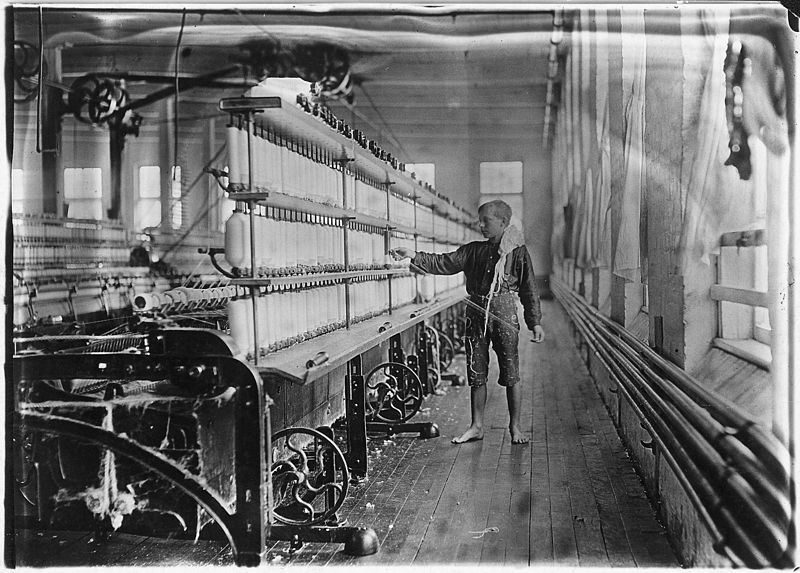
    Mule-spinning room in Chace Cotton Mill in 1909 by Lewis Hine courtesy of Wikimedia

    Similar posts: