Category: economy

  • the price on our heads

    the price on our heads

    Over 500 million people have signed up on Facebook, trading their privacy for the ability to connect with friends and online communities. In turn, Facebook has built that massive group of people into an asset worth an estimated $41 billion dollars. But does it rely on us selling our privacy too cheaply?

    A common factor in many of our communication channels in the last fifty years has been how we, as a group, have been prepared to trade something personal in return for a cheap service.

    Broadcast media’s model offers us free or – in the case of newspapers, magazines and Pay TV – subsidised news, sport and entertainment in return for shrill or intrusive commercials that usually wastes our time.

    Similarly with social media tools, in return for a free and easy way to find friends and relatives, we trade our privacy for targeted online advertising which can be so precise a commercial can be designed just for one individual.

    The social media advertising model is on many levels a great idea, it cuts out irrelevant messages to the consumer and for the advertiser it’s more effective than the “throw it against the wall and see what sticks” methods of the broadcast advertising world.

    A weakness in social media advertising in that it relies on users being prepared to trade away their privacy. Until now, all of us have been fairly relaxed about this despite the evidence mounting that giving away all our privacy and access to our networks often has costs to our reputations and friendships.

    That cost can be great,  with the worst case seeing people lose jobs, friendships or even their liberty for something that they, or one of their friends, thought was quite innocent.

    Under the old trade off, we could turn off the TV or not buy a magazine if we found the advertising too distracting or offensive. With new media we can’t recover our privacy once it’s been given away.

    As we begin to understand the nature of our connected society and the values of our online reputations, we’ll expect a better price for our privacy. The challenge for platforms like Facebook and other social media tools over the next few years will be to convince us that these trade offs and potential risks are worthwhile for the benefits they offer.


    Similar posts:

    • No Related Posts
  • Australia’s one trick economy

    Australia’s one trick economy

    Earlier this week, Reserve Bank of Australia Governor Glen Stevens gave a speech to the Australian Industry Group on the world’s changing economic currents.

    That presentation has a number of pointers for Australian businesses on how we use technology, our investments and, most importantly, where the Canberra sees our economy going.

    Much of the Governor’s speech discussed how those of us who at the beginning of the century believed Australia’s economy had to diversify into new industry sectors — such as the IT sector — were proved wrong by the Dot Com Bust and the subsequent boom in the resources sector.

    “Australia would probably do best, in its production structure, to stick to its comparative advantages in minerals or agriculture or various services.” Mr Stevens quoted from ten years ago, “but it was hard going trying to make sensible points against the barrage of market and media commentary.”

    Perfect hindsight

    It’s impressive the Governor had this perfect hindsight which can overlook the role of ramping the housing markets by the Rudd and Howard governments to avoid the 2001 and 2008 US recessions along with the sheer good luck of having a resources boom through the last half of the decade.

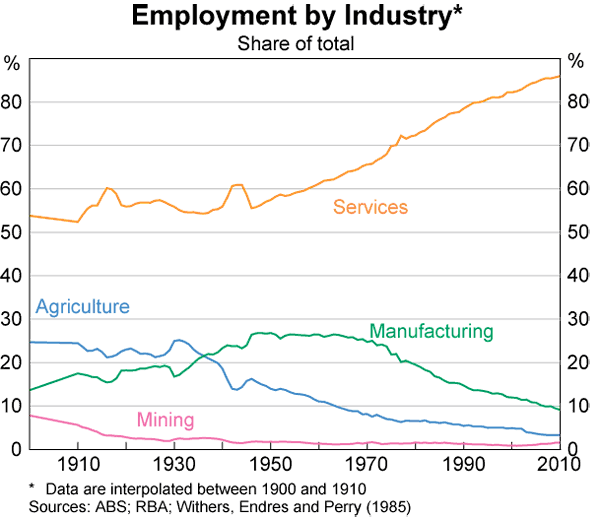
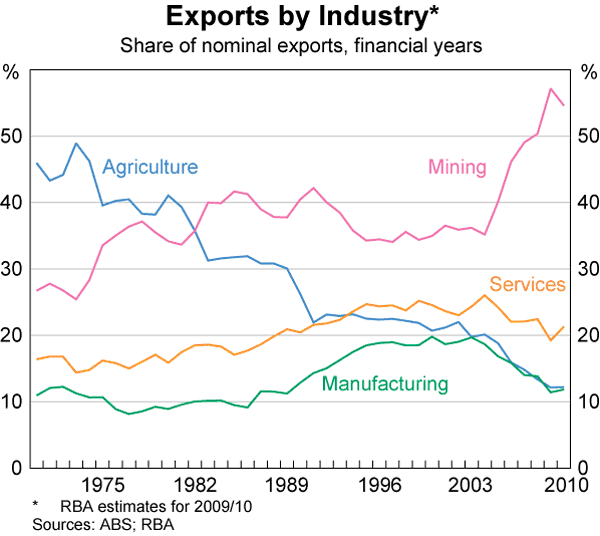
    During his speech the governor referred to an RBA research paper, Structural Change in the Australian Economy which casts an interesting light on the comparative advantages in those “various services”.

    That paper shows that service sector employment has risen to nearly 85% while its share of GDP has stayed around the same for the last twenty years, which to this non-economist’s mind implies the portion of national wealth is declining for service based workers and businesses.

    Sleepwalking into the dutch disease

    Of course those of us in the service sector could make it up by exporting but here again, service sector exports haven’t done much over the last decade which won’t be helped by the current high Aussie dollar — another aspect of the Dutch Disease we seem to have sleep walked into over the Howard and Rudd years.

    Those same statistics show mining employment has declined over that period as well and if you’re considering sending your kids down the pit, or even packing in your own city job to drive a mining truck, you might want to read the interesting work being done by the University of Sydney’s school of robotics.

    Generously, Governor Stevens didn’t completely write off the role of technology observing that, “in the old versus new economy stakes, it was probably in the use of information technology, rather than in the production of IT goods, that the gains would be greatest.”

    Invest in, but don’t develop, technology

    The Governor’s messages are clear to business people; our businesses have to invest in technology to be more efficient and we need to understand that government policy will be geared around the mining sector.

    Most importantly, we need to understand that on a national level there is no Plan B.

    In the last election it was clear both sides of politics based their policies, such as they were, on the assumption the China boom will last for the foreseeable future. Yesterday’s speech shows Glenn Stevens and the Reserve Bank share that outlook and no other alternative is being planned for.

    That’s fine for Glenn, Julia, Tony and their colleagues as they have safe, indexed pensions when they deign to cease giving us the benefit of their visionary leadership.

    In the business community we don’t have that luxury; a plan B is required just in case things don’t quite work out the way we hope. As the Governor says:

    Succeeding in the future won’t ultimately be a result of forecasting. It will be a result of adapting to the way the world is changing and giving constant attention to the fundamentals of improving productivity. That adaptability is as important as ever, in the uncertain times that we face.

    That’s excellent advice. How adaptable is your business in these uncertain times?

    Similar posts:

  • ABC Nightlife October 15 2010

    Update: You can download the show from the ABC Nightlife homepage included in the program are some ideas on how kids use the net, the challenges for franchises and the importance of search engine optimisation.

    The Internet is changing how businesses are working online. Join Tony Delroy, Paul Wallbank and Chistena Singh from Sensis to discuss some of the ways customers and businesses are changing the way the buy and sell on the Internet.

    Business has changing for last fifteen years as customers move online to check the deals and products available. With most people now on broadband and more using their mobiles, the game is changing again.

    We’ll be looking at the e-business report which is a free download available from the Sensis website.

    Tune in on your local ABC radio station or listen online at www.abc.net.au/nightlife.

    If you’d like to join the conversation with your questions or comments phone 1300 800 222 within Australia or +61 2 8333 1000 from outside Australia.

    You can SMS Nightlife’s talkback on 19922702 or twitter @paulwallbank using the #abcnightlife hashtag

    Similar posts:

    • No Related Posts
  • On being a price taker

    As Australia’s dollar reaches parity with the US dollar for the first time in thirty years, the nation’s newspapers and politicians are awakening to the reality that this is not a good thing for most Australian exporters, particularly for those mineral industries which are cited as being responsible for the Goldilocks economy.

    Those concerns are real, as this affects the employment of millions of Australia in the agriculture, mining and tourism industries.

    Selling a price dependent commodity product locks a country or business into cycles they can’t control; currency movements, trade wars and cheaper competitors.

    Adding value and creating products that can withstand the commodity cycles is the future for advanced economies. It’s as true for the businesses within these countries as it is for the entire nation.

    If your business sells on price, then you’ll need to think on how you can change your customer’s perception about your product before they see it as a commodity which can be bought cheaper from someone else.

    Similar posts:

    • No Related Posts
  • The innovation smugglers

    The innovation smugglers

    “Sales staff have bought a pile of iPad’s!” wailed a senior executive last week “they didn’t get authorisation through IT, there are all sorts of security and business risks!”

    This echoed the comments I’d heard a few weeks earlier while doing a workshop on cloud computing, that people were running software as a service applications alongside their businesses’ software without telling their management what they were doing.

    All of this is reminiscent of the spread of personal computers in the late 1980s where IT departments, such as they then were, banned the use of IBM compatible or Macintosh computers because they were outside the control of the organisation.

    The prevailing view was that computer systems were the domain of a select few, running the payroll and doing complex calculations in batches at two in the morning. There was no reason why the average worker should need this sort of technology.

    Eventually, managements realised those subversive personal computers running programs like Wordstar and VisiCalc improved productivity and made businesses more flexible. Within five years few businesses didn’t have computers on the desks of every office worker.

    We’re at the same stage now with cloud computing, social media and portable devices as many of today’s managers see them as at best toys and a threat to their organisation’s integrity. Quietly though, groups within are using theses tools to improve their teams’ effectiveness while not letting IT or senior management know how they are doing it.

    These dissenters are an organisation’s innovators and in a perfect world they would be embraced by managers, directors and shareholders alike as the future of the company.

    Many large organisations though don’t see it this way, as their view of the workplace is that innovation and new ideas have to be signed off by seven layers of management after being cleared by legal, HR and the facilities department.

    This is where the opportunity lies for the smaller, smarter companies. These tools make organisations faster and more responsive to threats and opportunities which is perfect for the nimble and flexible enterprises.

    If you have staff who are smuggling in these tools and devices into your business, consider sitting down with them and getting them to show you how these products improve their work. You may be surprised and it may save you some time in writing stern memos which will be ignored anyway.

    The beauty of these tools is you don’t need to throw out your existing equipment and methods as often these new innovations sit happily alongside the legacy stuff. Cloud services are good example of this where services such as Salesforce and Google Apps work with and often plug into the older, established tools.

    Because they play nice with existing business tools it’s easy to introduce or evaluate new systems by encouraging the innovators to set up groups or pilot projects within the organisation, which is probably what they are doing anyway without telling you.

    In a competitive world, your dissenters are one of your greatest assets, by questioning how and why we use the tools we do, these folk are figuring out how businesses will run in the connected economy.

    The question is, do you want your business to be succeed in this new economy?

    Similar posts:

    • No Related Posts