
Category: Innovation

  • Beating the first mover advantage

    Beating the first mover advantage

    Twitter founders Biz Stone and Ev Williams can’t be accused of standing still, along with having founded the Blogger service that made creating websites easy which they sold to Google, their company Obvious Corporation has been working on various new projects.

    Branch and Medium are their two latest releases.

    At first glance Branch is similar to the Quora service where people ask questions and followers. While Quora is reasonably successful, it hasn’t gained traction outside of the tech community.

    Medium is a new blogging service, which superficially appears similar to Tumblr or even the Blogger service Ev and Biz founded in 1999.

    It’s tempting to dismiss both Branch and Medium as they aren’t doing things that are new. both are iterations of older services but that doesn’t mean they can’t succeed. When Facebook was launched there was plenty of competition in services like Friendster and MySpace, the upstart blew them both away.

    The same is true of the iPod, Windows and Google – all entered markets that were already crowded and well catered for. All of them succeeded because they were better than what was on the market.

    In the tech industry is that the first mover advantage is illusionary at best, unless you have a compelling position in the marketplace your product is vulnerable to a smarter, slicker upstart. This is particularly true if the existing services have serious flaws.

    Should Branch avoid falling into Quora’s trap of silly policies and overzealous administrators – the same trap that doomed the open source directory DMOZ and threatens Wikipedia – then it may well succeed.

    Medium could also disrupt the blogging industry, Blogger is being neglected by Google while WordPress is becoming increasingly complex and difficult to use. The success of services like Tumblr, Instagram and Posterous shows people want an easy way to publish their ideas or what they are doing onto the web.

    While it’s too early to say if Branch or Medium will be a success remains to be seen, but writing them off as being unoriginal would be a mistake.

    Similar posts:

  • Why would a plumber want a broadband connection?

    Why would a plumber want a broadband connection?

    A question that still bugs me from the Cloud + NBN forum this week is “why would a plumber want a broadband connection.”

    It doesn’t seem so long ago that question was asked about mobile phones – in the early 1990s the question made sense as cellphones in those days were heavy bulky things that sat in cars. They were of little use to plumbers or anyone else except the executives and politicians who could afford them.

    Today there are few plumbers who don’t have a mobile phone.

    Why would plumbers want a broadband connection? Job scheduling, inventory management, stock ordering, quoting and invoicing are five tasks that spring to mind.

    One of the big areas for all business is research and training. Keeping up with industry changes, particularly in fields where professional development is required to maintain your license or accreditation, is made far easier with online learning services.

    For the plumber, being able to find out what’s new on the market and how to install or maintain the latest products keeps them in the marketplace.

    Then there’s the necessity of being listed online – without a broadband connection the local plumber will struggle to keep up to date with the sites customers are using to find tradesmen.

    Even asking the question “why should a plumber be online?” betrays just how many of us aren’t understanding how business is changing.

    Similar posts:

  • Extending the knowledge graph

    Extending the knowledge graph

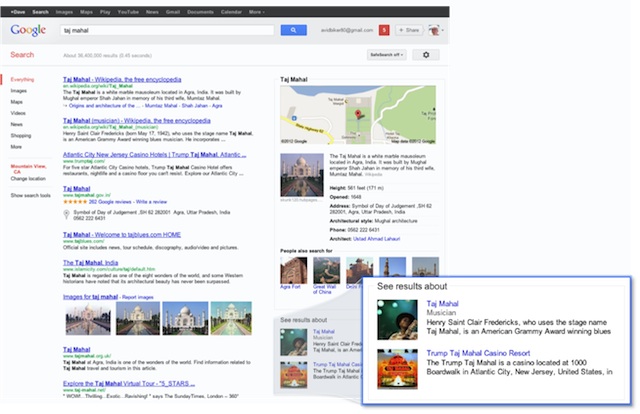
    Google’s latest search changes – introduced by Search Senior Vice President Amit Singhal – are another development, or baby step as Amit would call it, in making data more useful for us.

    The flood  of data that’s washed over us since the web arrived has left most of us befuddled. Increasingly, a basic keyword search just hasn’t been enough to find the information we’re looking for and we’ve had to trawl through pages of irrelevant information.

    One of the aims of Google’s new features is to make data more relevant to a user – so if someone in the US types “Kings” into Google, they will be given details of the Los Angeles Kings hockey team or the TV series “Kings”.

    Those details will include snippets of information about the topic. It could be the teams venue or the cast of the TV show. For tourist locations it could be some basic facts or transport information.

    Amit is particularly proud of integrating tourist information and flight details into search and Gmail which indicates Google is beginning to leverage its buyout of the ITA travel booking network last year.

    Google’s treatment of data reflects what’s happening with other services. At the recent Australian Xero conference and in an interview with MYOB executives, it’s been emphasised how knowledge is being aggregated to give customers and users better, more useful results.

    With Google’s knowledge graph we’re seeing the realisation of what big data can do, there’s many baby steps ahead but there’s a lot of potential.

    Similar posts:

  • Are IT workers the new loom weavers?

    Are IT workers the new loom weavers?

    “There are IT workers who can’t put food on their table,” complained an industry representative at an outsourcing conference.

    It’s true – there are hundreds of once well paid project managers, technicians and support staff staff who can’t get work in their industry as some tasks go offshore and others are supplanted by new technologies.

    None of this is new, we only have to think back to the heady days of the Dot Com boom when any punk with a basic knowledge of HTML could pull down six figures a year.

    Just like the loom weavers of the 17th Century who became the Luddites, the HTML coders of 1998 and the project managers of 2008 have had a short period of affluence before been overtaken by change.

    It’s something that today’s hot shot coders should keep in mind, bubbles burst and technology changes.

    Similar posts:

  • So you think services are easy?

    So you think services are easy?

    ZDNet columnist Ed Bott is possibly one of Microsoft’s closest followers and among the few to defend Windows Vista, Ed though can’t be faulted for doing the hard yards including reading Microsoft’s stock market10-K  filings.

    In their most recent filing, Ed finds Microsoft has used the word “service” 73 times as opposed to 44 appearances last year.

    A key phrase in the filing is “a growing part of our strategy involves cloud-based services used with smart client devices.”

    This is consistent with the hands on previews of Windows 8 which Microsoft have been giving journalists over the last few months. Something that leaps out is the integration with online services; something that both Google and Apple have also been pushing.

    What should worry investors is that moving into services isn’t easy. Service businesses are far more labour intensive and, as a consequence, far less profitable.

    Despite having relatively low labour costs, cloud computing services are problematic as many sectors have been commoditised, which is the genius of Salesforce in establishing a profitable niche.

    The fat margins Microsoft are used to in their core software business can’t be replicated in the cloud based markets, which is one of the reasons why customers are switching to the cloud.

    Microsoft’s problem is shared by telecommunications companies who are finding their cloud offering don’t generate the same ARPUs — Annual Revenue Per User — that they’ve become accustomed to in the mobile phone market. Which means pain for executives whose KPIs are tied to historical performance.

    For Microsoft, the problem is compounded by their simultaneous move into hardware with the Surface tablets. Meaning the company’s has to deal with two significantly different business models to the ones they are used to.

    Again Microsoft aren’t alone in this, Google is having similar problems adjusting to the hardware market though its acquisition of Motorola Mobility.

    Integrating hardware with services and manufacturing isn’t impossible, we only have to look at Apple for how a company can succeed in that space although most managements struggle with the very different demands of each sector.

    During the 1980s we saw the rise of the “all business is soap” philosophy where MBAs and management consultants preached that the challenges of running a business were the same regardless of whether you sold cleaning products, soft drinks, computers or automobiles.

    Those folk were wrong. Most famously the Australian media company Fairfax hired as CEO a business school professor who preached this philosophy and managed to ignore the rise of the Internet, the echoes of the failed McKinsey ideas haunt Fairfax over a decade later.

    While its possible for a software company to succeed at services or hardware, the magnitude and complexity of the management challenge shouldn’t be understated. Both Google and Microsoft will be defined by how well their leaders succeed.

    Similar posts: