Category: Innovation

  • Digital art is more than iPod wielding basket weavers

    Digital art is more than iPod wielding basket weavers

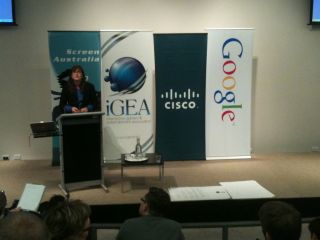
    This is a transcript of the digital arts opening keynote for the Digital Culture Public Sphere conference discussing the Australian government’s cultural strategy.

    Thank you Senator Lundy. A little bit more about me, as well as being a writer and broadcaster on change I spent 18 months with the NSW Department of Trade & Investment setting up the Digital Sydney project.

    Digital Sydneyis a program designed to raise the profile of Sydney as an international centre of the digital media industry.

    One of the problems with Digital Sydney was that it was very inner Sydney centric and this is a perennial question we face as to where does Australian culture, and art, spring from? The first idea I’d like to throw to the room is that ‘digital’ frees us from many narrow geographic boundaries.

    When we add the term ‘digital’ we hit another problem, that almost every aspect of our lives – be it in art, business or our personal lives – is being affected in some way by the Internet and digitalisation. In reality all art is becoming ‘digital’ in one way or another.

    As broadband becomes more pervasive, particularly as the National Broadband Network is rolled out, we’ll see art and the creative industries become even more digitised.

    In many ways we are today at the point in history not too dissimilar to that our great grandparents found themselves a hundred years ago. In 1911, our forebears couldn’t imagine the massive changes the century ahead would bring and we’re in a similar position in the first decades of the digital century.

    The first half of the Twentieth Century saw radio start a cultural shift which was accelerated in the second half as television radically changed and redefined our culture. Today the Internet is doing exactly the same in ways none of us quite understand.

    Given the massive disruption and technical advances we’re going through we need to be cautious about being too prescriptive as we can’t foresee many of the new technologies that will become normal to us over the next decade.

    This provides a challenge for government agencies supporting the arts as the established gatekeepers such as galleries, production studios and regional organisations become less relevant as the means of distribution evolve and become easier to access.

    We’re already seeing the traditional model of government support to big producers; be they factories, movie producers or games studios suffering as economic adjustment undermines many of their business model. The old economic development models are becoming irrelevant as history overtakes them.

    It may well be that the role of governments over the next decade is to create a framework that allows new mediums, creation tools and distribution channels to develop.

    One area we should be careful of when looking at the digital future of the arts is not to follow the UK’s Digital Economy Act where the protection of existing rights holders took precedence over the creative process.

    It is important that governments create legislative frameworks that balance the rights of all stakeholders, consumers and new content creators with the objective of encouraging new works and innovations to evolve.

    In an Australian context we need to acknowledge and develop our diverse population and the opportunities this presents. Our indigenous and immigrant communities with their artistic and cultural traditions give our national economy advantages that many other countries lack, this is one thing I regret I wasn’t able to push more in my role with the NSW government.

    Education is another critical area, this isn’t just in the arts but right across Australian society and industry as new entrants into the workplace are expected to spring forth with the skills making them as productive as experienced workers, this is clearly a flawed idea, particularly when many of the tools business expects students to be skilled in weren’t invented when the students started their studies.

    Over the next decade we’ll also have to confront one of the great Twentieth Century conceits; that artists are a separate breed from scientists, Engineers and business people.

    Prior to the beginning of the last Century it was accepted a tradesman or inventor could also be an artist and this damaging idea of silos between creative and so called ‘real’ industries, suited only to a brief period of our mass industrial development, will have to forgotten. This will be a challenge to our governments, educators and training providers.

    The digital arts are not about iPad wielding basket weavers, they about giving today’s workforce the creative tools and flexible, imaginative thinking to meet the challenges our mature, high cost workforce faces in a world where the economic rules are changing as fast as our technology.

    We have a great opportunity at events like today to determine how we as a nation will benefit from the next decade’s new technologies that will change our arts communities and society in general.

    The great challenge to policy makers will be dealing with the rapidly changing and evolving world that the digital economy has bought in the arts, in business and in society in general.

    Today I’m sure we can bring together ideas on how we, and our governments, can meet these challenges.

    Thank you very much Senator Lundy, Minister Crean and Pia Waugh for giving the community an opportunity to contribute to the development of this valuable policy.


    Similar posts:

  • Price points

    Price points

    It’s no coincidence Amazon’s media release announcing the new range of Kindle e-book readers was headlined introducing the All-New Kindle Family: Four New Kindles, Four Amazing Price Points.

    The $79 price for the base model has authors excited, and quite rightly too as this will guarantee sales of the e-readers and spur sales of e-books.

    Once a product’s perceived as being affordable by the market, sales take off. The classic is Josiah Wedgwood selling bone china at prices affordable to the 18th Century English working classes. The basic product was similar in all but the decoration to the ornate wares Wedgwood sold to Europe’s royal families and the then new methods of mass production guaranteed a quality product to all customers.

    Just over a century later, Henry Ford did a similar thing with the motor car, meeting the price points that made the horseless carriage accessible to the middle classes in early 20th Century United States.

    In more recent times we’ve seen similar trends happen; the under $2,000 personal computer in the 1990s, the sub $500 netbook in 2008 and the affordable smart phones of recent years.

    We can add broadband Internet and budget airlines as other examples of how demand has exploded when the cost has dropped below a certain price point.

    As technology becomes affordable, we use more of it. A point that’s often lost monopolists and established players in industries.

    This is the real opportunity Amazon are now offering with the cheap Kindles and we’ll see e-books boom as people are prepared to make a small investment in the devices.

    Almost certainly this will open new markets and unforeseen opportunities for entrepreneurs and writers. The resulting pressures on competitors like the Apple iPad and the various Windows or Android tablet devices should increase innovation as well.

    In our own businesses we need to ask what those price points are and what is stopping us from meeting them. As other price busters have shown, if you can meet these price points, the riches are there for the taking.

    Similar posts:

  • Do you have customers or just users?

    Do you have customers or just users?

    “I was on your mailing list for general info, for spams and scams etc which were helpful. Suddenly it changed and now the business format is not useful to me” said an lady when unsubscribing from one of my newsletter mailing lists.

    The lady concerned had been on one of the mailing lists for over ten years and, once upon a time, had been a paying customer for my old business, PC Rescue. Although we’d only earned a $100 off her and that was seven years ago.

    While it’s sad to lose a subscriber – you don’t run a service business for twelve years without caring about those who use your services – the question is was the lady really a customer?

    This is an important distinction where many of us are giving away much of our knowledge for free; are our users really customers?

    For the social media and web2.0 sites, this is easy; users are the raw material for their aggregated and segmented data feeds and audience, the customers are the advertisers. This is just a modern twist on the broadcast model that sustained the radio and TV industries for most of the 20th Century.

    Many of those social media platforms aren’t making much money from that data and there’s a good argument those who are have been wildly overvalued by investors.

    The value of user data, whether it’s aggregated or identifiable appears to be nowhere as high as most of us think, unless you intend to rob your users’ bank accounts.

    Overvaluation of your customer, or user, database is a common problem for smaller businesses too. If you’re the local plumber, computer repair guy or coffee shop then the value of any mailing list is probably way overstated – the only metric that ultimately matters to the business is how much money you’re making from the customer.

    If you care about the people that you deal with, this may be a hard reality to face but those who visit your shop, subscribe to your newsletter or download your free e-book aren’t your customers, only those who are prepared to pay are.

    This is something we have to understand in this era of abundant free information and online services. The challenge for most of us is how many users we can convert from being window shoppers and freebie seekers into customers.

    Similar posts:

  • The quiet revolution

    The quiet revolution

    Earlier this weekPricewaterhouseCoopers released their Productivity Scorecard, which showed Australia’s business efficiency isn’t improving as fast at it once was and the country’s relative performance is steadily slipping down international tables.

    One of the notable things in the PwC report is the massive growth of productivity in the 1990s, a point emphasised by the accompanying paper on business productivity in a presentation by economist Saul Eslake last month to the Reserve Bank of Australia.

    Economists attribute most of this late 20th Century growth to deregulation and privatisation by governments in the 1980s and 90s but the driving force was really computerisation that allowed most businesses to do much more with less.

    Immediately noticeable for an Australian walking into a British, European or Japanese office during the early 1990s was the lack of desktop computers.

    Australian businesses adopted technology a lot quicker than their counterparts outside of North America and this alone was probably responsible for the country’s relatively good productivity growth in that decade.

    The arrival of computers – followed by desktop printers and Internet access – suddenly gave small businesses access the means to do jobs that even the biggest corporations had struggled to do previously and drove a rapid reorganisation of most offices.

    Everybody from secretaries to architects and graphic designers to lawyers – even economists – suddenly found they had the tools at their fingertips to do work they could have only dreamed of prior to 1990. This drove massive productivity gains in businesses of all sizes.

    From 2000 onwards, things became tougher as the easy gains had been made and the incremental improvements in technology, such as smartphones, cloud computing and web publishing didn’t have the same substantive effect the early PCs delivered with spreadsheets, word processing and desktop publishing.

    The real challenge we now face in business – and government – is to start harnessing cloud computing driven online services that promise to deliver similar productivity gains to what we saw twenty years ago.

    We have the tools; online office apps, Customer Relation Management services (CRM) and sharing platforms all deliver major improvements in the way we work within our businesses and with external partners like contractors, suppliers and event clients.

    One of the most powerful aspects of cloud computing services is reduced capital cost meaning reduced barriers to entry into markets we previously may have thought were safe.

    This easy access into established sectors is one of reasons the retail industry’s giants are now struggling as online competitors can setup cheaply and quickly while offering better prices and service.

    Retail is only one of the more obvious sectors being changed by these technologies and as the decade continues we’re going to close to every industry be radically changed by low cost computers accessing the Internet.

    As business owners and managers we need to look at our own processes and systems with an eye on how we can improve workflows and customer service within our organisations.

    Those of us who manage to get these new technologies are going to reap the benefit of the next productivity wave, those who don’t are going to go the way that many uncompetitive and slow to respond industries did in the 1980s.

    Similar posts:

  • A Capital Question

    A Capital Question

    How do you raise funding for new venture? Business coach Lindy Asimus asked over the weekend. It’s a question that perplexes many people starting out a new enterprise or trying to grow an existing one.

    The real question though is “how much capital do you need?” Being undercapitalised will often stunt a venture’s growth and is probably the reason why many otherwise excellent business ideas fail to achieve their potential.

    How much money do you need?

    While business plans are often disparaged, one of the great advantages of doing one is the budding entrepreneur gets an idea of the capital required along with the cash flow required to service any debts. Even if the business plan itself is filed away and never looked at again, understanding the upfront cash requirements can help avoid some nasty mistakes.

    The other key factor is the business itself, if you’re buying a fast food franchise, setting up a store or fitting out a restaurant then there’s going to be some big upfront capital costs involved before you start trading but there is more to it than just the immediate cash needs.

    What is the type of business?

    A business’ capital needs are going to vary with the type of business and the objectives of the owners, not just in size but also in type. As business writer and educator Steve Blank says, there are six types of startups and for certain types an equity investment from say an angle investor or venture capital company will be more appropriate than a bank loan.

    For small businesses, the type that Steve Blank describes as “work to feed the family” businesses, a bank loan that can be paid back out of cashflow is going to be the most obvious way to fund an enterprise while it would be rare a venture capital investor would even answer a phone call from such a business.

    On the other hand, a family member or friend might be interested in taking equity in such a business, the old “families, friends and fools” is a time honoured way of setting up a venture.

    Government grants

    In these times of rampant corporate welfare for big banks and major corporations, it’s tempting to think the government may be able to help the small businessperson. Sadly most of the grants available are small sums for specific purposes like export programs or hiring trainees, they aren’t designed or intended to provide entrepreneurial capital.

    Bootstrapping and “sweat capital”

    Most businesses though are best served by “bootstrapping” and “sweat capital” for most, particularly in the service sectors, funding your business out of cashflow and the hard work of the founders is the way to grow a viable enterprise.

    The term “sweat capital” refers to the founders working hard and capitalising their businesses from the sweat of their brows while  scrimping and saving every penny. Most founders of successful businesses have stories of spending years expending that “sweat capital” while living on cheap pizzas or packet noodles.

    Bootstrapping, funding your business through sales, is the other great capital source. In many ways, this is the best form of capital in that it proves a business is viable and doesn’t involve signing over assets to banks or giving equity away to investment partners. Again a well thought out business plan quickly shows whether this is feasible.

    So the question of capital is complex, but having enough is always the biggest struggle for those starting a business.

    Of course it is possible to have too much capital and we might talk about that in another blog post.

    Similar posts: