“Location, location, location” is the mantra for real estate investors and property speculators, that rule is just as true for those setting up a shop or cafe.
When you pay attention to the retail strips or malls in your suburbs you’ll notice how some locations are doomed to fail.
The featured picture in this post is what should be a good location in the centre of a dining strip in an affluent Sydney suburb. Just fifty metres either side of the premises are successful and long running cafes.
However this spot has had five different business fail in the last three years and in the past decade hasn’t had a single stable tenant.
The question is what causes this? Is it because the landlord’s are greedy?
In some cases it is, the featured premises had a stable tenant in a very nice and well priced fish restaurant for many years. When the landlord jacked up the rent, the seafood cafe moved out and the place has struggled ever since.
Something many people have mentioned to me over the years is how difficult they find it to negotiate on price with landlords over commercial space with the owners very reluctant to budge on rents.
Often, the letting agents are prepared to throw in sweeteners like fitout costs, rental holidays or paying utilities but it’s very rare that the headline rent will be negotiated down.
Part of this could be due to the properties being valued as a multiple of their monthly rents; so if the leasing rate falls, so too does the property value which is bad news for the landlord and their bank.
When landlords get too greedy properties lie vacant for a long time. A good example is nearby to the featured property.
The bike shop that occupied this unit for about 12 months moved out over two years ago and before that it had been vacant for a long time. Despite being on a busy commuter strip in an affluent suburb, it’s a lousy location with poor visibility, truly awful parking and lousy amenities.
In a genuine free market the rent should fall until a business that can operate in such a low turnover location can afford it, that no entrepreneur can make the numbers work indicates the asking price is too high.
Although even the cheapest rents won’t help a truly blighted location which is why it might be a good idea to ask around the local shops and residents to see how a location has performed before signing that lease.
It would be a shame to doom your business because of a lousy choice of location.
Regular visitors to San Francisco would notice how the city has changed in the last few years.
Companies that were setting up in Silicon Valley are now basing themselves downtown, the business community is energised and the seedier parts of the town are looking substantially spruced up.
Laurel is the council’s Director of Business Development and we discussed how the local government has worked with the community and business leaders to drive San Francisco’s economic growth.
The shift from Silicon Valley
A striking change in the tech industry is how the startup focus has shifted from Silicon Valley fifty miles away to downtown San Francisco. Laurel puts it down to a shift in the priorities of the sector.
“I think we benefited from a shift in the tech industry, being much more focused on design and user experience,” says Laurel.
“The people who are investing in that are people who want in San Francisco and people who want to live and work in the same city.”
“A lot of the entrepreneurs creating those companies are concerned their employees see people using their products, they want them riding the bus to and from work and see people interacting with their products.”
Changing the tax code
Like Barcelona, the Global Financial Crisis shook the city up, “with the economic downturn our whole city made jobs a top priority.”
Part of that review focused on the disadvantages of basing a business in San Francisco.
“It was bought to our attention that we were the only city in California that taxed stock options.” Laura says, “companies that wanted to go public were having to leave San Francisco to afford it.”
“We did an entire revision to our tax code which showed to investors they could count on San Francisco to be business friendly.”
Regenerating communities
Along with the problem of city taxes, the city was facing the problem of regenerating blighted neighbourhoods and the administration decided to address both problems together by offering incentives for businesses to setup in the mid-market district – I’d been warned not to call it ‘The Tenderloin.’
“We had a neighbourhood that was facing a lot of blight and we had not been able to successfully increase business and we had companies like Twitter telling us that our payroll tax was causing them problems and making it hard for them to grow in San Francisco,” Laura tells.
“So we combined those two problems and made it so a San Francisco company was able to move into a neighbourhood that needed more investment and business and it would be able to save some money while helping us improve the neighbourhood.”
The future for San Francisco
A common point when talking to city leaders and economic development agencies around the world is the focus on building a diverse economy and Laura sees that as part of the future for San Francisco.
In that vision includes manufacturing, biotechnology and tourism along with the internet based industries that are today’s investment and media darlings.
The focus though is on the city’s residents and how life can be improved for everyone, not just the business community and high tech investors.
“We are really focused on creating an economy for all,” says Laura. “We want to remain as diverse as possible.”
“Every San Franciscan, from no matter what socio-economic background, has a place that they can be.”
Coffee’s view is that the internet of things is an opportunity to delight the customer with proactive service that allows companies to fix customers’ problems before they happen.
Zero planned maintenance
Taking this idea further is GE’s Chief Economist, Marco Annunziata, who sees the internet of things as an opportunity to introduce the concept of Zero Planned Downtime where there is no need to stop machines for scheduled repairs and maintenance.
“A lot of the maintenance work is done on a fixed schedule,” Annunziata. “You end up wasting time and money servicing machines that are perfectly fine.”
“On the other hand you might miss that something is about to go wrong between two maintenance periods.”
“The idea of the industrial internet is that by gathering so much data from these machines themselves – plus having the software to analyse this data – you will have information that flags to you when intervention is needed.”
Annunziata’s view is that connected machines won’t need to have regular service intervals, instead of insisting a car has an inspection every ten thousand kilometers where the tyres are replaced and the oil changed, often unnecessarily, the vehicle need only be called in for maintenance when its sensors flag that a part or consumable needs attention.
Finding the benefits
While that can mean big savings for car owners, it’s in fields such as aviation, mining and logistics where the greatest benefits of Zero Planned Downtime would be found.
For businesses it’s another example of how they will fall behind if they don’t invest in modern technology as those who invest in newer, connected equipment will be able to reduce downtime and maintenance cost.
How achievable Zero Planned Downtime is in many fields remains to be seen, not least because of regulatory hurdles in sectors like aviation, however the idea does promise to change the business model of companies that depend upon service revenue.
It turns out his bravery wasn’t rewarded as Blackberry’s brave attempt to reclaim their smartphone market share failed and now their hopes of a private equity takeover has failed with Heins announcing his resignation.
Still he walks away with several million dollars, so life isn’t too hard for Thorsten.
For Blackberry though the struggle continues with the company hoping to raise a billion dollars through a convertible note issue. It would be an investor braver than Thorsten Heins who takes that offer.
Spain and Barcelona have faced challenges in recent years as the economy was hit hard by the 2008 crisis. Now the city is looking to the internet for the next wave of prosperity.
This quest for reinvention isn’t new for the city, “Barcelona used to be an industrial city, that was badly hit by the economic crisis of the seventies,” said Deputy Mayor Antoni Vives. “There were some guys in the city at the time that decided that we had to keep on being an important city.”
“There’s a new generation of politicians, civil servants, of thinkers and people committed to the city that ten years ago started to work on a new phase of what the city was to become.”
Antoni Vives – Deputy Mayor of Barcelona
“We decided that Barcelona had to become the edgiest city in the world related to the new revolution and the new revolution was this one — the technology related to mobility, devices and mainly the internet.”
That vision resulted in Barcelona starting to rewire the city which was one of the reasons for Cisco choosing the city as the venue for its inaugural Internet of Things World Forum.
As part of the event, the City took delegates on tours of some of the connected infrastructure the city has installed. Here’s what we learned on the press tour.
The digital bus stop
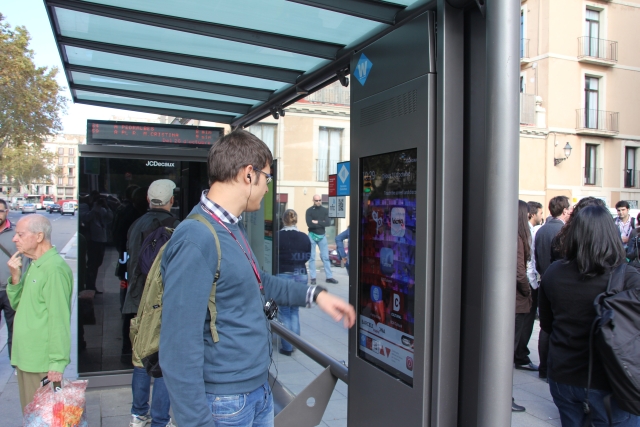
Digital bus stop
The digital bus stop is one of the prides of Barcelona, not only does it display digital advertising and real time bus schedules it also offers tourist information, USB charging sockets and acts as a free WiFi base station.
One of the barriers Barcelona has encountered has been the Spanish telecoms regulators objection to the city providing municipal WiFi so services are restricted to the city’s property, which happens to include bus stops.
The bus stops themselves are connected to the city’s fibre network that runs most of the backhaul and connects many of the fixed devices.
Smart parking spots
Smart parking space
Connected to the city’s WiFi network are these smart parking spaces that detect the presence of cars through a combination of light and metal detectors.
The city’s plan is that payment and monitoring of the smart parking spots will happen online and with smartphone apps.
Powering the dot, which is a fairly dumb device, is a battery with an expected five to seven year lifespan. Interestingly, the dots don’t work with motorcycles.
One of the reporters on the tour questioned the durability of these devices given Barcelona doesn’t get extreme temperatures, the response from the Cisco and city staff indicates that ice or hot weather may shorten the lifespan of these devices.
Smart lighting and monitoring
Smart lights and monitors
In the square outside the Born Cultural Centre, the city has installed a row of streetlights with multiple features including CCTV, air monitoring and Wifi. All of these lights are connected to the city’s 500Km long undeground fibre network.
The fibre network itself is being installed progressively as the city carries out routine maintenance to roads and other underground services. By co-ordinating the work with other trades it reduces the installation cost dramatically.
Smart censors in the street lights
Smart rubbish bins
Smart rubbish bins in Barcelona
The connected garbage bins are one of the showpieces of the city’s services. By monitoring trash levels, the council’s sanitation team can plot the optimal routes for collection services.
Smart rubbish bins sensor
Again the sensors on the bins are fairly dumb devices that connect wirelessly to a base station, shown on the pole above the bins in the earlier photo, these track rubbish levels and later versions are expected to detect the presence of obnoxious or hazardous materials that might be dumped in the bin.
Single person operation of the connected garbage truck
Operators of the garbage trucks get real time updates to their routes which optimises their productivity. It’s cost savings in the city’s operations which is one of the key drivers for the city’s investment in these technologies.
Power savings
Smart lighting systems
One of the major cost savings identified by the Barcelona Council is in energy costs. Along with the expense of running garbage trucks unnecessarily are power bills.
Part of the smart lighting system is that it will dim when there’s no motion detected in the streets and lighten when pedestrians are around. This is intended to save money and help the city meet it’s zero carbon emission targets.
Barcelona and the future
Every single one of the technologies being shown today in Barcelona will be commonplace in most developed cities in the near future.
The problem for adopting these systems is going to be connectivity, in places where there aren’t the fibre optic services or easily deployed WiFi it will be difficult to install smart devices and monitor them.
Every major city is going to be facing the question of how they deploy these devices over the next decade as their residents expect better and more efficient service. Barcelona has taken the first steps that most others will follow.