Category: Investment

  • Can Australia continue the mining employment boom?

    Can Australia continue the mining employment boom?

    The Prime Minister’s comments at the ADC China Forum last week raised an important question about Australia’s mining boom – can the industry sustain employment as the construction of mines, ports and railways are completed?

    After her keynote speech at the event’s gala dinner the Prime Minister was interviewed by Busines Spectator’s KGB – Alan Kohler, Robert Gottliebsen and Stephen Bartholomeusz – about the country’s relations with China.

    In that interview, the Prime Minister was upbeat about the continued employment bonanza from the resources boom.

    I think overwhelmingly the prospects are good for resources. There is nothing to fear here. The absolute peak of the price cycle has probably passed, but we will still be doing good business in resources. It will be supporting jobs.

    A few days earlier Fortescue Mining Group’s CEO, Nev Power, spoke to Alan Kohler on Inside Business.

    Nev was a little more circumspect about the prospects for continued booming employment in the mining sector.

    our capital expenditure program and expansion is coming to an end around mid-year. And then we’re into a very high volume phase and it’ll be a matter of driving the maximum efficiency out of the business through that phase.

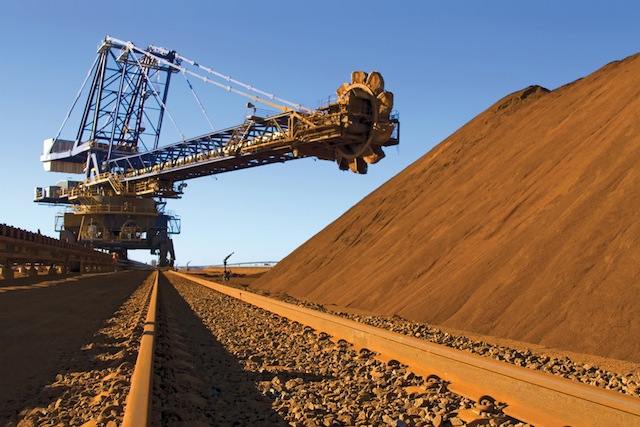
    So even if the iron price and export volumes do hold up, it looks like the resources employment boom may be reaching its end as mining projects move from the labour intensive construction phase to being relatively hands off production mines.

    If Nev gets his way with ‘maximum inefficiencies there may be fewer jobs to go around.

    The Prime Minister – along with all of Australia’s political leaders – remains hopeful, as she said in her speech.

    So we are not, indeed we have never been, simply a quarry or a beach; ours is a diverse and sophisticated economy and a valued trading partner with the biggest global economies.

    As the expansion phase of the mining boom tails off, that economic diversity is going to be tested. Hopefully there is a Plan B.

    Similar posts:

  • What is a fully informed market?

    What is a fully informed market?

    Given the stock market movements following last week’s Associated Press Twitter Hack it may be time to reconsider the way exchanges and listed companies share and control information.

    One of fundamental principles of modern stock exchanges is that the market is fully informed – that everybody buying or selling security gets access to the same information at the same time.

    In an Australian context, this is covered by a term called ‘continuous disclosure’, should a company’s management become aware of any issue that could affect they must advise the market immediately.

    What’s interesting with this principle is the way that information needs to be made public, specifically clause 15.7 of the ASX listing rules.

    An entity must not release information that is for release to the market to any person until it has given the information to ASX and has received an acknowledgement that ASX has released the information to the market.

    This puts the Australian Securities Exchange, a private company with an almost monopoly position in the Australian investment community, in the position of being the ultimate gatekeeper of knowledge.

    While there’s good regulatory and probity reasons for having a central clearinghouse – that the clearinghouse itself has some serious conflicts of interest is another matter – one has to wonder how long its position can be retained in a world where information is moving fast.

    It may be however that we’re in a passing phase as the financial of the global economy has reached a stage where no stock exchange, futures market or clearinghouse can manage the data that’s flowing through it.

    Time will tell, but the markets themselves are finding other ways to inform themselves.

    Similar posts:

  • Australia’s entrepreneurial opportunity

    Australia’s entrepreneurial opportunity

    The recent PwC report Startup Economy – How to support tech startups and support Australian innovation focused, naturally enough, on the barriers to developing a Silicon Valley like business community in Australia.

    Unlike most coverage of the report, The Economist raised an interesting point from the findings, that entrepreneurial Australians are far more likely to start up businesses than many other nations.

    PWC-international-entrepreneur-funnell

    On one level this isn’t suprising as starting a business in Australia is easy compared to many other countries with the World Bank’s Doing Business survey rating the country second after New Zealand for the ease of setting up an enterprise.

    Interestingly though, the number of Australians setting up their own businesses is falling reports Smart Company, citing the Productivity Commission’s Forms of Work in Australia report.

    The Productivity Commission speculates this might be because the mining boom is encouraging workers to take resource contracts rather than set up their own businesses.

    No doubt there’s some truth there, as much of the nation’s investment has been directed into the mines and associated infrastructure in recent years however there’s probably some more mundane reasons.

    Top of the list would be the nation’s property obsession; it’s difficult to service a massive mortgage while running your own business.

    Fifty years of mainly increasing property prices has groomed Australians into believing that having a steady job and a brace of investment properties is a much easier path to success than taking a risk with your own business.

    Added to that is the increasing hostility towards businesses. As the nanny state grows, regulations that make it harder for business multiply, the latest example being a Sydney council that wants to charge professional dog walkers for using parks.

    Overwhelmingly these petty regulations hurt those starting new businesses rather than bigger corporations.

    The good news though is that people still want to start their own businesses. In an economy that’s increasingly concentrated in fewer hands, diversification is critical.

    In a world that’s becoming increasing automated, we need smart startups finding ways to use the new tools and create the jobs to run them. If Australia can get its policy mix right, kick the property and nanny state addictions then it might open some great opportunities.

    Similar posts:

  • Starbucks Coffee as a digital innovator

    Starbucks Coffee as a digital innovator

    USA Today has an interesting interview with Starbucks CEO and founder Howard Schultz.

    It’s worth watching as he maps out where the coffee chain is heading and the importance of innovation and relevancy to his business.

    Schultz’s view about the coffee store of the future is intriguing – he knows it will be different but he doesn’t know in what way and that’s why his business is experimenting with different ways of doing things.

    “Sure, we’re doing work now on the store of the future,” says Schultz. “It is not only linked to the physical but the digital experience.”

    It’s not only the use of digital tools, social media and mobile payments that Schultz is exploring, it’s how does such a huge chain remain relevant to its customers.

    “We have to answer the question in the affirmative about how to maintain relevancy. Relevancy can’t only be in the four walls of our stores, we have to be as relevant with our customers where they work, play and even on their phones.”

    Relevancy is something that can’t be taken for granted by any business – becoming irrelevant to customers is a death-knell for most enterprises. This is something that challenging the media industry as its struggles to find its role in changed society.

    On the same day that story was posted, IBM’s CEO Virginia Rometty made a pointed address to her 434,000 employees on where the company has fallen behind.

    “Where we haven’t transformed rapidly enough, we struggled,” The Wall Street Journal reports. “We have to step up with that and deal with that, and that is on all levels.”

    “Our performance reminds us that there are profound shifts under way in our industry.”

    That the world’s biggest coffee chain is dealing with those profound shifts better than one of the biggest technology companies is a notable point about the times we live in.

    Similar posts:

  • Crying over spilt Chinese milk

    Crying over spilt Chinese milk

    East Asian based expats have many conceits – the greatest being that they understand Asia.

    For a high paid executive based in Hong Kong or Singapore sitting in a comfortable air conditioned CausewayBay or Beach Road highrise it’s easy to not to know what you don’t know.

    In Bangkok though the drinkers at Bangkok’s Cheap Charlies Bar are under no illusions about the complexity of Asia as every night brings another surprise.

    During the 1990s it was a regular drinking haunt of those working on the ground in South East Asia – aid workers from Cambodia, oil explorers from Vietnam. gem traders from Laos or builders in Myanmar all swapped stories about their trials and tribulations.

    One of the toughest jobs was setting up a diary industry in tropical Thailand, no trivial task in an environment that isn’t kind to soft, milk producing cattle.

    Through the late twentieth century the Australian government spent millions helping build the Thai industry with the intention of it helping the Aussie industry build markets and expertise.

    Sometime in the late 1990s, the Australian industry decided programs like these were all too hard and not only withdrew from the Thai and Malaysian markets but also let the Chinese opportunity slip through their fingers.

    Today, as Business Spectator reported last week, New Zealand’s Fonterra is not only beating the Aussies in China but also has substantial holdings in Australia as the company’s website describes;

    The company has NZ$11.8 billion in total assets and revenues of NZ$13 billion and employs more than 18,000 people worldwide. In Australia, Fonterra has revenues of $1.9 billion, processes 21 per cent of all Australian milk and employs over 2,000 people. This makes Fonterra very much an Australasian company.

    Fonterra’s story, both in China and Australia, illustrates how something went amiss in Australia’s business sector in the late 1990s.

    The point of Australia’s deregulations and industry consolidations through the 1980s and 90s was to make local businesses and industries more competitive. Instead those Australian conglomerates have been sold to overseas interests as domestic investors find they aren’t interested in investing.

    Instead Australian businesses decided that having being allowed to consolidate they could use their market power to clip the tickets of the industries they controlled rather than innovating or expanding internationally.

    At the same time, Australia’s compulsory savings scheme poured billions into the local share market leaving boards under no pressure to perform better than the index.

    The lazy investing philosophy forced internationally focused businesses to look for overseas investors and has created the steady flow of Australian business, farming and mining assets being sold onto overseas buyers.

    In the meantime, the shock jocks and populists whip up xenophobia rather than holding Australian business community to account for its failure to seek and build new markets.

    This doesn’t mean bad news for young Australians, there are opportunities for smart, innovative and hard working entrepreneurs to challenge the country’s staid duopolies.

    If we choose not to challenge the comfortable duopolies, it may be the next generation of Aussie expats find more opportunities at Cheap Charlies in Bangkok than at home.

    Similar posts: