Category: Investment

  • Penny wise and pound foolish

    Penny wise and pound foolish

    “We were penny wise and pound foolish” says Peter Trimble, Finance and Systems director of the V8 Supercars, about the IT setup he found when he started with the motor sport organisation 18 months ago.

    The V8 Supercars were like many businesses who had outgrown their basic IT setup and were struggling as a result.

    A touring organisation – “a travelling circus” as described by CEO David Malone – with 15 races in Australia, New Zealand the US has some fairly unique challenges as contractors, teams and a dispersed workforce put demands on the businesses which a basic small business system struggles to cope with.

    What Trimble found at the business were employees struggling with cheap internet connections and antiquated, inadequate servers.

    Focusing on the pennies and missing the bigger picture is a common problem when managements skimp on technology which leaves their staff spending more time on IT problems than getting their jobs done.

    Basically the $80 a month home internet connection doesn’t cut it when you have more than two or three workers and the server that worked fine when those people were in the same office becomes a security risk when a dozen a people are trying to login over the Internet.

    It wasn’t surprising the V8 Supercars management decided to go with a cloud computing service – in this case Microsoft Office 365 – and invest in proper, reliable internet connections.

    What the Supercars found that being penny proud and pound foolish with IT doesn’t work for a business, office tech is an essential investment.

    Paul travelled to the V8 Supercars in Launceston courtesy of Microsoft Australia. 

    Similar posts:

  • Corporate palaces and the new Ceasars

    Corporate palaces and the new Ceasars

    One of the key traits of managerialism is executives spending vast quantities of shareholders’ money on opulent corporate headquarters, is Apple the latest company to succumb to this disease?

    Building a new headquarters is fun for managers. One company I worked for in the early 1990s was debilitated for months as executives spent most of their time moving walls, rearranging desk positions and changing lift designs to reflect their status as grand visionaries.

    For the company gripped with delusions of management grandeur a flashy head office is the must have accessory. It’s the corporate equivalent of the Skyscraper Index and is almost as good a predictor that a change in fortunes is imminent.

    Apple’s new headquarters is nothing if not impressive. Bloomberg Newsweek reports the building which, at two thirds the size of the Pentagon, will house 12,000 employees is currently estimated at costing five billion dollars, sixty percent over the original budget.

    The plans call for unprecedented 40-foot, floor-to-ceiling panes of concave glass from Germany. Before the Cupertino council, Jobs noted, “there isn’t a straight piece of glass on the whole building?…?and as you know if you build things, this isn’t the cheapest way to build them.”

    With over a $120 billion in cash, Apple can certainly afford to spend five or ten billion on new digs despite the grumbling of shareholders who have had to settle for a stingy 2.4% dividend from their shares.

    The big question though for Apple shareholders though is whether a project like this indicates a company that has peaked with management more intent on building monuments to itself or its genuinely visionary founder rather than deliver returns to owners or products to customers.

    On the latter point, there’s no evidence of Apple losing their way with their products yet, but it’s something worth watching in case management becomes distracted with their building project.

    For the company I worked for, the distracted managers all vanished one day when the main shareholder of the Thai-Singaporean joint venture discovered they’d been fiddling the books. They probably needed to pay for the office fit out.

    Similar posts:

  • Are Australians too risk adverse for startups?

    Are Australians too risk adverse for startups?

    Last week I had coffee with Clive Mayhew who chairs the board of Sky Software, a Geelong based student management cloud service.

    Clive covered a lot of interesting aspects about Sky’s business; including the opportunities for regional startups, government support and his experiences in Silicon Valley during the dot com boom. All of which I’ll write up in more detail soon.

    One notable point Clive raised was how he struggles to get Australian staff to take equity in the business – people want cash, not shares.

    The question Clive raises is why and that question is worth exploring in more depth.

    My feeling is that it’s a cultural thing related to property – four generations of Australians have been bought up believing housing is the safest way and surest way to build wealth.

    As a consequence young Australians are steered into getting a ‘safe’ job and plunging as much money into accumulating property equity as early as possible. Just as mum and granddad did.

    Even those who don’t want to play the property game are affected as property speculation pushes up prices and rents; the landlord or bank won’t accept startup stock to pay the bills so employees need cold, hard cash to keep a roof over their heads.

    The other angle is tax and social security policies, through the 1970s and 80s various business figures used share option schemes to minimise their taxes and successive Australian governments have passed laws making it harder for businesses to offer these incentives.

    Interestingly this not only affects the Silicon Valley tech startup business model but also hurts the aspirations of Australia’s political classes to establish the country, or at least Sydney, as a global financial centre.

    Putting aside the fantasies of Australia’s suburban apparatchiks – which if successful would see the country being more like Iceland or Cyprus than Wall Street or the City Of London – it’s clear that the existing government and community attitudes toward risk are reducing the diversity of the nation’s economy.

    That the bulk of the nation’s mining and agricultural investment, let along startup funds, comes from offshore despite the trillion dollars in compulsory domestic superannuation savings is a stark example of risk aversion at all levels of Aussie society, government and business.

    For those Australian entrepreneurs prepared to take risks, the risk adverse nature of most people becomes an opportunity as it means there’s local markets which aren’t being filled.

    The problem for those local entrepreneurs is accessing capital and that remains the biggest barrier for all small Australian businesses.

    How this works out in the next few decades will be interesting, it’s hard not to think though that Australians are going to have to be weaned off their property addiction – whether this takes a harsh recession, retired baby boomers selling down their holdings or government action remains to be seen.

    In the meantime, don’t base your business plan on staff taking equity as part of their employment package.

    Similar posts:

  • Too many presidents spoil the enterprise computing broth

    Too many presidents spoil the enterprise computing broth

    Last week Oracle, the world’s third largest software vendor, had an eight percent drop in its stock price  after the company missed earning estimates.

    Part of the research for are article I’m writing on the company involved digging into the organisational structure of the company and interestingly it has a pair of ‘co-presidents’ – Mark Hurd and Safra Katz.

    Safra is the Chief Financial Officer who has a pretty powerful CV and seems well qualified for the job of controlling the finances of a $150 billion dollar company.

    Mark on the other hand is my favourite IT executive, his tenure at HP is a case study in the entitlement culture of modern managerialism and no small reason for that company’s present day problems.

    The analyst briefing (free subscription might be required) following Oracle’s disappointing reports betrays a little bit of tension between the two. First Safra;

    We’re not at all pleased with our revenue growth this quarter. So it didn’t help that our quarter ended on the same day as the sequester deadline. What we really saw is the lack of urgency we sometimes see in the sales force as Q3 deals fall into Q4.

    Since we’ve been adding literally thousands of new sales reps around the world, the problem was largely sales execution, especially with the new reps, as they ran out of runway in Q3.

    It seems there’s a touch of ‘dog ate my homework’ in mentioning the US political sequester, but the message is clear – “what we really saw is the lack of urgency we sometimes see in the sales force.”

    These are IT sales people we are talking about, ‘a lack of urgency’ is an insult to a group of people who have been known to work 120 hour weeks and sell their grandmothers if it means getting a fat commission.

    Mark is in the poo. We quickly learn why when it’s his turn to speak,

    We’ve added over 4,000 people to the Oracle sales force in the last 18 months. We’ve significantly expanded our customer coverage. We’ve seen material growth in our pipeline. But Q3 [conversion rates] were below what we expected, while our actual win rate went up.

    An investor would hope there’s material growth in the sales pipeline when you’ve added 4,000 salespeople to your workforce.

    In Oracle’s case though revenues have fallen .8% for the year and are only up 2% over the time Mark’s added all those go-getting Willy Lomans to the company’s payroll.

    The interesting thing with Oracle’s figures is the company has spent nearly $400 million on restructuring costs over the last year, has hired over 4,000 new sales people and yet total operating costs, and margins, have barely moved in that time.

    Which indicates somebody in Oracle is bearing the costs of Mark’s hiring spree.

    During Hurd’s tenure at HP, he was notorious for penny pinching and cutting worker’s benefits. While staff were finding they were stuck in economy for international business meetings, Mark himself was staying at some of Europe’s best hotels and showing off his bank account to attractive employees.

    Hopefully history isn’t repeating itself.

    Probably the most perplexing thing with Oracle today are Mark’s and Safra’s roles of c0-Presidents. What on Earth are those roles?

    Most telling with the co-Presidents is that they aren’t really in charge – if Larry Ellison, the CEO and founder, wakes up one morning and decides either Safra or Mark have to go then they’ll be out of the company well before lunchtime.

    Along with carparking spots, inflated executive job titles are good indicator an organisation’s management is focusing on it’s perks, benefits and privileges rather than delivering for customers and shareholders.

    Perhaps Oracle’s analysts and common stock holders should be focusing more on management’s behaviour more than the details of the company’s sales performance.

    Similar posts:

  • Social media’s irrational exuberance comes to an end

    Social media’s irrational exuberance comes to an end

    Last week saw the annual Y Combinator demo day where the startups funded by the incubator get to strut their stuff and it appears the age of social media hype is over.

    In the Wall Street Journal’s Digits blog, Amir Efrati reports Social is Out, Revenue is In as the companies showed off their income streams rather than the number of users which has been the measure for free social media apps.

    That social media is out shouldn’t be surprising as the services have been tracking a standard Gartner Hype Cycle with a boom in services, coverage and investments that’s now turning into the inevitable bust and a fall into the trough of disillusionment.

    Coupled with that fall for social media services are the disappointing stockmarket floats of Facebook and Groupon which have cruelled the enthusiasm for investing in tech startups with lots of user but not much revenue.

    Last week’s headlines featuring Yahoo!’s purchase of Summly for $30 million and Amazon’s acquisition of Goodreads for an estimated $150 million show how the days of greater fools writing billion dollar cheques is over as more sensible valuations take hold.

    Amazon’s purchase of Goodreads is more interesting than Yahoo! buying a teenage wunderkind’s venture in that Amazon is cementing its position at the centre of the global book publishing industry.

    Goodreads has been one of the quiet social media success of recent years having built its subscriber base to over 16 million members sharing book reviews and reading lists.

    The book review site is a natural fit for Amazon although the head of the US Authors’ Guild rightly worries the company is becoming a monopoly.

    Of course the obvious retort to this is that someone else could have bought the site and Forrester’s James McQuivey speculates on why an established publisher didn’t do so much earlier.

    This year’s Y Combinator Demo Day and the acquisitions of Goodreads and Summly show the era of irrational tech exuberance is over.

    For good businesses operators and investors this is not a bad thing as everyone can now focus on building good businesses rather than worrying about hype, spin and fools with more money than sense.

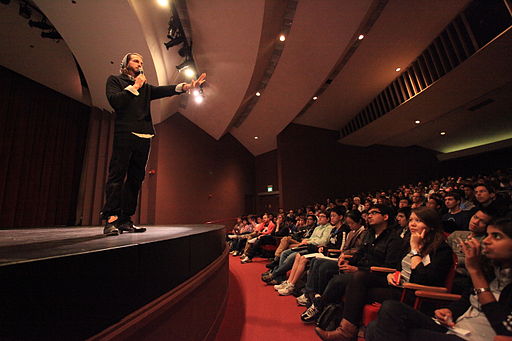
    Photo of Ashton Kutcher speaking at Y Combinator by Robert Scoble through Wikimedia commons

    Similar posts: