Category: media

  • Squandering a reprieve

    Squandering a reprieve

    ABC Radio National’s Background Briefing has a terrific story on the struggles of the Fairfax newspaper empire during the early days of the Internet.

    One of the major themes that jumps out is how Fairfax, like many media and retail organisations, squandered the opportunity presented by the tech wreck.

    The tech wreck was an opportunity for incumbents to claim their spaces in the online world, instead they saw the failure of many of the dot com boom’s over-hyped online businesses as vindication of their view the Internet was all hype.

    As former Sydney Morning Herald editor Peter Fray said “In florid moments you could even think this internet webby thing would go away”.

    For Fairfax the profits from the traditional print based business were compelling. According to Greg Hywood the current CEO, for every dollar earned by the company, 70c were profits – a profit margin of 233%.

    The Internet threatened those “rivers of gold” and media companies, understandably, did nothing to jeopardise those returns.

    Another problem for Fairfax was the massive investment in digital printing presses in the 1990s. These behemoths revolutionised the way newspapers were printed as pages could be laid out on computer screens and sent directly from the newsroom to the press itself which printed out pages in glorious colour rather than with smudgy black and white images.

    Moreover these machines were fantastic for printing glossy coloured supplements and the advertising revenue from those high end inserts kept the dollars rolling in.

    When the tech wreck happened, the massive investments in printing presses were vindicated as the rivers of gold continued to flow while the smart Internet kids went broke.

    Fairfax’s management weren’t alone in this hubris – most media companies around the world made the same missteps while retail companies continued to build stores catering for the last echos of the 20th Century consumer boom.

    In 2008, the hubris caught up with the retailers and newspapers. As the great credit boom came to an end, the wheels fell off the established business models and the cost of not experimenting with online models is costing them dearly.

    Value still lies in those mastheads though as more people are reading Fairfax’s publications than ever before.

    Readers still want to read these publications, one loyal reader is quoted in the story that Sydney Morning Herald should aspire to “being a serious international paper.”

    That isn’t going to happen while management is focused on cutting costs to their core business instead of focusing on new revenue streams.

    Somebody will find that model, had the incumbent retail and media organisations explored and invested in online businesses a decade ago they may well have found that secret sauce.

    Now many of them won’t survive with their horse and buggy ways of doing business.

    Similar posts:

  • Will write, play and cook your dinner for free

    Will write, play and cook your dinner for free

    From the Internets;

    Craigslist Ad:
    We are a small & casual restaurant in downtown Vancouver and we are looking for solo musicians to play in our restaurant to promote their work and sell their CD. This is not a daily job, but only for special events which will eventually turn into a nightly event if we get positive response. More Jazz, Rock, & smooth type music, around the world and mixed cultural music. Are you interested to promote your work? Please reply back ASAP.

    A Musician’s Reply:
    Happy new year! I am a musician with a big house looking for a restauranteur to come to my house to promote his/her restaurant by making dinner for me and my friends. This is not a daily job, but only for special events which will eventually turn into a nightly event if we get a positive response. More fine dining & exotic meals and mixed Ethnic Fusion cuisine. Are you interested to promote your restaurant? Please reply back ASAP.

    Shamelessly lifted from the Telecaster Guitar Forum via Bob Lefsetz’s blog.

    The discussion about Amanda Palmer offering unpaid gigs for local musos on her US tour has been heated and the perspectives are interesting.

    What’s missed is the difference between artist and workers – the local violin player or trombonist getting up on stage with Amanda Palmer in Poughkeepsie isn’t going onstage to make a buck, it’s because he or she loves playing and is honoured to get an opportunity to perform with a big act.

    On the other hand, one of the sites that’s been critical of Palmer advertised for a “insightful, knowledgeable and talented writers to contribute to the ongoing and ever-intriguing discourse on music and film.”

    For submitting three 200 word blog posts a day, the lucky writer will receive a grand payment of six dollars. That’s one cent a word. Plus a cut of advertising revenue.

    Should anyone be tempted to think that revenue could amount to much, they should keep in mind the web is awash with crap content that’s worth one cent a word; there’s no reason why any half decent writer couldn’t set up their own blog and stick adwords on it for a better return.

    A few decades ago when printing was expensive and distribution networks difficult to set up, indy magazines offering little but an outlet to their writers served a purpose.

    Today you can setup an outlet in five minutes on Blogger or WordPress and let the web do the distribution for you.

    Any business that relies on free or cheap content is doomed – we’re in a world awash with cheap, crappy content and the public don’t see much reason to pay for it.

    That there is no market for crap is something our once esteemed newspapers, magazines and TV stations should keep in mind as they sack subeditors, retrench journalists and increasingly source material that was available on Twitter a day earlier.

    There’s a big difference between a musician or blogger creating something for love versus a business ripping contributors off  – one needs a market to succeed, while the other just does it because they want to.

    Similar posts:

  • Freebies and rorts

    Freebies and rorts

    Something went badly wrong in Samsung’s PR department last month as their strategy of engaging bloggers turned into a series of embarrassing arguments over control.

    First, a pair of Indian bloggers found themselves stranded at Berlin’s IFA 2012 fair after arguing with Samsung then French blogger France Quiqueré told of her similar encounter with Samsung’s control freakery at the London Olympics.

    Both encounters raise the issue of what is expected when a journalist or blogger is given a free trip to a conference or event.

    Freebies are always a difficult issue, the blogger or journalist is always going to be in a conflicted position and the organisation paying the bills has an interest in what they report.

    In an ideal world, we’d all follow Sarah Lacy’s example where no-one accepts freebies. The problem with that is that most media companies, let alone bloggers, don’t have the funds to attend high priced conferences in their own cities and going to one half way across the world is out of the question if someone else doesn’t pay.

    Sarah’s journalist model works fine when you have a well funded operation like Pando Daily’s VC investors or someone prepared to work for nothing – the digital sharecropper model.

    With the collapse of newspaper revenues, most media companies long ago gave up their ethical objections to accepting paid trips to conferences – in sections like travel, tech and motoring the freebie has been well established for decades.

    Basically, if event organisers didn’t pay the bills for journalists and bloggers their conferences or product launches won’t get much media attention because most of the reporters simply couldn’t afford to attend.

    This is simple economics and where disclosure comes in. If a blogger or reporter has been given free travel or accommodation so they could attend an event then readers should be told.

    What really matters in all of this are the audience and the reporter’s ethical compass. If the readers or viewers can trust and value what reporters produce and in turn the reporters are comfortable within their own moral boundaries then everyone is a winner.

    The danger is getting the balance wrong. If readers lose trust, PR people start taking liberties (as Samsung tried to do) or bloggers and journalists are uncomfortable with what they do then it’s time to stop doing it.

    One quick way to destroy credibility is for PR managers to expect those blogger to act like performing monkeys in return for ‘winning’ a competition or believing that ferrying a journalist to an event will guarantee fawning coverage.

    Any decent journalist or blogger who respects themselves and their audiences won’t do that, if only because it will damage their brand or career prospects. This is the lesson Samsung have learned.

    For the record, I do accept freebies and disclose them at the bottom of any related blog posts. If an investor would like to bankroll a down under Pando Daily, you know where to contact me.

    Similar posts:

  • Driving agendas

    Driving agendas

    A feature of the new question and answer service Branch are “featured questions” highlighting popular or interesting conversations on the service.

    One of those early featured conversations was a question from investor Michael Arrington, “when is it good for founders to leak stuff to the press?”

    Strategic leaks have become the staple of most news services, time poor journalists are desperate for scoops and clicks which gives an opportunity for companies and governments to feed information that suits their agenda of the moment.

    As the answers in the thread indicate, this style of reportage is very common in the Silicon Valley tech press. The greater fool business model of many web start ups require they get lots of media coverage in order to attract buyers.

    That media coverage includes ‘leaking’ stories that one big company – a Google, Microsoft or Facebook – is interested in the business. This always creates credulous headlines on the tech media sites and one of these leaks prompted Arrington’s question.

    Strategic leaking isn’t just a tech media phenomenon. Australian politics was paralysed at the beginning of the year when numerous stories that “un-named Labor Party sources” were plotting against the Prime Minister dominated the headlines for weeks. All of these were pointless leaks from various minor politicians try to push their agendas. Often to their long term detriment.

    In the sports world the agendas often revolve around contract negotiations – remember this next time you read that a star player may be going to another team, almost certainly that story has been planted by that player’s agent in an attempt to increase his client’s value.

    The same thing happens in the business, property and the vacuous entertainment, travel and dining pages.

    Agenda driven journalism fails the reader and the writer, it also damages the publication as once readers start asking what the motivation is for a story, then the credibility of that outlet is failing.

    Increasingly this is happening to all the mainstream publications.

    Resisting the push to agenda driven journalism is tough as editorial resources are stripped from media organisations and as journalists come under more pressure to write stories that drive traffic.

    One of the great assets of big media is trust in the masthead. A hundred years ago people took what was written in their city’s newspapers as truth, a few decades ago it was what was on the evening news. If Walter Cronkite or your city’s news anchor said it was true, then that was good enough for most people.

    In the race for clicks, that trust has been abused and lost by all but the most dedicated fans. It’s probably the greatest loss of all for the established media giants.

    For readers, the web and social media is their friend. They can check with their peers to see if a story stands up and if it doesn’t they can spread this across their networks.

    Agenda driven journalism fuelled by pointless leaks helps no-one in the long term and it will probably kill many established mastheads. It’s another opportunity for smart entrepreneurs to disrupt a market that’s failing.

    Similar posts:

  • Saving Fairfax

    Saving Fairfax

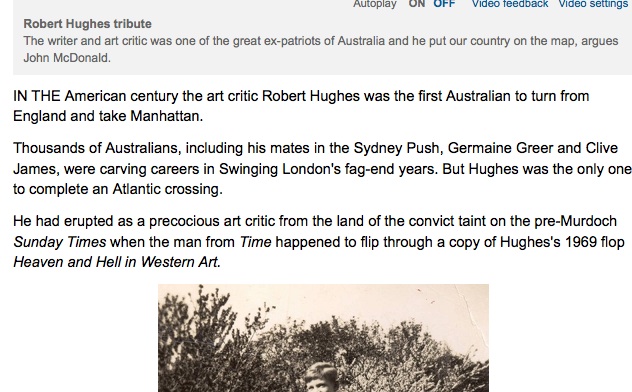
    The writer and art critic was one of the great ex-patriots of Australia and he put our country on the map.”

    One typo illustrates all that is wrong with Australia’s two oldest newspapers, The Age and The Sydney Morning, who are both part of the Fairfax stable.

    It’s particularly disappointing that one of the leading newspapers in the city of Hughes’ birth could have such a dumb typo, but adding to the insult is the paper’s underwhelming and disappointing coverage as compared to the New York Times, the paper of his adopted home town.

    Hughes was one of many in his generation left Australia because of the lack of opportunity. Fellow expatriate (note the spelling) Clive James said he could have never have developed his writing skills without the sharp editing his copy was subjected to at London’s newspapers. That is as true today as it was in 1960.

    Poor editing lies at the core of Fairfax’s problems, not just in silly typos but also with inappropriate stories like leading with a shop assistant’s Facebook profile or the hysterical regurgitation of spin doctor’s talking points.

    This isn’t to pick on Roy Masters and Asher Moses, both are capable of great work — Asher’s Digital Dreamers series profiling Australian technology expatriates (that word again) was excellent work and when Roy doesn’t get sucked into the petty ego wars that dominate Sydney’s Rugby League community his sports writing can match the world’s best.

    Both Roy and Asher, along with every other journalist at Fairfax, are let down by poor editors who don’t have the balls to tell them when work isn’t up to standard, let alone pick up dumb typos.

    If Fairfax is to survive, it requires strong and good editors that are prepared to hold their writers accountable and back them when the going gets tough. Right now Fairfax lacks those leaders.

    That lack of leadership extends throughout the organisation’s management and board. Fairfax’s management lacks people committed to delivering a great product or capable of grappling with the challenges of making online journalism pay.

    Making online journalism pay is more than just having one-way Twitter accounts, plastering your site with ads or irritating your users with auto playing video clips. Web strategist Jim Stewart dissects how these tactics aren’t working for Fairfax.

    Whoever figures out how to make money from online journalism will be the Randolph Hearst of the 21st Century, currently it’s safe to say there are no budding Hearsts or Murdochs among the comfortable ranks of Fairfax’s management.

    Similar posts: