Category: new media

  • Grappling with the online news beast

    Grappling with the online news beast

    The head of Google News, Richard Gingras, last week discussed how the news industry is evolving at Harvard University’s Nieman Foundation.

    Much of Richard’s discussion centred around disruption – the newspaper industry was disrupted in the 1950s by television and by the 1980s most print markets had seen several mastheads reduced to one or two.

    The remaining outlets were able to book fat profits from their monopoly or duopoly position in display and classified advertising.

    By 2000, the web had killed that business model and the newspaper industry was in a decline that continues today as aggregator sites like Huffington Post steal page views and Google News further changes the distribution model.

    One of the problems for the news industry is how different the online mediums are from print, radio or television broadcast. The struggles of media startup The Global Mail is a good example of this.

    In the middle of last year news started trickling out that one of the Australian Broadcasting Corporations’s top journalists, Monica Attard, had left the broadcaster to set up The Global Mail, an online news site funded by Wotif founder Graeme Wood.

    The site launched on schedule in February 2012 and underwhelmed readers with pedestrian content and a confusing layout. By May, Monica Attard announced she was leaving the organisation she’d founded.

    Tim Burrowes of the media site Mumbrella examined why the Global Mail is struggling, his Nine problems stopping The Global Mail from getting an audience details how the site doesn’t use online media effectively.

    At heart is a fundamental mismatch between the methods of journalists raised in the “glory days” of print and broadcast journalism against those of the online world, not least the much harsher financial imperatives of those publishing on the web.

    One key problem it the TL;DR factor – Too Long; Didn’t Read. Where online readers tend to leave stories after around four hundred words.

    Richard Gringas is quoted as encountering this problem when he worked at online magazine, Salon.

    At Salon, articles were paginated, but only 27% of readers made it to the end of the four-page articles. Compared to competitors, Richard was told, this was a good benchmark. But with fresh eyes, he was astounded that a product was being produced with the knowledge that the vast majority of the audience would not consume the entire piece. Richard loves the long form, but if the objective is to convey information, we need to think about the right form for the right medium at the right time.

    So “long form” journalism has to be written the right way and it has to be backed up with good visual components and have “short form” versions suited to the more impatient readers who make up the bulk of the web audience.

    The New York Times made a step in this direction with their iEconomy series on how the US middle classes have been displaced with manufacturing’s move to China.

    An even better example of journalists using the web well is The Verge’s Scamworld where an online expose of Internet get rich quick schemes and the conmen behind them.

    Scamworld shows us what skilled journalists can do online. The amazing thing is the site’s new steam is tiny compared to those of established outlets like the New York Times, Guardian, Fairfax or those of News Corporation.

    This failure to execute by incumbent news organisations isn’t because they are lacking talent – every young, and not so young, journalist has been required to have multimedia skills and the ability to file stories in multiple formats for at least a decade.

    Old Media’s problems lies in the mindsets of senior journalists, editors and their managements who are locked into a 1950s way of thinking where fat advertising revenues funded the adventures and expense accounts of roving reporters who tough as nails editors occasionally bullied into filing stories.

    That model started to die in the 1980s and the Internet gave it the last rites.

    Richard Gringas’ discussion at Harvard shows news and journalism isn’t dead, but it is evolving. Just like many other disrupted industries, the news media has to adapt to a changed world.


    Similar posts:

  • Digital roadkill

    Digital roadkill

    Digital Roadkill first appeared in Smart Company on 10 May 2012

    Just over thirteen years a group of Silicon Valley technologists wrote The Cluetrain Manifesto detailing what they saw as being the new rules of business in a connected world.

    Cluetrain was mandatory reading when terms like “information superhighway” were fashionable and Yahoo! was the dominant web portal. It’s somewhat fallen out of fashion today.

    Like most manifestos Cluetrain was partially unreadable and heavy on dramatics but it did lay down the principles that are now largely accepted in both the online and mainstream business worlds.

    I was reminded of the Cluetrain Manifesto earlier this week at a suburban marketing event run by one of the country’s biggest media organisations. The lessons of the last thirteen years seemed to have passed by almost every business in the room.

    Most of these businesses were operating they way they did in the 1990s. While some of them had a website and a couple had Facebook pages, their businesses had barely changed in the last twenty years.

    These businesses are digital roadkill. Many of them have no idea what’s about to hit them as they sit paralysed wondering what the bright lights baring down on them are.

    In this respect they aren’t dissimilar to the big department stores or electrical chains that are working to a model that’s ticked along nicely for decades and don’t realise how the fundamentals of the economy have shifted in the last five years.

    Many of these small traders are still taking orders by fax and some of them still keep their cheque book ready to pay their suppliers bills. It’s that bad.

    The idea of selling over the net is completely beyond them, only big overseas companies dodging GST do that sort of thing.

    Even in the marketing field, these businesses have ignored the obvious for years with many still advertising in their local Yellow Pages and freebie community newspaper, despite barely making a sale from either in five years. But these channels worked for them once.

    Few of them have up to date websites, are doing the bare minimum search engine or mobile optimisation and almost every single one hasn’t bothered to claim their local business listings.

    To be fair to the little guys the host organisation was no better, this large media organisation has a good online product – they even own one of the major online local business listing services – but their sales people on the night didn’t mention it as they are too locked into selling their traditional local newspaper advertising products.

    At least that company is wealthy and has other profitable arms that can prop up its dying local newspaper arms which can at least appear profitable while there are costs to be stripped from the operation.

    Unlike those big media companies and retailers, the small local business doesn’t have big cash reserves or deep pocketed investors allowing them to survive for years in a declining market.

    These small businesses are just going to drag their owners into poverty.

    Not only have the old rules of business gone, but the value of businesses which choose to live in the past has evaporated. Few people are going to buy a business with an old, declining customer base.

    “Roadkill” is an apt term for a business that probably won’t be around in two years.

    Today the Cluetrain is big lumbering road train carrying ecommerce goods down the fast lane of the information superhighway with a driver that has no intention of stopping.

    Make sure your business isn’t the cute fluffy rodent sitting in its path.

    Similar posts:

    • No Related Posts
  • Paying the piper – the cost of the internet’s walled gardens

    Paying the piper – the cost of the internet’s walled gardens

    With the web increasingly dominated by four major, and many minor, fiefdoms the cost of being part of those groups is gradually becoming clear.

    As part of Facebook filings in advance of their public float they published the key agreements with their developer partners including that with games provider Zygna, technology journalist Tom Foremski has a disturbing look at Facebook’s conditions that illustrate the costs and risks.

    In terms of the costs, Tom identifies Clause 2.1 of Facebook’s “Statement of Rights and Responsibilities” – shown as Annex 1 in the Developers  as probably the biggest price for all content creators;

    … you grant us a non-exclusive, transferable, sub-licensable, royalty-free, worldwide license to use any IP content that you post on or in connection with Facebook (“IP License”). This IP License ends when you delete your IP content or your account unless your content has been shared with others, and they have not deleted it.

    So by sharing something on Facebook, you grant Facebook the right to do what they like with what you’ve created. That’s something worth thinking about.

    For anybody trying to make a living off Facebook, it’s important to consider they also retain the right to throw you off the service at any time. From clause 4.10 of the Statement Of Rights Annex;

    If you select a username for your account we reserve the right to remove or reclaim it if we believe appropriate (such as when a trademark owner complains about a username that does not closely relate to a user’s actual name).

    So get into a trademark dispute with a big corporation – and often their lawyers cast a very wide net on potential similar spellings – and your account is shut down.

    There’s also the specifics of the Zynga agreement that should concern anyone investing in the games company. Right at the beginning of the agreement we see this clause;

    The parties further acknowledge that Zynga is making a significant commitment to the Facebook Platform (i.e., using Facebook as the exclusive Social Platform on the Zynga Properties and granting FB certain title exclusivities to Zynga games on the Facebook Platform). In exchange for such commitment, [*] the parties have committed to set certain growth targets for monthly unique users of Covered Zynga Games.

    So Zynga is closely tied into the fortunes of Facebook, we knew that on a business level but now we know just how deep and binding the agreements are.

    We should be clear, all the major social media and online services have similar clauses on intellectual property and copyright infringements; there’s no shortage of businesses who’ve been caught out by eBay or Paypal and plenty of people found their Google accounts shut down by their obsession with real names.

    For all businesses the message is clear – be careful before committing totally to one online platform or another. Should you end up in a dispute, or find you’ve backed the wrong service, it may be a very costly process to get your company off that platform.

    Similar posts:

  • The Internet’s cold war

    The Internet’s cold war

    “We’re designing exclusively for Android devices,” the software developer confided over a beer, “we don’t like the idea of giving Apple 30% of our income.”

    That one business owner is making a choice that software developers, newpaper chains, school text book publishers and many other fields are going to have to make in the next year – which camp are they going to join in the Internet’s cold war.

    As the web matures, we’re seeing four big empires develop – Google, Apple, Facebook and Amazon which are going to demand organisations and consumers make a choice on who they will align with.

    That decision is going to be painful for a lot of business; each empire is going to take a cut in one way or another with Apple’s iStore charges being the most obvious.

    For those who choose to go the non-aligned path – develop in HTML5 and other open web standards things will be rocky and sometimes tough. At least those on the open net won’t have to contend with a “business partner” whose objectives may often be different to their own.

    Over time, we’ll see the winners and losers but for the moment businesses, particularly big corporations and publishers should have no doubt that the choices they make today on things as seemingly trivial things like reader comments may have serious ramifications in a few years time.

    Consumers aren’t immune from this either; those purchases through iTunes, Amazon or Google are often locked to that service for a reason.

    Probably the development that we should watch closest right now is Apple’s push into education publishing; those governments, universities and schools that lock into the iPad platform are making a commitment on behalf of tax payers, faculty and students that will affect all of them for many years.

    For many, it might be worthwhile hedging the bets and sticking to open standards. A decision to join one or two of the big Internet empires is something that shouldn’t be made lightly.

    Similar posts:

  • Book review: The Information Diet

    Book review: The Information Diet

    We all know a diet of fast food can cause obesity, but can consuming junk information damage our mental fitness and critical faculties?

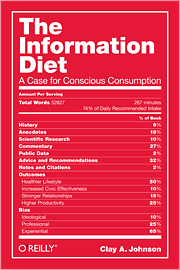
    In The Information Diet, Clay A. Johnson builds the case for being more selective in what we read, watch and listen to. In it, Clay describes how we have reached the stage of intellectual obesity, what constitutes a poor diet and suggests strategies to improve the quality of the information we consume.

    The Information Diet is based upon a simple premise, that just as balanced food diet is important for physical health so too is a diverse intake of news and information necessary for a healthy understanding of the world.

    Clay A. Johnson came to this view after seeing a protestor holding up a placard reading “Keep your government hands off my Medicare.” Could an unbalanced information diet cause a kind of intellectual obesity that warps otherwise intelligent peoples’ perspectives?

    The analogy is well explored by Clay as he looks at how we can go about creating a form of “infoveganism” that favours selecting information that comes as close from the source as possible

    Just as fast food replaces fibre and nutrients with fat, sugars and salt to appeal to our tastes, media organisations process information to appeal to our own perceived biases and beliefs.

    Clay doesn’t just accuse the right wing of politics in this – he is as scathing of those who consider the DailyKos, Huffington Post or Keith Olbermann as their primary sources as those who do likewise with Fox News or Bill O’Reilly.

    The rise of opinion driven media – something that pre-dates the web – has been because the industrial production of processed information is quicker and more profitable that the higher cost, slower alternatives; which is the same reason for the rise of the fast food industry.

    For society, this has meant our political discourse has become flabbier as voters base decisions and opinions upon information that has had the facts and reality processed out of it in an attempt to attract eyeballs and paying advertisers.

    In many ways, Clay has identified the fundamental problem facing mass media today; as the advertising driven model requires viewers’ and readers’ attention, producers and editors are forced to become more sensationalist and selective. This in turn is damaging the credibility of these outlets.

    Unspoken in Clay’s book is the challenge for traditional media –their processing of information has long since stopped adding value and now strips out the useful data, at best dumbing down the news into a “he said, she said” argument and at worse deliberately distorting events to attract an audience.

    While traditional media is suffering from its own “filter failure”, the new media information empires of Google, Facebook, Apple and Amazon are developing even stronger feedback loops as our own friends on social media filter the news rather than a newsroom editor or producer.

    As our primary sources of information have become more filtered and processed, societal and political structures have themselves become flabby and obese. Clay describes how the skills required to be elected in such a system almost certainly exclude those best suited to lead a diverse democracy and economy.

    Clay’s strategies for improving the quality of the information we consume are basic, obvious and clever. The book is a valuable look at how we can equip ourselves to deal with the flood of data we call have to deal with every day.

    Probably the most important message from The Information Diet is that we need to identify our biases, challenge our beliefs and look outside the boxes we’ve chosen for ourselves. Doing that will help us deal with the opportunities of the 21st Century.

    Clay A. Johnson’s The Information Diet is published by O’Reilly. A complimentary copy was provided as part of the publisher’s blogger review program.

    Similar posts: