Category: new media

  • You can’t buy cool

    You can’t buy cool

    In many ways it was Yahoo! who pioneered Silicon Valley’s Greater Fool Business Model during the dot com boom of the late 1990s.

    The Greater Fool model involves hyping a website, online service or new technology in the hope a hapless corporation dazzled by the spin will buy the business for an improbably large amount.

    Fifteen years later many of those services are closed down or languishing and the founders who were gifted millions of dollars by gullible boards and shareholders have moved on to other pursuits.

    The news that Yahoo! has sealed a deal to buy blogging site Tumblr for $1.1 billion dollars shows the company’s urge to buy in success remains under new CEO Marissa Mayer.

    It’s difficult to see exactly what Tumblr adds to Yahoo!’s wide range of online properties except a young audience – exactly the reasoning that saw News Corporation’s disastrous investment in MySpace.

    What’s particularly concerning is a comment made by Yahoo!’s CFO Ken Goldman at JP Morgan’s Global Technology Conference last week.

    “So we’re working hard to get some of the younger folks,” Goldman said on a webcast from the J.P. Morgan Global Technology conference in Boston.

    It’s all about trying to “make us cool again,” he said, adding that Yahoo will focus on content that’s “more relevant to that age bracket.”

    So they are spending a billion dollars to “make us cool again” – it’s disappointing Marissa Mayer has allowed middle aged male executives to run free with the shareholders’ chequebook in a quest to rediscover their youth.

    Like most middle aged life crises, it’s unlikely to end well.

    For Tumblr’s founders and investors things have ended well. It’s time to buy those yachts and fast cars those middle aged execs covet.

    In the meantime the quest for internet ‘cool’ – whatever that is – will move onto whatever online service teenagers and twenty somethings are using.


    Similar posts:

  • Discovering an online media model

    Discovering an online media model

    Peter Kafka of the Wall Street Journal’s All Thing D blog has been closely following Google’s attempts to position YouTube as a successor to television.

    Key to that success is getting advertisers on board to spend as much money with online channels as they do on broadcast TV.

    To date that’s failed and most of the online ad spend has come at the expense of print media – the money advertisers spent on magazines and newspapers has moved onto the web, but TV’s share of the pie is barely changing and may even be increasing.

    The challenges facing web advertising is discovering what works on the new mediums.

    McDonalds Canada Behind The Scenes campaign is touted as one of the success stories of YouTube advertising, although Kafka isn’t fully convinced.

    McDonald’s modest ad tells a story, flatters viewers by telling them they’re smart enough to go backstage, and still ends up pushing pretty images of hamburgers in front of them. That’s pretty clever advertising sort-of masquerading as something else but not really.

    We’re trying to apply old ways of working to a new technology something we do every time a new technology appears.

    Moving from silent movies

    Probably the best example of this is the movie industry – if you look at the early silent movies they were staged like theatrical productions. It took the best part of two decades for movie directors to figure out the advantages of the silver screen.

    Shortly after movie directors figured out what worked on the big screen, the talkies came along and changed the rules again. Then came colour, then television, then the net and now mobile. Each time the movie industry has had to adapt.

    It isn’t just the movie and advertising industries facing this problem; publishers, writers and journalists are struggling with exactly the same issues.

    Most of what you read online, including this blog, is just old style print writing or journalism being published on a digital platform. Few of us, including me, are pushing the boundaries of what the web can do.

    Waiting for Sarnoff

    David Sarnoff figured out how to make money from broadcast radio and television in the 1930s with a model that was very different from what the movie industry was doing at the time.

    Sarnoff built Radio Corporation of America into the world’s leading broadcaster and the modern advertising industry grew out of RCA’s successful model.

    Today both the broadcasting and advertising industries are applying Sarnoff’s innovations of the 1930s to the web with limited success. Just like movie producers struggled with theatrical techniques at the beginning of the Twentieth Century.

    Figuring out what works online is today’s great challenge. Google are throwing billions at the problem through YouTube but there’s no guarantee they will be the RCA of the internet.

    We may well find that a young coder in Suzhou or a video producer in Sao Paolo has the answer and becomes the Randolph Hearst or David Sarnoff of our time.

    The future is open and it’s there for the taking.

    Similar posts:

  • Doing social media right

    Doing social media right

    After last week’s Associated Press hack and the stock exchange fallout, regulators are struggling with implications of social media and informed markets.

    In a speech delivered last week the Australian Securities and Investments Commission’s Deputy Chair Belinda Gibson and Commissioner John Price gave some refreshing commonsense views on how businesses should handle public information.

    The continuous disclosure advice given by Price and Gibson is aimed at meeting the requirements of Australian corporate law, but it’s actually good social media advice.

    • Having delegations in place for who has authority to speak on behalf of the company – whether in response to an ASX ‘price query’ or ‘aware’ letter, or when they become aware of information that needs to be released to the market, perhaps in response to speculation.
    • Ensuring that there is a designated contact person to liaise with the ASX, who has the requisite organisational knowledge and is contactable by ASX.
    • Have a clear rapid response plan and ensure all board members and senior executives are fully appraised of it. Give it a practice run every so often – a stress test of sorts.
    • Have a plan for when you will consider a trading halt appropriate.
    • Have a ‘Request for trading halt’ letter template ready for use.
    • Have guidelines for determining what is ‘material’ information for disclosure, tailored to your company.
    • Prepare a draft announcement where you are doing a deal that will
    • likely require an announcement at some time, and a stop-gap one in case of a leak

    Having a nominated contact person with requisite organisational knowledge is possibly the most important point for any organisation.

    Even if you think social media is just people posting what they had for lunch or sharing cute cat pictures, it isn’t going away and those Twitter feeds and Facebook pages are now considered official communications channels.

    The intern running your social media is now your company’s official spokesperson. Are you comfortable with this?

    A good example of where this can go wrong is the Australian Prime Minister’s Press Office where an immature staff member has been put in charge of posting messages. The results aren’t pretty.

    prime-ministers-office-twitter-feed

    The funny thing is the Prime Minister’s office would never dream of some dill getting up and saying this sort of thing on her behalf, yet allows an inexperienced, loose cannon put this sort of material in writing on the public internet.

    Here’s Twenty Rules for Politicians using the Internet.

    On a more mature level, the ASIC executives also have some good advice on writing for social media.

    Don’t assume that the reader is sophisticated or leave readers to read between the lines. Companies need to highlight key information and tell it plainly.
    While the ASIC speech is aimed at the specific problems of complying with company law and listing requirements, it’s a worthwhile guide for any organisation needing to manage its online presence.
    Don’t be like the Prime Minister’s office, understand that an organisation’s social media presence is an official channel and treat it with the respect it deserves.

    Similar posts:

  • Can maps change the way we work?

    Can maps change the way we work?

    “Work the Way You Live” is Google’s motto for their enterprise maps service which the search engine giant hopes to make as ubiquitous in business as it is in the home.

    At Google Atmosphere the company showed off their mapping technology and how it can be used by large organisation. It’s a compelling story.

    The technology behind Google Maps is impressive – twenty petabytes of images, one billion active monthly users, 1.6 million map tiles served every second and a target of getting those tiles onto the users screen within ten milliseconds.

    Maps are one of the Big Data applications that cheap computing makes possible, until a few years ago even desktop computers would have struggled with the sort of mapping technology that we take for granted on our smartphones today.

    Rethinking products

    google-street-view-enabled-treadmill

    Adding mapping technologies to products allows businesses to rethink their products. A good example of this is the internet connected treadmill.

    Using the treadmill a jogger, or a walker, can map out a route anywhere in the world and the screen will show them the Google Street View as they travel along the route. The treadmill even adjusts to the changing gradients.

    The Google Maps driven treadmill is a trivial example of the internet of machines, but it gives a hint of what’s possible.

    The search for truth

    ground-truth-and-google-maps

    The success of a map depends on whether it can be trusted – this is what caught Apple out with their mapping application which was released before it was ready for prime time. Google, and most cartographers, take seriously errors and changes.

    In the early days of Google Maps, the company would pass errors and changes onto the private and government mapping providers they licensed the data from. It could take months to fix a problem.

    “It was really hard, you have to get maps from all over the world to create the product,” says Louis Perrochon, the Engineering director of google maps for business.

    “That’s a limitation if you work with third party data so we started a project called Ground Truth where we build our own maps.”

    Google pulls together its Street View data, satellite images and information sent in from the public through their Map Maker site and the Maps Engine Lite to build an accurate map of an area.

    Changing consumer behaviour

    Having accurate and accessible maps has changed the way consumers have behaved; “this revolution hasn’t happened slowly,” says Google Enterprise Directore Richard Suhr, “it’s happened really quickly.”

    “Customers have become savvy about spatial. What this means is that businesses are starting to rethink the problem.”

    “What are the exciting things I can do with maps, what else can I do with my data.”

    That’s a big question of all businesses – how they use the massive amount of information in their organisation will mark the winners from also runs over the next decade. Maps are one way to visualise their data.

    While Google Atmosphere was a marketing event for the companies mapping technologies the message is clear – mapping is changing the way we work and play and it’s affecting business.

    How is mapping changing the way your business works?

    Similar posts:

  • Social media’s irrational exuberance comes to an end

    Social media’s irrational exuberance comes to an end

    Last week saw the annual Y Combinator demo day where the startups funded by the incubator get to strut their stuff and it appears the age of social media hype is over.

    In the Wall Street Journal’s Digits blog, Amir Efrati reports Social is Out, Revenue is In as the companies showed off their income streams rather than the number of users which has been the measure for free social media apps.

    That social media is out shouldn’t be surprising as the services have been tracking a standard Gartner Hype Cycle with a boom in services, coverage and investments that’s now turning into the inevitable bust and a fall into the trough of disillusionment.

    Coupled with that fall for social media services are the disappointing stockmarket floats of Facebook and Groupon which have cruelled the enthusiasm for investing in tech startups with lots of user but not much revenue.

    Last week’s headlines featuring Yahoo!’s purchase of Summly for $30 million and Amazon’s acquisition of Goodreads for an estimated $150 million show how the days of greater fools writing billion dollar cheques is over as more sensible valuations take hold.

    Amazon’s purchase of Goodreads is more interesting than Yahoo! buying a teenage wunderkind’s venture in that Amazon is cementing its position at the centre of the global book publishing industry.

    Goodreads has been one of the quiet social media success of recent years having built its subscriber base to over 16 million members sharing book reviews and reading lists.

    The book review site is a natural fit for Amazon although the head of the US Authors’ Guild rightly worries the company is becoming a monopoly.

    Of course the obvious retort to this is that someone else could have bought the site and Forrester’s James McQuivey speculates on why an established publisher didn’t do so much earlier.

    This year’s Y Combinator Demo Day and the acquisitions of Goodreads and Summly show the era of irrational tech exuberance is over.

    For good businesses operators and investors this is not a bad thing as everyone can now focus on building good businesses rather than worrying about hype, spin and fools with more money than sense.

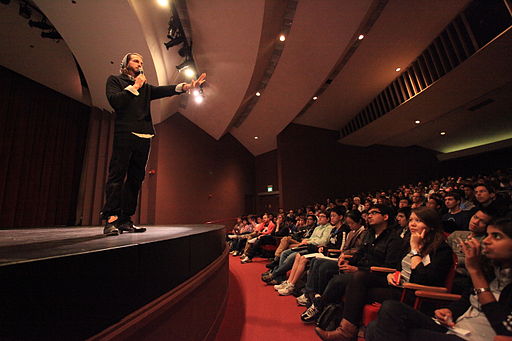
    Photo of Ashton Kutcher speaking at Y Combinator by Robert Scoble through Wikimedia commons

    Similar posts: