
Category: old media

  • Irrelevance and the media

    Irrelevance and the media

    It’s a shame we weren’t around when dinosaurs became extinct. Then again, maybe we are.

    News Limited business commentator Terry McCrann writes about the “Bleakest of views from the shopfronts” in his Sunday column describing the problems of retail.

    All of the problems Terry cited are from big retailers – Woolworths, Dick Smith, Harvey Norman and JB HiFi. To make it clear he was talking about corporate issues there’s even a reference to General Motors.

    Nowhere does Terry talk about smaller businesses or those challenging the big guys, folk like Ruslan Kogan or the Catch of the Day team. It’s all about the big end of town.

    Terry’s article illustrates the problem of relying on incumbent mainstream media commentary; that it is Big Media talking about Big Business and Big Government.

    “Small”, “ordinary” or “average” has no place in their conversation, if you can call the pronouncement of mainstream media commentators a conversation at all.

    We can understand this – for a journalist, it’s good for the ego and career to look like a “heavy hitter” in big business. For the politician, small business and community groups can’t pay the speaking and consulting fees paid by corporations to supplement their meagre retirement benefits.

    Increasingly what happens in the corporate board rooms or the once smoke filled rooms of political caucuses is out of touch with the real world.

    This has become particularly acute since the responses to the 2008 crash proved to the management classes that their bonuses and perks will be protected by government bailouts regardless of how many billions of shareholder wealth they manage to destroy.

    In the United States we see this in political controversies being focused on contraception – an issue settled forty years ago – while the country faces fundamental challenges to its economic base and the basic welfare of its citizens and industries.

    While in Australia the media ‘insiders’ rabbit on about pointless internal party politics and soothing articles on how everything else is fine, we just need to be more optimistic. Yet the real questions about how we take advantage of the country’s greatest export boom, position the economy for the next 50 years and the nation’s dependence on the Chinese economy are being ignored.

    Terry McCrann’s story is emblematic of just how out of touch Big Media, and their friends in Big Business and Big Government, are with the real world.

    All we can do is let them get on with it and not take them too seriously.
    Similar posts:

  • Book review: The Information Diet

    Book review: The Information Diet

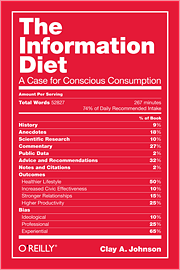
    We all know a diet of fast food can cause obesity, but can consuming junk information damage our mental fitness and critical faculties?

    In The Information Diet, Clay A. Johnson builds the case for being more selective in what we read, watch and listen to. In it, Clay describes how we have reached the stage of intellectual obesity, what constitutes a poor diet and suggests strategies to improve the quality of the information we consume.

    The Information Diet is based upon a simple premise, that just as balanced food diet is important for physical health so too is a diverse intake of news and information necessary for a healthy understanding of the world.

    Clay A. Johnson came to this view after seeing a protestor holding up a placard reading “Keep your government hands off my Medicare.” Could an unbalanced information diet cause a kind of intellectual obesity that warps otherwise intelligent peoples’ perspectives?

    The analogy is well explored by Clay as he looks at how we can go about creating a form of “infoveganism” that favours selecting information that comes as close from the source as possible

    Just as fast food replaces fibre and nutrients with fat, sugars and salt to appeal to our tastes, media organisations process information to appeal to our own perceived biases and beliefs.

    Clay doesn’t just accuse the right wing of politics in this – he is as scathing of those who consider the DailyKos, Huffington Post or Keith Olbermann as their primary sources as those who do likewise with Fox News or Bill O’Reilly.

    The rise of opinion driven media – something that pre-dates the web – has been because the industrial production of processed information is quicker and more profitable that the higher cost, slower alternatives; which is the same reason for the rise of the fast food industry.

    For society, this has meant our political discourse has become flabbier as voters base decisions and opinions upon information that has had the facts and reality processed out of it in an attempt to attract eyeballs and paying advertisers.

    In many ways, Clay has identified the fundamental problem facing mass media today; as the advertising driven model requires viewers’ and readers’ attention, producers and editors are forced to become more sensationalist and selective. This in turn is damaging the credibility of these outlets.

    Unspoken in Clay’s book is the challenge for traditional media –their processing of information has long since stopped adding value and now strips out the useful data, at best dumbing down the news into a “he said, she said” argument and at worse deliberately distorting events to attract an audience.

    While traditional media is suffering from its own “filter failure”, the new media information empires of Google, Facebook, Apple and Amazon are developing even stronger feedback loops as our own friends on social media filter the news rather than a newsroom editor or producer.

    As our primary sources of information have become more filtered and processed, societal and political structures have themselves become flabby and obese. Clay describes how the skills required to be elected in such a system almost certainly exclude those best suited to lead a diverse democracy and economy.

    Clay’s strategies for improving the quality of the information we consume are basic, obvious and clever. The book is a valuable look at how we can equip ourselves to deal with the flood of data we call have to deal with every day.

    Probably the most important message from The Information Diet is that we need to identify our biases, challenge our beliefs and look outside the boxes we’ve chosen for ourselves. Doing that will help us deal with the opportunities of the 21st Century.

    Clay A. Johnson’s The Information Diet is published by O’Reilly. A complimentary copy was provided as part of the publisher’s blogger review program.

    Similar posts:

  • Successful Sources Will Not Be Paid

    Successful Sources Will Not Be Paid

    The whole world wants a freebie, and many of us are giving our ideas, intellectual capital and service away to online magazines in the hope of getting a link or a little bit of publicity.

    Bringing the idea undone is the unfortunate reality that web is awash with free pointless material that adds little value. Your contribution, however valuable, gets lost in the static of PR driven articles and SEO optimised fluff.

    This is why Google are trying to tie social recommendations into their search results, although it’s hard to see how your cousin’s LOLCat posts are going to add any more value than the generic garbage served from services like eHow.

    Yet every day there’s more callouts for  free content – desperate journalists and publishers beg for our ideas or labor in return for some ‘exposure’.

    And that ‘exposure’ floats away into the ocean of noise and irrelevance filled with the rest of the ‘free’ content.

    Giving stuff away for free isn’t working well anymore and for those of us who are trying to build a business around that model, we’re struggling to get found or heard in the morass.

    Along with the wasted time, the danger is we start giving away our best, most valuable work in order to get attention and then we have nothing left to sell.

    Consumers are waking up to this and beginning to focus about what they read online. We should too.

    Similar posts:

  • the new gatekeepers

    the new gatekeepers

    As the net matures, are we seeing a new phalanx of gatekeepers gathering to complement the old ones?

    Four companies striving to control great parts of the Internet economy; Google in the search market, Facebook for social media, Amazon in e-commerce and Apple in mobility.

    Of the four, Apple seems to be the furthest along this path as the iTunes store coupled with the market take up of iPad, iPhone and iPod combination are beginning to dominate the mobile device segment of the Internet.

    This is illustrated by two stories in recent days; the first is News Corporation’s deal to develop a dedicated iPad “newspaper” and the other Robert Scoble’s description of how Application developers are increasingly focused on the Apple platform.

    The telling part of Scoble’s story is where he speculates how the tech media could be being rendered irrelevant by Apple’s control of the iTunes store, he goes on to say;

    “Do app developers need the press anymore?

    They tell me yes, but not for the reason you might think.

    What’s the reason? Well, they suspect that Apple’s team is watching the press for which apps get discussed and hyped up.”

    Scoble’s article is interesting in how Apple’s dominance of the distribution chain allows them to bypass other media channels; why go to Facebook or Google, let alone your local newpaper to find out what the hottest new apps are?

    Even more fascinating is how Apple’s control of its distribution channels ties in with its dominant hardware platform, this is the online equivalent to one company owning the paper mill, the presses, the trucks and the news stands then forcing every magazine and newspaper publisher to work them.

    It’s instructive that despite the real risk that Apple could end dictating all terms to those who rely on iTunes as their publishing platform, newspaper publishers are locking themselves onto this world. This is despite the publishers spending the last two decades shoring up profitability by reducing margins to their news sellers and delivery agents.

    Despite these risks, News Corporation isn’t holding back after Rupert Murdoch described the iPad as “a fantastic invention”, across the empire various outlets are promoting their iPad applications, including the New York Post, London Sun and the Sydney Daily Telegraph.

    It will be very interesting to see how this alliance between an old and a new media empire will turn out.

    Meanwhile the new empires are jostling each other where they meet, Google’s latest spat with Facebook over data is just one of many skirmishes and we can expect to see many more as the big four explore the boundaries of their businesses.

    The real question for us is how do we see ourselves working with these empires. Will we reject them, or will we accept that doing business with Facebook, Google, Apple and Amazon is the easiest way of getting on with our online lives?

    If it’s the latter then we’ll have seen the old gatekeepers of the media, retail and communications simply replaced by new, bigger toll collectors.

    Similar posts:

  • the price on our heads

    the price on our heads

    Over 500 million people have signed up on Facebook, trading their privacy for the ability to connect with friends and online communities. In turn, Facebook has built that massive group of people into an asset worth an estimated $41 billion dollars. But does it rely on us selling our privacy too cheaply?

    A common factor in many of our communication channels in the last fifty years has been how we, as a group, have been prepared to trade something personal in return for a cheap service.

    Broadcast media’s model offers us free or – in the case of newspapers, magazines and Pay TV – subsidised news, sport and entertainment in return for shrill or intrusive commercials that usually wastes our time.

    Similarly with social media tools, in return for a free and easy way to find friends and relatives, we trade our privacy for targeted online advertising which can be so precise a commercial can be designed just for one individual.

    The social media advertising model is on many levels a great idea, it cuts out irrelevant messages to the consumer and for the advertiser it’s more effective than the “throw it against the wall and see what sticks” methods of the broadcast advertising world.

    A weakness in social media advertising in that it relies on users being prepared to trade away their privacy. Until now, all of us have been fairly relaxed about this despite the evidence mounting that giving away all our privacy and access to our networks often has costs to our reputations and friendships.

    That cost can be great,  with the worst case seeing people lose jobs, friendships or even their liberty for something that they, or one of their friends, thought was quite innocent.

    Under the old trade off, we could turn off the TV or not buy a magazine if we found the advertising too distracting or offensive. With new media we can’t recover our privacy once it’s been given away.

    As we begin to understand the nature of our connected society and the values of our online reputations, we’ll expect a better price for our privacy. The challenge for platforms like Facebook and other social media tools over the next few years will be to convince us that these trade offs and potential risks are worthwhile for the benefits they offer.

    Similar posts:

    • No Related Posts