Category: politics

  • Life in the mob

    Life in the mob

    The reaction to last week’s tragic passing of a nurse over a hoax phone call shows how hysteria and cynicism in new and old media fuel each other.

    Having created villains, in this case the two hapless Sydney radio hosts, the mainstream media creates a moral outrage to stir up the mob which in turn generates more headlines.

    As with the Hillsborough tragedy, this allows those in positions of responsibility the opportunity to avoid scrutiny and accountability.

    In this case we see the hospital management demanding action being taken against the Sydney duo while conveniently ducking questions about why poorly paid nurses are expected to act as switchboard operators on top of their already considerable responsibilities.

    Now we’re seeing calls to make practical jokes illegal – no doubt there’ll be a wave of teenage boys being prosecuted for making prank phone calls when panicked politicians pass poorly drafted laws to deal with the ‘problem’.

    Our taxes at work.

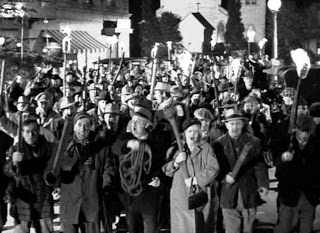
    Your mission in life is to use your brain and not to be one of the torch bearing mob.

    If it’s you the mob are looking for, then it’s best to lie low until another headline or something shiny distracts them.

    Similar posts:

  • Stumbing into recession

    Stumbing into recession

    The Committee for Economic Development Australia (CEDA) today released its 2012 Big Issues survey looking at the responses of 7000 business people on the issues confronting Australian industry in 2012.

    One of the notable results is that business people don’t care about government surpluses. A third are neutral on the question “do you believe maintaining a government surplus is important” while 35% disagree that it is a high priority.

    Q10

    Yet despite the electorate and business saying the deficit is not a priority, the politicians still obsess about maintaining their surplus.

    Now Australia’s mining boom has come to an end – along with the blue sky economic assumptions that underlie both sides of politics’ spending plans – governments are desperately trying to fudge the books and continue the pretense that their budgets are in the black.

    Driving this obsession with avoiding deficits is the religious belief among Australia’s political classes that Triple – A credit ratings from the discredited Wall Street ratings agencies is more important than educating the nation’s children, caring for the country’s sick or building the infrastructure to compete in the 21st Century.

    The real danger with this deficit obsession is that there is a very high possibility that state and Federal governments are going to tip Australia into a recession driven by European style austerity. Already we see this developing as various states start slipping backwards according to the ABS’ latest accounts.

    graph courtesy of Macrobusiness

    Another interesting result from the CEDA report is how business’ view the Australia in the Asian Century report with nearly 80% of respondents saying the issue is important or critical.

    It is questionable whether Australian business is prepared to face the realities of an Asian Century as David Llewellyn-Smith writes at the Macro Business Blog, Australia’s businesses are looking more at getting help from the government to cut domestic costs rather than sell into Asia. That inward focus of Australian business since the mid-1990s is the topic for another blog post.

    The sad thing is that the government aspects of Asian Century report is stillborn as surplus obsessed politicians carve into skills training and innovation programs in a vain attempt to balance the books while failing to reform the tax system or address the middle class welfare that’s squandered most of the returns from the last decade of prosperity.

    Australia’s politicians are very soon going to have to decide who they govern on behalf of, the corrupt and incomptent ratings agencies or the people who vote for them and pay the taxes which support them and their political parties. For some, this might be a tough choice.

    Similar posts:

  • Newly normal in the English Midlands

    Newly normal in the English Midlands

    On their metal, a story from BBC Radio’s In Business program looked at how the English Midlands is dealing with the toughest economic conditions the beleaguered region has suffered for decades.

    Once the centre of the industrial revolution, The Midlands have had a tough time of the last fifty years as the region caught the brunt of Britain’s de-industrialisation and the loss of thousands of engineering jobs.

    Today, the surviving engineering companies are struggling to find new markets as orders from Europe dry up and many Midlands workers find they are confronting the ‘New Normal’.

    The ‘New Normal’ for British industry is described by Mark Smith, Regional Chairman, Price Waterhouse Coopers Birmingham who points out that UK industries have to sell to the fast growing economies.

    Interestingly this is similar, but very different in practice, to the Australian belief – where the Asian Century report sees Australia continuing being a price-taking quarry for Asia rather than selling much of real value – the Brits see some virtue in adding value to what they sell to Asia’s growing economies.

    The British experience though shows the realities of the ‘New Normal’ for Western economies – the cafe owner featured in story now offers no dish over £3 and the idea of overpriced five quid tapas are long gone. The customers can’t afford it.

    Part of this is because of the casualisation of the workforce as people find salaried jobs are no longer available and become freelancers or self-employed. One could argue this is the prime reason why unemployment hasn’t soared in the UK and US since the global financial crisis.

    That ‘new normal’ features the precariat – the modern army of informal white and blue collar workers who have more in common with their grandparents who worked for day wages at the docks and factories in the 1930s than their parents who had safe, stable jobs through the 1950s and 60s.

    For the precariat, the idea of sick leave, paid holidays or a stable career started to vanish after the 1970s oil shock and accelerated in the 1990s. The new normal is the old normal for them, there just happens to be more of them after the 2008 crash.

    With a workforce increasingly working for casual wages without security of income, the 1980s consumerist business model built around ever increasing consumption starts to look damaged.

    The same too applies to the banking industry which grew fat on providing the credit that unpinned the late 20th Century consumer binge.

    When the 2008 financial crisis signalled the end of the 20th Century credit binge, the banks were caught out. Which is why governments had to step in to help the financial system rebuild its reserves.

    The effects of that reserve building also affected businesses as bank credit dried up. Early in the BBC program Stuart Fell, the Chairman of Birmingham’s Metal Assemblies Ltd described how his bank decided to cut his line of credit from £800,000 to £300,000 which forced the management to find half a million pounds in a hurry.

    That experience has been repeated across the world as banks have used their government support and easy money policies to recapitalise their damaged accounts rather than lend money to entrepreneurial customers to build businesses.

    Businesses are now looking at other sources to find capital from organisations like the Black Country Reinvestment Society which is profiled in the story that raises money from local investors to provide small businesses with working capital.

    Communities helping themselves and each other is the real ‘New Normal’ – waiting for the banks to lend money or hoping that surplus obsessed governments will save businesses or provide adequate safety will only end in disappointment as the real austerity of our era starts to be felt.

    The New Normal is declining income for most people in the Western world and we need to think of how we can help our neighbours as most of us can be sure we’re going to need their help.

    Just as the English Midlands lead the world into the industrial revolution, it may be that the region is giving us a view of what much of the Western world will be like for the next fifty years.

    Similar posts:
  • Here’s where the fees go

    Here’s where the fees go

    Becoming a partner of Goldman Sachs is a path to riches and is admission into the highest elites of the Western World’s corporatist society.

    The Guardian looks at the process of becoming a Goldman Sachs partner from joining the company as an ‘analyst’ or ‘associate’ through to achieving the highest partner level.

    What’s notable about the story are the layers of management and their grandiose titles; the position of “vice-president” being a case in point where it is the next step up for associates and analysts rather than the seat of power such a title suggests.

    The sheer number of these vice-presidents and Managing Directors, estimated in the hundreds by the Guardian, is another notable point. The fact there are nearly 500 partner positions in the firm indicates just how fat the fees must be to pay these people.

    If Goldman Sachs and their clients were private companies their fees and remuneration would be their own business. Since the Global Financial Crisis, Goldman Sachs and its too-big-to-fail competitors now are explicitly underwritten by the world’s taxpayers.

    That should make us all concerned at just how much our grandchildren are going to have to pay for the generous lifestyles of today’s banking elites.

    Similar posts:

  • Australia in the Asian Century – Chapter 8: Building sustainable security in the region

    Australia in the Asian Century – Chapter 8: Building sustainable security in the region

    This post is one of the series of articles on the Australia in the Asian Century report.

    The eighth chapter of Australia in the Asian Century looks at the security picture of the region, this is one of the bigger chapters and like some of the others it’s as notable for what it leaves out as for what it says.

    National objective 20. Australian policies will contribute to Asia’s development as a region of sustainable security in which habits of cooperation are the norm.

    That’s nice, worthy and has been undoubtedly true for most previous Australian governments. Except of course when Australian Prime Ministers join the prevailing colonial power in wars like Iraq, Afghanistan, Malaya, Korea, Vietnam or kicking around the German territories in World War I.

    Chapter Eight partly dives into territory already covered in Chapter Three, this time though the analysis does discuss the United States’ role in more detail and makes the observation that US military spending dwarfs that of any other Asian nation – interestingly this is one of the few times Russia gets a mention in the entire report.

    Encouragingly, the paper doesn’t confine the concept of ‘security’ just to military matters and takes a broader view of issues such as guaranteeing access to resources, food and water. There is some discussion of climate change and on regional responses to natural disasters such as tsunamis and earthquakes.

    One notable omission is that of refugees. Given that most of the asylum seekers arriving by boat are Asian – currently coming from Afghanistan and Sri Lanka – and almost all pass through other Asian countries, it would be expected this issue would get some exploration. Sadly it doesn’t and once again skirting over an important issue detracts from the paper’s substance.

    As befits Australia’s most important relationships in Asia, there is a lot of discussion of the three way relationship between China, the United States and Australia with a detailed breakout box in section 8.4.

    The discussion on Australia’s relations between China and the US makes an interesting statement;

    In managing the intersections of Australia’s ties with the United States and China, we will need a clear sense of our national interests, a strong voice in both relationships and effective diplomacy.

    Undoubtedly this statement is true, however successive Australian governments have conflated the interests of the United States with being the same as Australia’s. In recent times Australian leaders have followed the US lead even when it has been clear American policy conflicts with Australia’s Chinese relations.

    Moving away from a reflex support of the United States is going to be one of the biggest challenges for Australian governments in the Asian Century and one hopes the process is as gradual and incident free as the white paper hopes.

    National objective 21.The region will be more sustainable and human security will be strengthened with the development of resilient markets for basic needs such as energy, food and water.

    National objective 21 is an interesting statement in itself – “resilient markets for basic needs such as energy, food and water” smacks of the 1980s privatisation and corporatism that has left Australia with duopoly industries and an excessive financialisation of those markets for basic needs.

    It may well turn out to be the case that Asian countries choose not to follow that path, particularly those like the Philippines and Indonesia who have experienced the effects of crony capitalism in recent history.

    Chapter 8 of Australia in the Asian Century finishes with a detailed look at the regional efforts aimed at building trust and co-operation on trans-national issues.  Much is made of various international groups such as the G20 and the UN.

    An interesting case study is that of the Nuclear Non Proliferation Treaty with an examination of Japan’s and Australia’s work in that field. Sadly this is another area that’s let down by the actions of current and previous Australian governments in selling uranium to India.

    The nuclear weapons stand off between India, Pakistan and China is another ‘elephant in the room’ issue that doesn’t really get the coverage it should in such a report.

    Chapter 8 of Australia in the Asian Century is a very optimistic section of the report however it does hint at the path Australia could follow to being a credible, medium sized economy and influencer in the region. However one has to consider the actions of Australian leaders when asking if the nation is really interested in taking that path.

    Similar posts: