Category: politics

  • Double guessing the boss

    Double guessing the boss

    Two interesting articles, one from English media writer Nick Cohen and the other from American journalist Eveline Chao, show how effective fear is for driving self censorship.

    Eveline’s story, Me and My Censor, tells of her relationship with the Chinese Government censor appointed to monitor the publication she worked for in Beijing.

    As well as having to avoid the 3Ts – Taiwan, Tibet, and Tiananmen – there were also a range of other delicate issues an active writer could find themselves being censored for as she relates in this conversation with her censor Snow;

    We couldn’t use the cover image I had picked out for a feature on the rise of chain restaurants, because it was of an empty bowl, and, Snow told me, it would make people think of being hungry and remind them of the Great Famine (a period from 1958 to 1961 when tens of millions of Chinese starved to death, discussion of which is still suppressed). Even our Chinese designers began to roll their eyes when I related this change to them, and set them to work looking for images of bowls overflowing with meat.

    Snow had learned the hard way about the power of imagery to upset the party functionaries. Snow explained why when she urged Eveline didn’t illustrate a story with a graphic showing stars;

    I once published, in a newspaper, a picture of a book put out by the German embassy, introducing China and Germany’s investment cooperation. The book’s cover had a big stream on it, half of it the colors of the German flag, half of it red with yellow stars. I decided since it wasn’t a flag it was okay, and sent it to print. Our newspaper office was slapped with a fine of 180,000 yuan [today, around $28,000] and I had to write a self-criticism and take a big salary cut.

    Self criticism and big salary cut – the things that middle managers fears regardless of whether they work in the Chinese Communist Party, the BBC or a bank.

    The same fear of upsetting those in power is discussed in Nick Cohen’s article on the BBC’s disastrous and scandalous decision to pull a documentary exposing Jimmy Savile as a child abuser. Cohen quotes an interview where George Entwhistle, the executive responsible for pulling the program, was interviewed on the matter.

    When Entwistle implied that the editor of Newsnight had no need to worry about his bosses circling over him like glassy-eyed crows, Evan Davis did what any sensible person would have done and burst out laughing.

    Nick Cohen’s point was emphasised to me during the week when a former bank worker mentioned an executive had been disciplined for letting slip the bank was running several instances of a cloud computing service. Apparently the press and regulators could have been in the room where he discussed this.

    Another example is a big organisation I’ve been regularly writing on where staff members regularly say “this is not a place where you question management.” An acquaintance that recently started there had to agree that they wouldn’t mention anything about the organisation, ever.

    The problem with this self-censorship is that it quickly becomes destructive. In the United Airlines dead dog case, staff  subject to arbitrary whims and discipline of management  avoid taking decisions which often escalates situations where common sense would quickly find a simple solution.

    It also means people jump to conclusions. Eviline relates the story of the tourist story;

    One month, we ran a short news brief with figures on the number of mainland Chinese tourists that had visited the United States in 2007, and Snow flagged the number for deletion. We wondered what dirt we had unwittingly stumbled upon. Which government bureau oversaw tourism figures? What were they hiding? Finally, I called Snow, and learned that the numbers we had cited were for the number of Chinese tourists worldwide, not just in the United States.

    So much for the would-be plot. Chagrined, I had to announce to my colleagues that we’d made a mistake.

    A culture of secrecy also creates an atmosphere of distrust with every decision being analysed by staff, customers and outsiders for what nefarious motives lie behind even the most innocuous management decision.

    Eventually those organisations become insular and inward looking with only those perceived as being ‘safe’ allowed to move into responsible positions which further entrenches the culture of secrecy and blame.

    This is not healthy, but it’s where many of our government departments, political parties, sporting organisations and business are today including the BBC, Chinese media organisations and Australian banks.

    For the disrupters, this is another competitive advantage.

    Similar posts:

  • Being careful what you wish for

    Being careful what you wish for

    Economist Yanis Varoufakis posted the conclusion of his speech to British Euroceptics this week with the warning “the cruellest God is the one who grants us our wishes”.

    In a time of austerity this is something we all should carefully consider. Some of these people need to be careful about their wishes;

    • Those renters hoping for property prices to drop 40% may get their wish, but such a crash will leave the economy in ruins and the renters themselves without a job to service their mortgage.
    • Landlords who fantasise about rents tripling, not realising that ripping disposable income out of their tenants’ wallets will also push the economy into recession and hurt their property values.
    • Politicians obsessing about AAA credit ratings without understanding that this locks a government into the narrow, failed ideologies of the ratings agencies – the world’s most incompetent and corrupt organisations.
    • Business leaders demanding that workers be thankful for getting $1 a hour, forgetting that Henry Ford started paying his workers so they could buy his cars and pay executive bonuses.
    • Retired folk reducing their assets to get pensions because “they’ve paid their taxes” who then find life on the aged pension isn’t so great after all.
    • Middle classes urging the government to subsidise their private school fees and medical insurance because “they pay their taxes” and end up paying even more taxes.

    Yanis himself is an interesting guy, having amongst other things taught economics in Sydney for 12 years before returning to Greece;

    In 2000 a combination of nostalgia and abhorrence of the conservative turn of the land down under (under the government of that awful little man, John Howard) led me to return to Greece.

    John Howard himself wished for Australia to return to the “white picket fence” conservative, insular nation of the 1950s. He got his wish and Australians decided they liked the past so much they decided to take the economy back to an 1850s structure of living off the sheep’s iron ore train’s back.

    Today Australia’s inward looking and insular with an economy increasingly based upon mineral exports and property speculation. With both the export markets and property prices now wobbling we might be about to find the cost of our wishes being granted.

    Similar posts:

  • Australia in the Asian Century – Chapter Two: The future of Asia

    Australia in the Asian Century – Chapter Two: The future of Asia

    This post is one of the series of articles on the Australia in the Asian Century report. An initial overview of the report is at Australian Hubris in the Asian Century.

    “Asia’s economic resurgence is set to continue” is the bold statement at the beginning of Chapter Two of the Australia in the Asian Century report and with that the chapter immediately falls back to warm motherhood statements;

    Average living standards are set to improve dramatically and transform the way people live and work. Asia’s economies are projected to expand at a strong rate. The region’s expansion and development will change the contours of Asia and the globe—opening up exciting new opportunities, while also posing some challenges.

    All of this is true, however the report struggles to identify exactly what those challenges and opportunities are as Asia develops and where Australians fit into the region’s evolving economy.

    Demographics will matter, but they are not destiny

    The constant mantra through the report is “demographics will matter, but they are not destiny.” Yet, despite the headline, Chapter Two illustrates that so far it has been destiny.

    Graph 2.6 of the report shows how Japan’s, and now South Korea’s, productivity has tailed off as the population has aged. This is to be expected when economic expansion has been based on labour intensive manufacturing, as China’s is today.

    Frustratingly, the report acknowledges this with the following paragraph;

    But the fruits of adopting new technology and adapting it will become harder to harvest. A point will come, though it’s still some way off, where the growth of labour productivity in developing Asian economies will slow—opportunities for gains from importing foreign technology and for shifting workers from agriculture to industry will diminish.

    “Some point in the future” doesn’t wash when the rest of the chapter shows off various ‘firm’ numbers estimating ‘base’, ‘low’ and ‘high’ growth rates. If you can quantify those growth assumptions, then it should be fairly trivial to estimate the turning point where aging populations start to affect China.

    Luckily others have done this work, the Australian Macrobusiness site suggests that turning point could be as early as 2015. In which case, unlike Japan and South Korea, China will have got old before it got rich.

    If this true, then IMF’s projected growth rates will miss their targets – particularly the ‘low growth’ scenario which is almost identical to their ‘base scenario’.

    Rise of the middle class

    Much of the emphasis in this view of Asia’s development is on the rise of the middle class and the report features a case study of Hitesh, a middle class stockbroker in Ahmedabad.

    While there’s no doubt Hitesh and his family’s income and standard of living are rising, the idea that several hundred million Indian and Chinese will jump to European or North American income levels before 2025 is improbable.

    Most stockbrokers in New York, London or Sydney earn between 30 and 300 times Hitesh’s $5,000 a year and in 2010, average Chinese income was a tenth of the US.

    Even if the Indian and Chinese middle classes did manage a tenfold growth in income over the next decade, the assumption they would adopt the debt driven high consumption patterns of the US or Australia isn’t a given as we see in how the Japanese middle classes haven’t aped the spending behaviour of their profligate Western friends.

    The credit and banking points in this chapter illustrate the hubris mentioned in my original overview of Australia in the Asian Century.

    And with financial systems in advanced economies unwinding the high debt levels built up before the Global Financial Crisis, financial institutions in stronger economic positions, such as those in Australia and elsewhere in the Asian region, will have opportunities to expand into new markets.

    Given the dire records of Australian banks in expanding overseas along with the “stronger economic position” being due more to government guarantees during the GFC and the desperate political desire to prop up Australia’s property market at all costs, it’s difficult to see exactly what Australian institutions have to offer Asian savers except to further underwrite the never ending down under housing bubble.

    Chapter two of the Australia in the Asian Century report finishes with an overview of the current geopolitical situation which is notable more for what has been left out. This is again probably due to Canberra public service politics and the report suffers for it.

    One major region left out is Central Asia and Russia – outstanding given the report’s view  that a resource poor Asia (that Japanese assumption again) will need Australia to fuel its energy and resources needs – which ignores the construction of pipelines and railways to China and India.

    Also missed are the projects to upgrade China’s railway and road links to Europe and Central Asia. These in themselves may trigger major geopolitical changes over the next few years, as we’re seeing today in Tibet and Xinjiang after railways were built to Kashgar to Lhasa. Yet none of this is considered.

    Not the ‘Stans should feel aggrieved, like the rest of the report the emphasis is on China and India with scant mention of other Asian countries.

    For Australia, much of the hope in the report seems to be in providing raw materials for Asia’s industrialising and urbanising societies along with being a holiday destination and education provider. This is all lazy 1980s thinking which projects Australia’s Japanese experience of thirty years ago onto China and India today.

    The predictions of Asia’s future in the Australia in the Asian Century report are largely are a continuation of the status quo. If this report had been written in 1960, it may have picked the rise of Japan over the following twenty years but the main focus would have been on Burma as Asia’s richest independent country.

    Exacerbating the report’s weakness are the assumptions that development paths will follow the same course as Japan, Taiwan or South Korea in the late 20th Century.

    Development wasn’t a smooth path in all three of those countries and each had their own unique political and economic upheavals in that time, the failure to recognise that similar disruptions will happen in Asia’s emerging economies as they develop is probably the greatest weakness in the entire report.

    It’s very easy to draw straight lines on graphs based on ‘best case’ IMF projections but history is rarely linear. This is probably the greatest intellectual failing of the white paper.

    Similar posts:

  • Australian Hubris in the Asian Century

    Australian Hubris in the Asian Century

    This post is one of the series of articles on the Australia in the Asian Century report.

    The release of the Australia in the Asian Century discussion paper today raises the question of where the country sees itself and where it is going. It lets us down on many levels.

    While there’s a lot more to discuss in the paper, which I’ll do over the next few days, there’s a few issues that come to mind on first reading.

    The reliance on mining

    A constant  in the discussion about Australia’s future is the continued mining boom. This was the underlying theme of Monday’s Mid-Year Economic Outlook and is also the case in the Asian Century paper. Here’s chart 4.4.2 from the document which shows the forecast makeup of Australia’s exports.

    Today mining exports are shown as being just over 50% of Australia’s trade with Asia and have mineral income growing to well over 60% of trade by 2025.

    What is frightening about this is the belief across Australia’s political and business leaders that the mining boom is here to stay and will continue to keep growing.

    Little risk analysis

    Also notable about the report is how little acknowledgement of risk there is in the document. Most of the risks are dismissed in six paragraphs in Chapter 4.4

    Geopolitical risk does get its own chapter, but even there most of the challenges are glossed over. Eventually most of the risks are dismissed with this line.

    None of these developments of themselves make major power conflict likely—in some important ways they will probably act as a constraint. All the major powers recognise how interdependent their economic interests are.

    This is reminiscent of the line used in the late 1980s – “no two countries with a McDonalds have ever gone to war against each other.” A glib nonsense which ceased to be true when NATO attacked Serbia in an effort to stop the massacres of the Yugoslavian disintegration.

    Trivialising the big risks

    Had anyone predicted in 1986 that within five years, there would be a bloody civil war in Yugoslavia, the Eastern Bloc collapse and the Russian Empire’s eagle replace the hammer and sickle on the Kremlin they would have been dismissed as fools.

    Yet that is exactly what happened.

    The risk of instability within the People’s Republic of China isn’t mentioned or even the effects of what a collapse of North Korea would mean to South Korea – another key Australian mineral market – both of which would have massive effects on Australia’s export markets over the next decade.

    While I’m certainly not forecasting the collapse of either the DPRK or the Communist Party of China in the near future, these are massive risks to any plan which purports to look at the next decade. Ignoring them or trivialising them does not help the paper’s credibility.

    Australian hubris

    Most notable in the white paper is the tone of Australian Exceptionalism through the commentary. In the Prime Minister’s speech she said “we are the nation that stared down the economic crisis.”

    Calling massive stimulus packages, reinflating the property market and guaranteeing bank liabilities is hardly ‘staring down’. Australia’s avoiding going to into recession after the 2008 crisis was due to the “go early, go hard” philosophy of pumping money into the economy which was learned by Australia’s bureaucrats in the 1990s recession.

    That policy worked to stave off recessions during the Asian currency crisis of 1998, the Long Term Credit Bank collapse and the post September 11 uncertainty. It worked on massive scale during the post-Lehmann Brothers collapse.

    Crediting Australia with some sort of miracle economy is hubris on a grand scale and hardly the basis for developing a sensible plan to guide us through the next decade.

    What is Australia’s competitive advantage?

    Essential to understanding where the nation can prosper from the rise of Asian economies is where our current strengths lie. Apart from empty phrases on “skilled workforces” and “new opportunities will emerge in manufacturing” there’s no explanation of exactly where Australia can profit from these.

    In fact most of the case studies refer to Australian companies outsourcing or Asian trading patterns that really don’t need any skilled or valued added contribution at all, a case in point is the story of ‘Hitesh’, one of India’s rising middle class.

    Hitesh, 31, is a stockbroker in a firm that he opened with his friend several years ago. He brings in an annual income of US$5,280, placing his family squarely in the middle of Ahmedabad’s middle class.

    Nowhere does the case study explain exactly what Australia can offer him – the air conditioners and cars certainly won’t be made or designed in Australia and his daughters’ educations in 2025 might well come through the internet from MIT or the London School of Economics instead of them flying to Melbourne to drive taxis and do barista courses in the hope of getting Australian permanent residency.

    In fact if anything, it’s difficult to see why an Asian company would choose to do business with an Australian stockbroker when they earn thirty to a hundred times more than Hitesh.

    1980s thinking

    Much of what is in the white paper is what we’ve heard before in the 1980s – back then it was Yuske in Nagoya who was going to buy our wine and come to the Gold Coast for holidays.

    There’s nothing in the projections we haven’t heard before, except today we’ve squandered two decades of opportunity by ramping up our property markets and building an unsustainable middle class welfare state.

    Sometime in the 1990s – possibly around the time of John Howard’s election – Australia turned inwards and insular. We had the opportunity  to position Australia as a credible mid-level power in the region but we chose instead to renovate our kitchens.

    That opportunity has been lost and repeating the mantras of the 1980s with the words ‘China’ and ‘Chinese’ substituted for ‘Japan’ and ‘Japanese’ won’t cut it.

    Australia in the Asian Century was an opportunity to show some vision and stake a claim on sharing some of the 21st Century’s riches. Instead the writers chose to give us platitudes underpinned by the certainties of a never ending economic boom.

    Similar posts:

  • What are businesses thinking about?

    What are businesses thinking about?

    Last night the Sydney Business Awards honoured the city’s best enterprises at a gala dinner where a whole group of great businesses were acknowledged for their great work.

    The awards were the result of a three month process where the public voted on several hundred businesses to determine ten finalists in each category. The finalists were then evaluated by judges for each category. I judged the Online Business group.

    The Events Agency who organized the awards today sent me a word cloud taken from the winners’ entry forms. This illustrates what the entrants were talking about in their submissions.

    A wordcloud of the Sydney Business Awards winners entries
    The word cloud of the Sydney Business Awards winners’ entries.

    Staff is the biggest issue for businesses, followed by the two instances of ‘increase’ caused by one having a capital and the other not. If we combined the two instances ‘increase’ would probably be the biggest word.

    Given training is one of the other big words we can see the real challenge is training up staff. Marketing and funding also figure prominently.

    While basic and from a very narrow survey base, that word cloud gives us some ideas of what worries business owners and a base to start answering those challenges.

    The word cloud also explains why education, training and industrial relations are such important issues to the business community which is something both politicians and the media should consider.

    Overall the quality of the businesses entered into this year’s awards was terrific. In the online section I really struggled to separate the great finalists and there was very little between Appliances Online who won the category and the two runners up.

    What’s also interesting is how many of the finalists in other categories had strong online presences, illustrating how the web is important for all businesses.

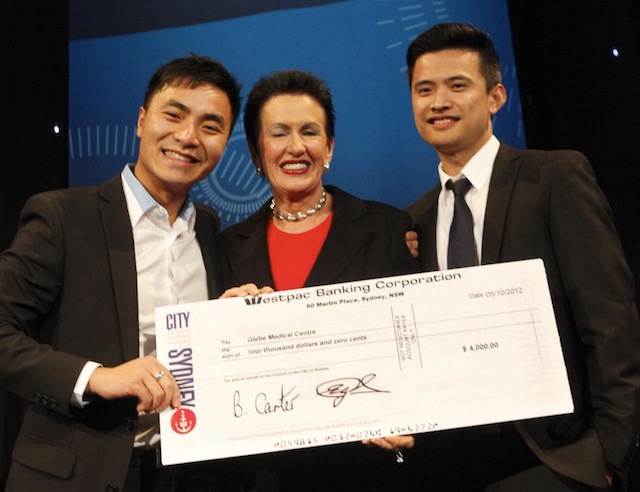
    Congratulations to all the entrants and particularly Climate Friendly who not only won the main Business Award but also the Sustainability and Environmental awards. Glebe Medical Centre was the winner of the Small Business Award and the Healthcare and Fitness category.

    For those who didn’t win this year, it’s worth entering next year as good businesses only get better with time. Hopefully we’ll see your business or vote next year.

    Similar posts: