Category: politics

  • A website can’t save a dying business

    A website can’t save a dying business

    The last week has seen some interesting changes in the local online business community.

    Embattled department store David Jones’ announced they are following Harvey Norman into an “omni channel strategy”.

    Harvey Norman chief executive in turn appeared on national television to state the “internet drives no sales.”

    In the political field, it was reported the Australian Labor Party are looking at using Blue State Digital tools to counter voter and member apathy.

    Each one in it’s own way illustrates how organisations can be distracted by shiny new technology while ignoring much deeper problems.

    In the case of David Jones, the department store ignored their core competencies and tried to ape their down market competitors in milking the financial services cow.

    This worked fine while they could offer 24 and 36 month interest free deals and as soon as their partners American Express started charging a monthly “Administration Fee” that business evaporated.

    One of DJ’s down market competitors is Harvey Norman, co-founder Gerry Harvey has spent his life building a fortune based upon providing cheap credit to consumers.

    It was always going to be a mistake for DJs to compete with Harvey’s as Gerry is far better at the business than the well connected, genteel board of David Jones and their snappily dressed friends in the store’s executive suite.

    Worse for DJs, the whole strategy alienated their core markets and while management focused on financial services customers went elsewhere to find the quality goods and services that the upmarket department store should be providing.

    For both though, the financial services business model is now fading as the 20th Century debt supercycle comes to an end; consumers no longer want to load up on “buy now, pay later” schemes.

    So all the talk of “omni-channel strategies” really doesn’t address the underlying weaknesses in both business.

    This disconnect with reality is true in politics as well where the ALP is reported to be considering using the Red State Digital tools that Barak Obama used so well in his 2008 US Presidential campaign.

    While the tools are impressive, they don’t address the problem that the electorate – and the member bases of the major political parties – have become rightly disillusioned and disconnected from the political processes that exclude everyone except an increasingly smaller circle of cronies and insiders.

    The only good thing that will come of using US political communications tools in the spectacular eruption the first time one of the ALP’s factional warlords encounters a grass roots online campaign like The Great Schlep.

    Heck, the resulting furore might even see some of the apparatchiks distracted from partying and whoring on their union credit cards for a day or two.

    All the frivolity aside, the reality for the Australian Labor Party, David Jones and Harvey Norman is their problems are far deeper than a well designed website and impeccably executed social media strategy can fix. These organisations need major rethinks about how and why they exist.

    It doesn’t matter how much money you throw at the web or how effective your social media strategy is – if the foundations of a business are shaky then a nice “omni-channel strategy” aren’t going to fix things.

    For some of organisations, a failure to embrace the online world may be one of the causes for their problems, for many though there are far more basic issues they need to address.


    Similar posts:

  • Irrelevance and the media

    Irrelevance and the media

    It’s a shame we weren’t around when dinosaurs became extinct. Then again, maybe we are.

    News Limited business commentator Terry McCrann writes about the “Bleakest of views from the shopfronts” in his Sunday column describing the problems of retail.

    All of the problems Terry cited are from big retailers – Woolworths, Dick Smith, Harvey Norman and JB HiFi. To make it clear he was talking about corporate issues there’s even a reference to General Motors.

    Nowhere does Terry talk about smaller businesses or those challenging the big guys, folk like Ruslan Kogan or the Catch of the Day team. It’s all about the big end of town.

    Terry’s article illustrates the problem of relying on incumbent mainstream media commentary; that it is Big Media talking about Big Business and Big Government.

    “Small”, “ordinary” or “average” has no place in their conversation, if you can call the pronouncement of mainstream media commentators a conversation at all.

    We can understand this – for a journalist, it’s good for the ego and career to look like a “heavy hitter” in big business. For the politician, small business and community groups can’t pay the speaking and consulting fees paid by corporations to supplement their meagre retirement benefits.

    Increasingly what happens in the corporate board rooms or the once smoke filled rooms of political caucuses is out of touch with the real world.

    This has become particularly acute since the responses to the 2008 crash proved to the management classes that their bonuses and perks will be protected by government bailouts regardless of how many billions of shareholder wealth they manage to destroy.

    In the United States we see this in political controversies being focused on contraception – an issue settled forty years ago – while the country faces fundamental challenges to its economic base and the basic welfare of its citizens and industries.

    While in Australia the media ‘insiders’ rabbit on about pointless internal party politics and soothing articles on how everything else is fine, we just need to be more optimistic. Yet the real questions about how we take advantage of the country’s greatest export boom, position the economy for the next 50 years and the nation’s dependence on the Chinese economy are being ignored.

    Terry McCrann’s story is emblematic of just how out of touch Big Media, and their friends in Big Business and Big Government, are with the real world.

    All we can do is let them get on with it and not take them too seriously.

    Similar posts:

  • When history bites

    When history bites

    In a strange way Peter Watson, the Australian Labor Party election candidate disendorsed and expelled for his homophobic views, is a trend setter for his generation.

    Mr Watson was caught out by the unsavoury views he’d posted on Facebook and other online forums. That he defended what he had written “when I was like 14, 15 years old, so we’re talking about four, five years ago” made matters worse.

    Our digital footprints – material about us on the web or in social media sites – sometimes show we’ve strayed into places we’d rather admit to.

    There’s plenty of others who have posted things that will bite them later when they apply of jobs or seek political office.

    It will be interesting to see how society and the media adapt to our histories and the dumb stuff we did as teenagers being freely available, Mr Watson is an early casualty of that adjustment process.

    One of the more disturbing aspects of the Peter Watson case is his political party’s failure to do the most basic of checks on their candidate’s background. Something that again illustrates just how out of touch the nation’s political structures are with modern society.

    When we talk about disruption, we often focus on the jobs, business and social aspects of that change. One thing we often forget is that social upheaval directly affects political parties.

    Political parties who fail to adapt to the needs of their society become irrelevant and fail.

    So maybe Peter Watson has, through sheer dumb luck, found himself on the right side of history in being expelled from a political party that doesn’t know how to use Google search.

    Similar posts:

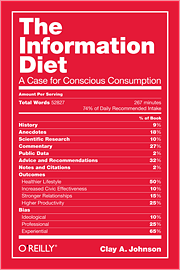
  • Book review: The Information Diet

    Book review: The Information Diet

    We all know a diet of fast food can cause obesity, but can consuming junk information damage our mental fitness and critical faculties?

    In The Information Diet, Clay A. Johnson builds the case for being more selective in what we read, watch and listen to. In it, Clay describes how we have reached the stage of intellectual obesity, what constitutes a poor diet and suggests strategies to improve the quality of the information we consume.

    The Information Diet is based upon a simple premise, that just as balanced food diet is important for physical health so too is a diverse intake of news and information necessary for a healthy understanding of the world.

    Clay A. Johnson came to this view after seeing a protestor holding up a placard reading “Keep your government hands off my Medicare.” Could an unbalanced information diet cause a kind of intellectual obesity that warps otherwise intelligent peoples’ perspectives?

    The analogy is well explored by Clay as he looks at how we can go about creating a form of “infoveganism” that favours selecting information that comes as close from the source as possible

    Just as fast food replaces fibre and nutrients with fat, sugars and salt to appeal to our tastes, media organisations process information to appeal to our own perceived biases and beliefs.

    Clay doesn’t just accuse the right wing of politics in this – he is as scathing of those who consider the DailyKos, Huffington Post or Keith Olbermann as their primary sources as those who do likewise with Fox News or Bill O’Reilly.

    The rise of opinion driven media – something that pre-dates the web – has been because the industrial production of processed information is quicker and more profitable that the higher cost, slower alternatives; which is the same reason for the rise of the fast food industry.

    For society, this has meant our political discourse has become flabbier as voters base decisions and opinions upon information that has had the facts and reality processed out of it in an attempt to attract eyeballs and paying advertisers.

    In many ways, Clay has identified the fundamental problem facing mass media today; as the advertising driven model requires viewers’ and readers’ attention, producers and editors are forced to become more sensationalist and selective. This in turn is damaging the credibility of these outlets.

    Unspoken in Clay’s book is the challenge for traditional media –their processing of information has long since stopped adding value and now strips out the useful data, at best dumbing down the news into a “he said, she said” argument and at worse deliberately distorting events to attract an audience.

    While traditional media is suffering from its own “filter failure”, the new media information empires of Google, Facebook, Apple and Amazon are developing even stronger feedback loops as our own friends on social media filter the news rather than a newsroom editor or producer.

    As our primary sources of information have become more filtered and processed, societal and political structures have themselves become flabby and obese. Clay describes how the skills required to be elected in such a system almost certainly exclude those best suited to lead a diverse democracy and economy.

    Clay’s strategies for improving the quality of the information we consume are basic, obvious and clever. The book is a valuable look at how we can equip ourselves to deal with the flood of data we call have to deal with every day.

    Probably the most important message from The Information Diet is that we need to identify our biases, challenge our beliefs and look outside the boxes we’ve chosen for ourselves. Doing that will help us deal with the opportunities of the 21st Century.

    Clay A. Johnson’s The Information Diet is published by O’Reilly. A complimentary copy was provided as part of the publisher’s blogger review program.

    Similar posts:

  • The end of the troll

    The end of the troll

    Australian union leader Paul Howes today claimed in Sydney’s Daily Telegraph that New Media is denigrating politicians. His point being anonymous users on newspaper websites (such as the one he writes for) and online services like Twitter encourage abuse and slander which is degenerating politics and media discussion.

    The rough and tumble of the Internet was raised during the Canberra Media140 conference last September where conversation turned around Liberal politician Joe Hockey’s comment that anonymous, banal tweets was causing him to lose faith in online services like Twitter.

    Media140 provided more discussion about anonymity when The Australian decided to out the anonymous blogger Grogs Gamut, aka Greg Jericho. Greg wasn’t being abusive however his commentary had clearly found its way under the skin of some members of the Canberra political classes.

    But does anonymity matter?  We are kidding ourselves if we believe we are truly anonymous on the Internet. Few of us have the skills or diligence to fully hide our tracks from people we offend or upset.

    Anonymity also discredits much of a person’s statements – as both Paul and Joe have pointed out, if you aren’t prepared to put your name to your views then there is a good argument that your opinions are really worthless.

    However that argument ignores the power imbalance between the ordinary citizen who may find their career at risk by stating their views, as Greg Jericho found, and politicians and those working for political parties or allied organisations, like Joe and Paul who are protected by powerful and often tribally loyal party structures, PR machines and compliant journalists.

    Probably the part that’s most disingenuous though about Paul Howes’ article is that anonymous Internet commenters are dragging politicians down. Sadly our politicians did that job themselves long before social media or web2.0 based websites came on the scene.

    Today’s politicians are only reaping what they have sown themselves. Paul and Joe’s mentors – people like Graham Richardson, John Howard and Bob Carr – went out of their way to pander to and encourage the shrill, anonymous harridans of talkback radio.

    Unfortunately for today’s politicians, the Internet doesn’t have the same gatekeepers in the form of friendly announcers, producers and editors to save them from the public’s genuine, unfiltered opinions.

    The fact many of those anonymous comments – whether online or in more traditional media channels – may be true is another thing to consider; that people genuinely believe these politicians are doing the wrong thing. Rightly or wrongly, is that the fault of the Internet, or the fault of those politicians and their advisors who claim to have wonderful communication skills?

    Internet anonymity is not perfect, and often not right, but the privilege of being able to make an anonymous statement is a fundamental part of a working democracy.

    It’s not surprising our current generation of spin-doctored, on-message politicians feel threatened by a medium they struggle to understand or control, but that isn’t the fault of the anonymous online troll who could turn out to be what ultimately saves our democracy.

    Similar posts: