Category: security

  • The Age of Rattling the Cage

    The Age of Rattling the Cage

    “It’s no longer the big beating the small, it’s the fast beating the slow,” says Eric Pearson, CIO of the InterContinental Hotels Group.

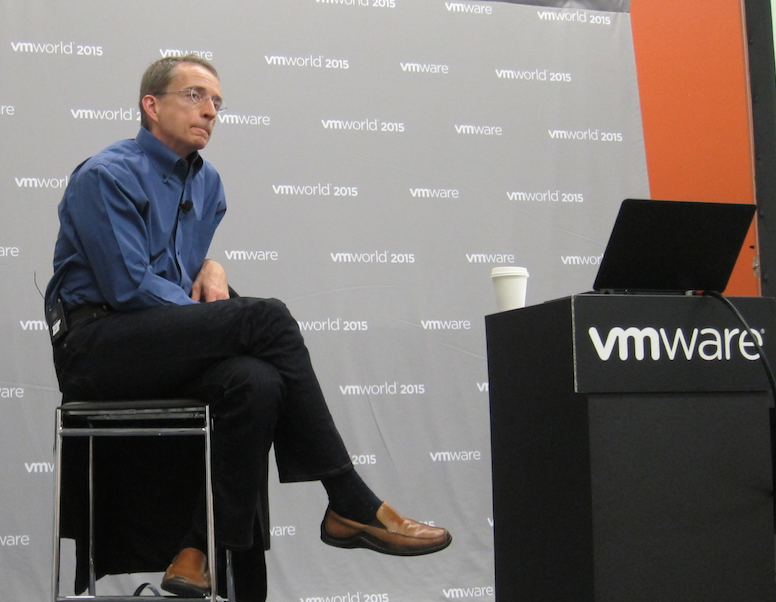
    Pearson was quoted by VMWare CEO Pat Gelsinger in his five imperatives for digital business keynote at the VMWorld 2015 conference being held in San Francisco this week.

    The five are an interpretation of the trends in a radically changing business environment where the barriers to entry have fallen dramatically, industries are globalised and the time to market for new products has collapsed.

    Put together, Gelsinger believes established businesses have to be more nimble as market and industry forces are going to punish those who are too slow to adapt.

    Elephants must learn to dance

    Gelsinger’s initial point is the world of business is now asymmetric – incumbents have everything to lose in the face of new businesses where upstarts have nothing to lose.

    Part of that asymmetry comes from the world of shared resources, which gives startups and smaller businesses access to tools that were once only available to large organisations.

    An obvious example of this are the cloud computing services that is concentrating VMWare’s minds, however another good example of how shared resources will change industries is the self driving car where Gelsinger cites vehicle utilisation will go from 4% to 71%.

    Gelsinger points out using a car on a pay for use basis will change the structure of our cities which in turn changes the economics of living in suburbia and the business models built around it.

    Standardising the cloud

    Cloud computing is at the end of its formative, experimental phase and entering into a professional era where different types of services are going to have to work together.

    “We have the private cloud which is focused on IT as we know it today, pulling out costs, slow and complex applications but also has powerful governance and does what I need it to do while meeting compliance purposes,” said Gelsinger. “On the the other side we have the public cloud which is fast and is able to scale effectively but has weak governance.”

    In a perverse way, it’s Edward Snowden’s revelations that are driving many businesses to maintain their own private cloud networks due to concerns about foreign powers tapping their information flows and the sovereignty of data.

    The consequence of a range of different cloud environments mean they are all going to have to get along with open standards becoming more important as businesses ‘mix and match’ their requirements.

    Meeting the security challenge

    As the Snowden affair shows, IT Security is difficult, complex and messy and becomes more so as workers start using their mobile devices and data is pushed around the cloud.

    Gelsinger sees the online security sector as being the one of the biggest opportunities for startups and one of the fastest growing costs for business, “the only thing growing faster than the spend on security is the cost of security breaches.”

    While Gelisinger’s focus is on VMWare’s security proposition, the security mindset is going to have be adopted by all business people. As the Target and Ashley Madison breaches have shown, the damage that can be done by a security lapse can be crippling and is a tangible business risk that senior managements and boards need to be across.

    Proactive technology

    Artificial intelligence has been through a thirty year gestation and Gelsinger told of his early days as a computer engineer working on AI projects in the late 1980s. Those early days of AI were a failure as the results as the time didn’t live up to the hype.

    Gelsinger sees this as the next wave of computing as it moves from being reactive to proactive as systems become able to anticipate actions based on the data they are seeing.

    While this has major ramifications for the computer industry, it also promises to change management and the role of many professions.

    “This is going to change human experiences,” says Gelsinger however there will be challenges as businesses strike a balance between creepy versus convenience and invasive versus valuable.

    Welcome to the age of rattling the cage

    Half of the firms on today’s Tech 100 list will be gone within 10 years, was the warning in Gelsinger’s final point and he focused on the need for businesses large and small to break out in order to stay relevant.

    “Welcome to the age of rattling the cage,” stated Gelsinger. “A time when taking risk is the lowest risk.”

    Paul travelled to VMWorld 2015 in San Francisco as a guest of VMWare

    Similar posts:

    • No Related Posts
  • Developing the world of trustworthy data

    Developing the world of trustworthy data

    Last month’s remote hacking of Jeeps through their entertainment systems was a wake up call to the technology industry as it underscored the risks of connected devices and now a series of initiatives are looking at improving the security landscape.

    One of the benefits of the new top level domain regime, despite its reeking of rent seeking by the ICANN names agency, is larger companies and industry groups can improve management of their online identities and those of the services and devices their operations rely upon.

    Top level security

    Having their own top level domains and being able to issue security certificates for devices and services within their own walled gardens means financial institutions, hardware vendors and service providers can have more confidence in the identities of those they are dealing with.

    Bloomberg Business examines how corporations are applying for domains to enhance and while the focus is on guaranteeing the veracity of their websites, the scope in having done that expands to a range of other application, particularly that of ensuring everything from bank point of sale equipment through to connected cars and kettles are authenticated.

    A top level domain is only part of the answer though and for the systems to work effectively there has to be more sophisticated ways for systems to ensure they are talking to trusted parties. This need becomes particularly acute with automated systems making business decisions in milliseconds where corrupt or incorrect data can cause havoc with financial markets or supply chains.

    Blockchain’s potential

    Some of the work being done around Bitcoin, particularly with the use of Blockchain technology to ensure transactions are valid, is one intriguing area where researchers are looking at ensuring all parties in a connected society are genuine and trustworthy.

    It’s early days yet in the development of these services and there will be many mistakes as businesses and consumers adopt services where security hasn’t been properly thought through or implemented.

    As Chrysler found with the Jeep hack, the risks of getting it wrong are real and potentially fatal and it’s notable Uber has hired the researchers who discovered that vulnerability to design security for their driverless car project.

    Trustworthy data

    With autonomous vehicles authentication is essential, not just for the passengers or operator starting the car but for all the devices and services communicating from outside and within. As the Jeep hack showed, the braking system needs to have confidence the instructions its receiving are genuine and not coming from a malicious outsider.

    Outside the car other services will be communicating, the vehicle’s navigation system needs to be confident the mapping information it’s receiving is reliable and from the genuine provider. Similarly plans to reduce the road toll using roadside devices and other cars needs to ascertain the data being transmitted about highway conditions is trustworthy.

    It’s often said computers are only as smart as the data going into them – garbage in, garbage out is the classic saying of the computer industry. As we move into a world where more decisions are being made by machines, those systems are going to become more demanding that information is trustworthy.

    Similar posts:

    • No Related Posts
  • Google’s Android problems point the way for the Internet of Things

    Google’s Android problems point the way for the Internet of Things

    As regular security problems are being exposed in the Android operating system, Google and Samsung have announced regular updates to their devices and software.

    For long timers in the IT industry this is a return to the Microsoft days of Patch Tuesdays, the monthly bundle of updates for Windows and Office the company used to issue on the first Tuesday of each month.

    While Android has nothing the like the problems Microsoft did in the early 2000s with the explosion of malware that crippled millions of users, the risks to the Google system are real with some predicting a security armageddon.

    For users, there’s a serious question in the problems facing Android system in that unlike the Windows systems the rollout of updates is controlled by the telcos or handset vendors rather than the software developers.

    As a consequence many older devices simply aren’t being updated leaving millions of smartphone users exposed to malware and having no way of fixing known security problems.

    The problems facing Android are common across the entire Internet of Things, how Google respond the current smartphone security problems is going to be a pointer for the rest of the IoT sector.

    Similar posts:

    • No Related Posts
  • The need for an IoT manifesto

    The need for an IoT manifesto

    Last May at the ThingsCon conference in Berlin a group of European designers came together to form the IoT Manifesto.

    Now vendors have the ability to put a chip into almost anything companies and designers are tempted to add connectivity simply for the sake of doing so.

    In many cases this is opens up a range of security risks ranging from the screaming baby monitor to the hackable jeep.

    Coupled with the security risks of your intimate devices being hacked there’s the related privacy risks as millions of devices collect data ranging from how hard you press your car’s brake pedal through to last time you burned your breakfast toast.

    In an era where governments and businesses are seeking to amass even more information about us, there are genuine concerns about what that data is going to be used for and why it is being collected in the first place.

    The IoT manifesto looks to manage these problems facing the sector through ten guiding design principles;

    1. Don’t believe the hype around the IoT
    2. Only design useful things
    3. Deliver benefits to all stakeholders
    4. Keep everything secure
    5. Promote a culture of privacy
    6. Gather only a minimal amount of data
    7. Be transparent about who that data will be shared with
    8. Give users control over their data
    9. Design durable products
    10. Use the IoT and its design to help people

    All of the principles are laudable and it’s not hard to think that meeting the guidelines would make devices and services that aren’t just useful and safe but also simpler, cheaper and more effective.

    There’s many ethical, business and safety issues facing the Internet of Things as connected devices rollout across almost every industry. The IoT Manifesto may well be a good framework in which to design them and the cloud services they’ll depend upon.

    Similar posts:

    • No Related Posts
  • Security, smartcars and Microsoft Windows – ABC Nightlife July 2015

    Security, smartcars and Microsoft Windows – ABC Nightlife July 2015

    Security problems with smartcars and dating sites along with asking if a new version of Microsoft Windows matters any more are the topics for July’s Nightlife tech spot.

    Paul Wallbank regularly joins Tony Delroy on ABC Nightlife on to discuss how technology affects your business and life.

    If you missed this month’s show, you can listen to the program through the ABC website.

    July’s Nightlife

    A decade ago people lined up all night for a new version of the Windows operating system. Next week Microsoft will be launching Windows 10 to an indifferent market place, does what was once the world’s biggest software company matter anymore in a world of smartphones, connected cars and cloud computing?

    Some of the questions we’ll be answering include.

    • So what are Microsoft announcing next week?
    • What happened to Windows 9?
    • Does Windows really matter any more?
    • The internet has changed things but not always for the better. What about connected cars being hacked?
    • Is this a bigger problem than just connected cars when we’re seeing things like kettles being wired up to the internet?
    • Of course it’s not just cars suffering problems on the Internet, adult dating site Ashley Madison has had potentially 37 million customers’ details leaked online.
    • Could this happen to any business? How do we protect ourselves?

    Listeners’ questions

    A few of the questions from listeners couldn’t be answered on air.

    Running Flash of iPhones and iPads: Steve Jobs’ hatred of Adobe Flash was legendary and as consequence iOS devices like the iPhone and iPad don’t come with the ability to run the software. That’s a problem for those who need Flash for some packages.

    The Puffin web browser gives iPad and iPhone users the ability to use Flash on their devices and is available from the iTunes store.

    Securing Android: While smartphones are less prone to viruses and malware than personal computers, they still are at risk. For Android users there is no shortage of choice for security packages, some of which include;

    Android power hogs: A downside with smartphone apps is they can drain battery life. One excellent feature on Android phones is the ability to easily check what’s using your juice.

    • Open device settings
    • Scroll to “about phone”
    • Click on “battery use”

    Join us

    Tune in on your local ABC radio station from 10pm Australian Eastern Summer time or listen online at www.abc.net.au/nightlife.

    We’d love to hear your views so join the conversation with your on-air questions, ideas or comments; phone in on 1300 800 222 within Australia or +61 2 8333 1000 from outside Australia.

    You can SMS Nightlife’s talkback on 19922702, or through twitter to@paulwallbank using the #abcnightlife hashtag or visit the Nightlife Facebook page.


    Similar posts:

    • No Related Posts