
Category: social media

  • Who will build the next Barnes and Noble?

    Who will build the next Barnes and Noble?

    As US bookseller Barnes and Noble shrinks its store network, Mark Athitakis has a tribute to the once ubiquitous chain in The New Republic.

    Barnes and Noble was never popular among US independent booksellers because of the perception, probably true, that the chain drove locally owned stores out of business.

    What it offered though was a safe, comfortable place for booklovers to gather in suburban shopping malls. As Mark points out, it created a community.

    Its stores were designed to keep people parked for a while, for children’s story time, for coffee klatches, for sitting around and browsing. That was a business decision—more time spent in the store, more money spent when you left it—but it had a cultural effect. It brought literary culture to pockets of the country that lacked them.

    In recent years that community moved to coffee shops, in the United States B&N’s role was taken by Starbucks, at the same time our reading habits changed and the business of selling books and magazines became tougher.

    Now that community is changing again, as the online societies like blogs, Facebook and Twitter become important, the coffee shops have responded with free wi-fi which is a perfect example of how the online and offline world come together.

    That need to create communities, either physically or online, is a driving human urge.

    Online that role is being catered to with social media platforms and sites like food, mommy or tech blogs where like minded people can gather.

    Down at the mall, Barnes and Noble catered for that need in the 1980s and Starbucks in the 1990s. What will follow them may be the next big success in the retail or hospitality industry.

    Image courtesy of Brenda76 on SXC
    Similar posts:

  • Tracking the knowledge graph

    Tracking the knowledge graph

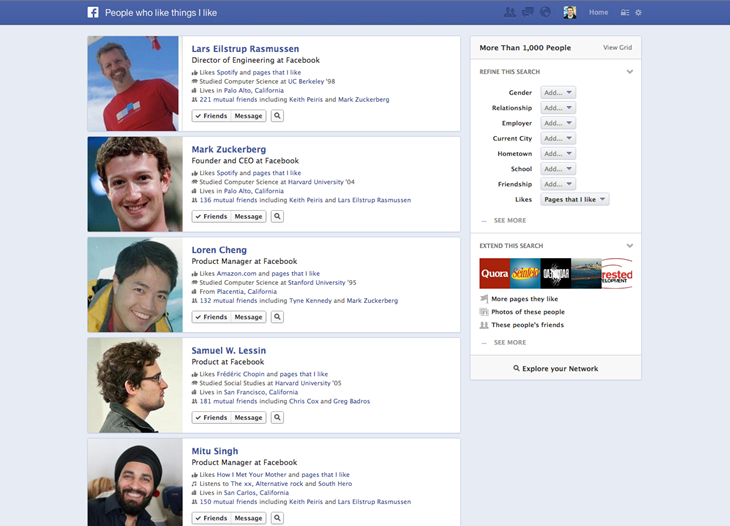
    “Married Men Who Like Prostitutes” is juicy search term and the results can wreck marriages, careers and lives.

    This is one of the Facebook Graph searches UK tech commentator Tom Scott posted on his Actual Searches on Facebook Tumblr site which lists, mercifully anonymised, the results.

    What should worry anybody who uses Facebook is that this data has been in the system all along, advertisers for instance have been able to target their marketing based on exactly this information, Graph Search just makes it quicker and easier to access. This is why you should be careful of what you like and who you friend online.

    Tom Scott has a terrific Ignite London presentation which looks at just how vulnerable an individual is by over sharing online. In I know what you did five minutes ago, Tom finds an individual, discovers his mother’s maiden name and phone number all within two minutes.

    Facebook isn’t the only service we should be careful of, it just happens to be the one we overshare data with the most. When you start stitching together social media services with government and corporate databases then a pretty comprehensive picture can be made of a person’s likes and preferences.

    The best we can hope for in such a society is that picture is accurate, fair and doesn’t cast us in too unfavourable a light.

    In same cases though that data can be dangerous, if not fatal.

    As potential employers, spouses and the media can easily access this information, it might be worthwhile unliking obnoxious, racist and downright stupid stuff. There’s a very good chance you’ll be asked about them.

    Similar posts:

  • Pennies for Apps – how Apple and Google dominate online income

    Pennies for Apps – how Apple and Google dominate online income

    “App Store tops 40 billion downloads” trumpets Apple in a media release curiously timed to coincide with the opening of the Consumer Electronics Show.

    While impressive, those figures aren’t great for developers. As writer Ed Bott points out they are getting 17.5 cents per download.

    Making things worse, that return is trending downwards. Tech site Giga Om put the return at 20 cents a year earlier.

    Giga Om also points out App Store returns are skewed towards the big successful game apps, meaning the majority of app developers are scratching for pennies.

    This phenomenon is also happening with online advertising as Google Adsense partners find their income dwindling for pay for click adverts.

    On top of declining revenues, there’s the cut that Google and Apple take. In the App Store, Apple’s take is 30% while Google pocket over 50% of Adsense revenue.

    Working for pennies has become the norm for for creators like musicians, writers and app developers in the digital economy. The long tail is fine, but it barely pays the bills for all but a few outliers. Everyone else needs a day job.

    In some respects this isn’t new – writers, poets, musicians and painters have generally starved in their garrets throughout history – but the Twentieth Century model of intellectual property, record labels and broadcast empires offered at least a decent living to many.

    Right now the 21st Century model seems to be that creators can go back to starving, while the big four online conglomerates make the profits previously shared around by the movie studios, record labels and book publishers.

    Maybe though the rivers of gold which are making Apple and Google’s managers rich may turn out to be just as vulnerable as those of the newspapers they’ve displaced.

    It may well be that the current dominance of the App Store and Adsense are a transition effect as we move to other business models. It’s difficult to see right now, but we can’t rule it out.

    Similar posts:

  • Customer lock in as a business asset

    Customer lock in as a business asset

    US booksellers Barnes and Noble has been struggling for years and things aren’t getting better reports the New York Times.

    An important part of the New York Times story is the quote from a Forrester industry analyst,

    “The problem is not whether or not the Nook is good,” said James L. McQuivey, a media analyst for Forrester Research. “What matters is whether you are locked into a Kindle library or an iTunes library or a Nook library. In the end, who holds the content that you value?”

    Locking in customers lies at the heart of the Kindle and iTunes business model. Once users have a substantial investment in their book or music collections on one platform it’s unlikely they will go elsewhere as the costs, and risks, of moving are too great.

    This doesn’t always end well for the customer and it gives online businesses great power which they often misuse.

    Every online business tries to lock their customers into their ecosystem – Google, Amazon, Facebook and Apple are the most successful but every single social media and cloud service tries to make it hard for users take their business elsewhere.

    In some respects this is no different to the phone company or bank which have historically tried to lock customers into their services, but the online social media, cloud computing and e-commerce platforms make a much more ambitious grab for their users’ data and assets like music and book collections.

    The New York Times article illustrates just how critical that user lock in is to the success of online businesses. The question for us as consumers is how much we want to be locked inside the web’s walled gardens.

    Similar posts:

  • The Lives they Loved – Another future for journalism?

    The Lives they Loved – Another future for journalism?

    The New York Times’ wrap up of the year’s obituaries may give us an idea of one of the many futures for journalism.

    It’s easy to fall into the trap of thinking that obituaries are just dry recantations of the lives of dead white men and they often are – particularly when about celebrities or undistinguished politicians and businessmen.

    Good obituaries though are masterpieces and those of society’s genuine unsung heroes are moving and educational. A well written obit of an obscure but deserving person is usually a rewarding read.

    As part of the their summation of 2012, The New York Times has taken their obituaries one step further by asking readers to submit photos and stories of their loved ones who’ve passed away during the year.

    The Lives They Loved is the result, a wonderful collection of touching photographs and stories of parents, partners, children and friends who have passed away in the last year.

    User Generated Content – UGC – is one of the foundation stones of new media. The idea is the audience themselves provide the content which frees services like Facebook, YouTube or I Can Haz Cheeseburger from the costs and irritations of actually creating things that people are interested in.

    The New York Times project may well show that traditional news channels with their dedicated audiences and relevance to communities may do UGC as well as any hot new Silicon Valley startup.

    While User Generated Content isn’t the future of journalism, it almost certainly will be one of the them. Whether it turns out that old media use it better than the newer upstarts remains to be seen.

    Similar posts: