Category: social media

  • Online tools to turbocharge your business

    Online tools to turbocharge your business

    Flying Solo’s 2011 Independents Day conference featured our Online Tools to Turbocharge your Business.

    We looked at some of the most popular cloud computing, social media, productivity and collaboration tools that can help a business make more money and grow faster.

    Most importantly, it shows how business owners can free up some of their most valuable asset – their time.

    Some of the tools we discussed include the popular social media platforms like Facebook, LinkedIn and how they can be used for customer service and market intelligence on top of being marketing services.

    We also looked at how collaborative and cloud computing services can help small businesses work together and improve the ways consultants can work with big business clients. In many ways, collaborative tools like Google Apps, Zoho and Dropbox help build team and deliver projects more effectively.

    The Online Tools to Turbocharge Your Business presentation itself is available on Slideshare and if you subscribe to our newsletter, you’ll receive a free copy of the accompanying Online Business Essentials e-book.

    Similar posts:

  • The online review challenge

    The online review challenge

    Last Christmas a group of office workers gathered at a city hotel to celebrate the year’s end. The meal was a disaster as slow, surly staff made mistakes and delivered poorly cooked food.

    Within an hour of the workers returning from lunch, negative reviews of the hotel started appearing on the Eatability and Urbanspoon websites. By the time Christmas Day rolled around, the reputation of the establishment was throughly trashed.

    The rise of online review sites along with social media services like Facebook challenges many businesses, particularly those in the hospitality industry as café owners, restaurateurs and hotel managers struggle with unfavourable comments about their establishments.

    Customers now research on the web before deciding to dine out or make a purchase, so online reviews can make or break an establishment. How does a business make sure their online reputation is safe.

    Pay attention

    The most important part is to pay attention to what people are saying about your business.

    Big corporations will have their own social media staff and community managers to handle much of this, Telstra last week announced their online team will now be on the web 24/7.

    Larger organisations will also subscribe to online monitoring services like BuzzNumbers and PeopleBrowsr to report what’s being said about them.

    For smaller businesses it falls on the owner and staff to keep an eye on the popular review sites and to monitor the business’ Facebook page for negative comments.

    Engage the critics

    No matter how good your business is, you will get the odd unhappy customer. When that happens you need to contact them, preferably through the same public forum they have complained about you.

    Once you’ve established contact, take the discussion offline onto email, phone or even face to face meetings. If the resolution is positive, try to publicise the result in the original channel the complaint was made.

    Fix the problem

    Despite many in the hotel industry believing that most online complaints are deliberate campaigns against them, regular complaints are usually legitimate and indicate an underlying systemic problem in the business.

    If customers are complaining about service, you need to let your staff know customers are talking about them. Should there be regular criticisms of your food, then you need to talk to your kitchen staff or suppliers.

    Don’t get defensive

    Complaints happen. Even the best business in the world has a bad day or encounters a customer who woke up on the wrong side of bed.

    If you think the criticism is unfair or even defamatory, don’t get angry and certainly do not make threats as you’ll only inflame the situation more.

    Should the customer turn out to be unreasonable, at least by having publicly engaged them you’ll have shown the public you’re calm, professional and trustworthy.

    Don’t Lie

    The web is as great at exposing falsehoods as it is at spreading them. If you’re clearly not telling the truth, you’ll make your critics angrier and more determined to damage your reputation.

    A common way many businesses cheat online is with false reviews. Despite industry claims that organised damaging comments are widespread, the reality is the opposite as many hoteliers and restaurateurs frequently post clumsy and obviously fake glowing reviews of their establishments. It’s a bad look and the establishment often ends up looking foolish.

    Get your website right

    Many businesses, particularly in hospitality, have lousy websites or a site that has no Search Engine Optimisation (SEO) so when someone searches for a hotel or restaurant their page comes up way below those for review sites or critical blog posts.

    Regularly review how your site is doing and talk to your web designer or SEO consultant on making sure it’s coming up well when customers search for your type of business.

    It’s important not to overlook local search services so ensure your business has been listed on Google Places and has a Facebook Local Business Page otherwise local searches will go to the online review sites or your competitors.

    Ultimately, the best way to deal with negative online reviews is to minimise them by running a good business. The biggest effect the web is having on business is that it is making us accountable to our customers.

    As big corporations are finding, the days of covering up poor goods and indifferent customer service with marketing is over – if your product doesn’t match the promise you make to your customers they will tell the world.

    Similar posts:

    • No Related Posts
  • The corporates are getting social media and local search

    The corporates are getting social media and local search

    Shopping centre owner Westfield’s announcement this week that they’ll be offering Facebook Check-in Deals  at their local malls shows the corporate sector is beginning to rise to the challenges of the social, local and mobile driven marketplace. Smaller businesses need to be taking notice.

    Consumer behaviour is changing quickly as the SoLoMo revolution, a term invented by investor John Doerr, sees customers bringing together social media and local search on their mobile phones and iPads. That presents a lot of opportunities for savvy marketers and business owners.

    In the early days of mobile commerce we saw the idea of local, mobile based marketing being SMS based along the lines of nearby vending machines texting you on a hot day to say “hey, I have cold drinks” on a hot day.

    Thankfully for our sanity that concept never really took off and it’s taken the arrival of social media services and smartphones for this type of marketing to become feasible.

    Social media services also have the advantage that messages, particularly those appearing on a user’s Facebook wall, come from trusted sources, further increasing the credibility of a message.

    How the check-in deals work is a shopper checks into their local shopping mall which triggers messages there are deals available at stores in the centre. If the customer takes an offer, a “Like” appears on their Facebook wall.

    All of the customer’s friends then see the hot deal and that encourages them to visit the store and shopping centre. In this respect it’s similar to the social media aspect of group buying services, another area that Facebook have entered and which will almost certainly be integrated into this the Check-In Deals program.

    There are some issues with this for both the merchant and the consumer. The most obvious are the privacy and identity issues of the customer as social media sites work harder than ever to find angles on using our private information.

    For businesses, there’s the risk of being held hostage by Facebook and Westfield. Both organisations are well known for their strict terms and control of tenants and users, so having your business’ long term interests may not be served by being locked onto their platforms.

    Driving traffic to your website is the key objective of a social media presence, so the website has to tie into the proprietary social media, local search, group buying and whatever channels you’re using to promote your business online.

    What this emphasises is the importance of smaller businesses getting their local search listings working on services like True Local, Google and Facebook Places to compete on this platform against the big boys who are now making aggressive moves into the social and local services.

    The clear message from Westfield’s partnership is that corporate Australia is now beginning to understand how social media, e-commerce and online concepts like group buying fit into their businesses.

    Smaller businesses had a head start with online media as the larger corporations struggled to understand the new services. Now that advantage is gone, it’s time to make sure you’re getting local services right.

    Similar posts:

    • No Related Posts
  • What services does Google Plus really threaten?

    What services does Google Plus really threaten?

    Google+, the search engine giant’s latest attempt at competing with services like Facebook and Twitter, has seen 25 million people joining the service in the month since its launch at the end of June.

    Such a stellar growth rate – it took three years for Facebook to reach the same number of users – means it could be one of the most popular social media services ever. What does this new platform mean to business owners and start ups and how does it affect other platforms like Facebook, Twitter, Yammer and LinkedIn?

    Google+ differs from most social networks – particularly Facebook – in that you can divide your online connections into different groups called circles and restrict shared information to those segments.

    This addresses the biggest problem with social media; that what we share with our friends is not necessarily what we want our family or work colleagues to see, an issue identified last year by then Google designer Paul Adams, who has not co-incidentally since moved onto Facebook.

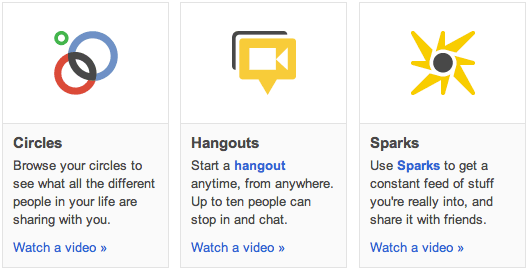
    Along with Circles, Google+ has a few other unique features such as Hangouts which allow impromptu video conferences and Sparks which are random popups of things you might be interested based upon your search history and posts.

    The collaboration aspect as the ability to create Circles and Hangouts for specific projects is one of Google+’s great strengths – and probably to be expected from an Engineering organisation like Google – which may make it an alternative to corporate social media services such as Yammer and possibly even LinkedIn groups.

    At the core of Google+ is the Google Profile which is shared with most Google services such as Gmail and Blogger which gives rise to quite a few privacy concerns as those you share with can get access to this information, although this is the same with most other social media services.

    Marketing is one area where businesses have focused on in the social media world and the lack of broader take up is one of Google+’s drawbacks as Facebook has a much bigger diverse spread of users and so marketing reach.

    At present the discussion of Google+ for marketing is moot as businesses aren’t allowed to create Google profiles which is another powerful advantage for Facebook.

    The question remains on how Google is going to integrate their other services, the obvious one is to incorporate Places in a similar way to Facebook so that businesses can create profiles that can then plug into local search.

    Coupling social media with local search along with Google’s Android mobile phone service pretty well touches all the bases of the SoLoMo revolution which is redefining the consumer world and is almost certainly part of the bigger game plan.

    Adwords will prove to be the greatest challenge, although we’re already seeing concerns being expressed about the potential for Google to misuse their databases and profiles of users and as social media tool plugged into profiles and personal search may be a bridge too far form some.

    Indeed there’s a question of how Google+ will affect other social media tools like LinkedIn and Twitter. Right now it’s difficult to see either being affected by the new service however we shouldn’t underestimate the size of Google’s war chest or how compelling a service that integrates email, search, local search and applications like documents will be.

    Another big advantage of Google+ is the lack of clutter as the game invites and people sending pictures of fluffy cats or their big night out aren‘t around – though this may change as the service moves from being used primarily by business geeks to the general public.

    Whether Google+ supplants Facebook or any of the other social media services remains to be seen as we’re only a few years into the decade where personalised services are changing how we use the web, it would be dangerous to make any bets on who will succeed.

    The stakes are quite high for Google with this product as the overwhelming amount of data at every Internet user’s fingertips is seeing people seeking out sources they trust for answers, recommendations and advice. The social aspect of the online world is going to define the web in this decade just as search did in the previous decade.

    For businesses, or anybody interested in social media who wants to experiment with the new service, it’s worthwhile having a play with the program to see if it works for you but abandoning Facebook, Twitter or even your own website for Google’s service is probably making too early a call at this stage.

    Anyway, the beauty of social media services are that you aren’t forced to use all or any and you may well find that other channels work better for your business regardless of Google’s success.

    Similar posts:

    • No Related Posts
  • No, I don’t like you

    Have you been asked to “Click ‘Like’ to find out more”?

    As more businesses use Facebook and other social media channels as marketing tools, the ‘Like’ button has become one of the key performance indicators for the success or otherwise of a Facebook page.

    So it’s not surprising to be required to ‘Like’ something to find out more about a business, product or competition – despite the latter often being against Facebook’s promotion guidelines.

    The problem with hitting the ‘Like’ button is my name is associated with that page or comment which is then visible to my Facebook friends and liking the wrong things can cost real friendships and even jobs.

    In social media forums like Facebook where there’s not even the pretence of anonymity, we are all accountable for our likes and dislikes. It creates part of our online persona and any observer is right to assume what we give a thumbs up on a social media site is what we like in real life.

    That’s not too damaging if it’s just fluffy cat pictures or some innocuous soft drink but it can have real life consequences outside of a social media platform.

    So no, I don’t like you because you have a Facebook page or a well executed social media strategy.

    If I do like you, it will because you’re putting out a good product, I respect your work or because you are a friend in real life.

    Random ‘Likes’ are a lousy measure of a business’ online success, they’re a lousy deal for the people who give them out as well.

    Similar posts:

    • No Related Posts