Category: Uncategorized

  • Neglecting the small business sector

    Neglecting the small business sector

    I’ve previously flagged how the IT industry fixates on the consumer sector, the Kickstart forum on Australia’s Gold Coast emphasised this with vendors, particularly those in the Internet of Things market, focusing on home users.

    This is mindset is understandable given the huge numbers being cited for consumer applications, but the sneaking suspicion is that home users simply aren’t going to pay for these technologies and that the real money will be made in helping the retail sector deliver services to customers.

    On Networked Globe today we discuss that quandary, it’s something that both vendors, consumers and small businesses should be thinking about given the way it’s going to change supply chains and entire industries.

    Similar posts:

    • No Related Posts
  • Hitting the eighty percent of needs

    Hitting the eighty percent of needs

    “I don’t use ninety percent of what’s in Microsoft Word” has been the complaint of computer users for years as they struggled through the myriad features of box software products.

    In the days of floppy disks and CDs, software developers tried to deliver as many features as they could; despite the fact that the ordinary user only needed a core set of functions and that most items on the menus went untouched.

    The result was bloated, difficult to use software. The cloud computing model changes this, particularly in business fields like accounting software.

    Last week saw a blitz of releases from cloud accounting services with Xero, Intuit and MYOB all making big announcements.

    MYOB announced a wide ranging product refresh, Intuit their mobile service and Xero its new board directors that point the direction for its US expansion.

    A key part of all the announcement was how the services are all boasting of their partner ecosystems developing add ons that improve users’ functionality.

    Once consequence of having an army of developers plugging into the product means that companies don’t have to ship bloated packages that have dozens of features that are irrelevant to each users’ needs.

    Xero’s Australian CEO,  Chris Ridd, put this well during the week by observing that company aims to “address the basic eighty percent of needs”.

    This is the exact opposite of the box software model of the past where vendors would try to pack more features into their products which gave rise to the term bloatware.

    Microsoft’s Office package was probably the best example of this massive growth in the product size, with the installation files eventually taking up a full 4.3Gb DVD to deliver something that most people were happy with when WordPerfect 2.0 shipped on three floppy disks.

    That change to the software model is a good example of how business practices and methods change as technology evolves; it also illustrates just one of the fundamental changes older software companies are having to deal with as cloud services change their industry.

    We can still have all the features we want in a software package, but we’ll just have to connect – and probably pay for the add ons.

    Today, we’re more likely to be scrambling to find an add-on rather than complaining about features we don’t need.

    Similar posts:

    • No Related Posts
  • Nothing is stabilising – welcome to an era of exponential innovation

    John Hagel of Deloitte’s Centre for the Edge joined Decoding the New Economy to discuss his view that we’re living in an age of exponential innovation.

    “Increasingly our view is that it’s creating a challenge for companies, traditional businesses who say ‘we’ve been operating in a linear fashion for decades or in some cases centuries or more’ but how do we move to an exponential approach to technology so we don’t get overwhelmed.”

    I’ll be writing the interview up in more detail later, but for the moment enjoy the video.

    Image of John Hagel by Trycatch though Wikimedia

    Similar posts:

    • No Related Posts
  • Refining the pitch

    Refining the pitch

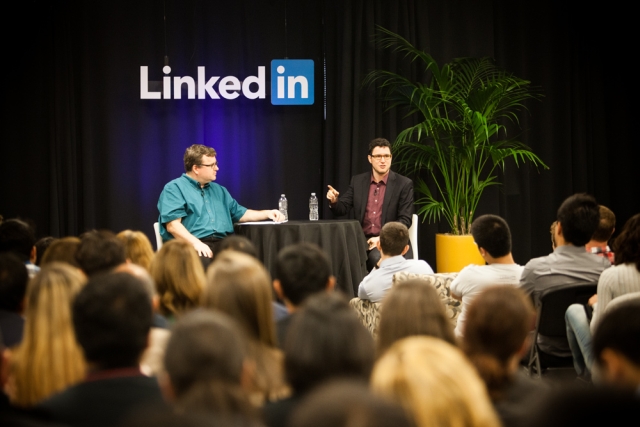
    LinkedIn founder Reid Hoffman has a great post on his website dissecting his original investor pitch in the light of what he’s learned in the subsequent decade.

    The post is full of excellent advice from a business leader; the importance of finance versus product strategy, the risks of confirmation bias and finding what makes your business stand out from a crowded market are just three good points.

    Hoffman also flags how pitching a business to sceptical investors helps entrepreneurs figure out what the real risks are in their business.

    Another important point is that investment come into and go out of fashion, with 2003’s investment climate being very different to today’s.

    In 2013, it’s whether you can break through the noise. Today, there are probably a thousand consumer internet startups founded every quarter — how do you become one of the 1 to 3 that matter in a 7-year timeframe? Those are the kinds of objections you need to steer into at the beginning of your pitch.

    Ultimately though, Hoffman emphasizes how a business needs to be defensible, saying of LinkedIn: “It’s a network effects business, which means it has inherent defensibility with a network.”

    Even for businesses that aren’t tech or web startups, Hoffman’s post is a great guide to developing a business plan and promoting a venture to investors and customers.

    Similar posts:

    • No Related Posts
  • Reinventing Moore’s Law

    Reinventing Moore’s Law

    Google attracted the headlines yesterday with their prototype smart contact lens that helps diabetes sufferers.

    The concept is an example of what’s possible with the next generation of tiny, low powered computers and illustrates how microchips can be slimmed down for a relatively dumb device.

    Liz Gannes at Re/Code received a briefing from Google on the details of the device and quotes project lead Brian Otis as saying that the lens is “the flip side of Moore’s Law.”

    Moore’s law

    For most of the microchip era the focus has been on increasing the number of transistors we could fit in a square inch of silicon, this was the basis of Moore’s law — that the number of transistors on integrated circuits will double every year.

    Co-founder of Intel, Gordon Moore, proposed this rule in 1965 and it has held fairly constant every since.

    Now we may be seeing the trend heading the other way as developers focus on what can be achieved with the bare minimum of computing power.

    Google’s smart contact lens shows how simplifying devices for specific tasks makes them more affordable and suitable for low power devices.

    While the internet of things won’t kill Moore’s Law, it does change the basis of how we think about advances in microchip technology.

    Similar posts:

    • No Related Posts