Category: Uncategorized

  • Will the internet’s insecurities damage economic growth?

    Will the internet’s insecurities damage economic growth?

    “No country is cyber-ready” warns Melissa Hathaway, author the Cyber-Readiness Report.

    Hathaway’s warning is that the economic benefits of the internet are being lost to the various vulnerabilities in our information infrastructure.

    Dutch research company TNO claims that the Netherlands lost up to 2% of their GDP to cybercrime in 2010 and Hathaway claims similar losses are being incurred in other developed countries.

    Supporting Hathaway’s views at a function in Sydney today, Cisco System’s Senior Vice President and Chief Security Officer, John Stewart, made a frightening observation about corporate networks.

    “Every single customer we have checked with, and these are the Fortune 2000, has high threat malware operating in their environment – every single one of them.”

    So the bad guys are in our networks and causing real economic damage. The question for businesses and governments is how do we manage this threat and mitigate any losses?

    On our more intimate level, how do we manage our own systems and online behaviour to limit our personal or business losses?

    Hathaway makes the point that the internet was never intended to do the job we now expect it to do and as consequence security was never built into the net’s design.

    Today, we rely upon the internet regardless of its lack of inbuilt security. With everyone from governments through to organised crime and petty scammers wanting to peek at our data, we have to start taking security far more seriously.

    Similar posts:

    • No Related Posts
  • Malware writing becomes bigtime crime.

    Malware writing becomes bigtime crime.

    “Fifteen years ago we saw a thousand types a malware a month, now we see a three thousand a day,” states Richard Cohen, Threat Operations Manager of Sophos Lab during a tour of the company’s head office outside Oxford in England last week.

    That one statistic alone describes the scale of online security risks facing every computer user. Making matters worse is that the attackers have moved from enthusiastic amateurs to committed professionals.

    A particularly notable change for home and small businesses has been the risk of ‘ransomware’ where a computer’s data is held hostage by the bad guys until an unlock code is paid for.

    Like many things in the computer world, ransomware isn’t new however the latest breed uses the latest cryptographic tools.

    “Now there’s money involved, there’s serious effort,” says Sophos Labs’ Vice President Simon Reed. “The quality of malware has gone up.”

    The early versions of ransomware were a joke, usually just being a scary opening screen warning people of the FBI or a similar agency had detected illegal downloads on their computer. Today – according to Sophos’ researchers – the new breed of malware features high level encryption that locks away data fairly comprehensively.

    While the researchers at Sophos were briefing me on the online risks they see, on the other side of the world Eugene Kasperski, founder of Russia’s most successful computer security company, was addressing an Australian National Press Club lunch on the state of the anti-virus market.

    “Traditional criminals are stupid,” Kasperski told the lunch. “Computer criminals are different. They are geeks; geeks with broken minds.”

    The message to homes and small business from both Kasperski and Sophos is quite clear – you have to take online security seriously. Start doing so now.

    Similar posts:

    • No Related Posts
  • Building a protocol for smart cities

    Building a protocol for smart cities

    One of the challenges for governments with smart city technologies is that most administrations don’t know the questions to ask about them, the City Protocol initiative aims to address this problem.

    During the recent Internet of Things conference in Barcelona, Barcelona Deputy Mayor Antoni Vives discussed the objectives of the City Protocol Initiative.

    “The solutions for our problems are more or less the same,” Vives says. “The problems cities have is they are too weak to talk to big corporations to ask for the solutions we need.”

    “So the idea is to set up standard solutions in the way the internet protocol did through agreements between cities around the world and then through these agreements we set up standards that can be developed anywhere around the world in a very cheap way in a physical way that can improve people’s lives.”

    The cities protocol already has fifty cities signed up to the protocol and partnerships with corporations ranging from Cisco to Schneider and Microsoft along with universities such as the MIT, the London School of Economics and the University of Chicago

    Barcelona’s city government was instrumental in setting up the protocol following a visit to Cisco’s head office in 2012.

    “We went to San Francisco and we explained to these guys, ‘we have a plan for our city, why don’t you join us?’ Provided that we convert this plan for Barcelona into something applicable and scalable for any city in the world.”

    “What you have in Barcelona is something we want to scale and replicate anywhere in the world,” Vires proudly states. “The technology you see in Barcelona is something you’re going to see in ten years time in Addis Ababa, Quito, Johannesburg or Moscow. That’s the real revolution.”

    Vires sees the smart city technologies changing the way councils and governments work with citizens, “we have discovered that rather than going from the administration to the citizens, going from the citizens to the people improves our own models. We never forget these guys are the people who pay our wages.”

    “If you put a device in the city that can talk to them, then people are going to interact with the city in a way they have never done.”

    As well as seeing it changing the way governments communicate with people, Vires is enthusiastic about what technology can do for his council delivering services to residents

    “I have to have the best tools in my hands to deliver a better quality of life for my people.”

    There are some risks though with the smart city technologies, particularly that of inclusion with less advantaged, immigrant or older age groups. Vires tells a story to illustrate how this is a priority for the city.

    “We installed the smart bus stop,” says Vires. “There was an old woman and this bus stop has slots to charge mobiles and that old woman went to the slot, took a penny from her pocket and tried to put the penny into the slot as she thought she had to put a coin into the slot to make it work.”

    “We have to make sure that that old woman understands that device is there to serve her, not to put coins into but to give her a better service.”

    The old lady’s story illustrates the challenge facing all governments in implementing new technologies in making sure that everyone has access to the new services. Addressing the problem of equal access will probably be one of the greatest tasks facing the Cities Protocol team.

    Similar posts:

    • No Related Posts
  • Into the ruins of Bedlam – visiting the industrial revolution’s birthplace

    Into the ruins of Bedlam – visiting the industrial revolution’s birthplace

    Nestled in a quiet wooded valley near the modern town of Telford in the English Midlands is the birthplace of the industrial revolution.

    Today the three quiet villages — Coalbrookdale, Coalport and Ironbridge are quaint little communities but two hundred years ago they were the powerhouse of the Industrial revolution.

    ironbridge-wooded-valley
    The hills around Ironbridge

    Coal and ironstone mining in the district started in medieval times with the locals having a wide range of words to describe different types of coal — Lancashire Ladies, Randle and Clod being just a few terms.

    coalbrookedale-blast-furnace-hearth

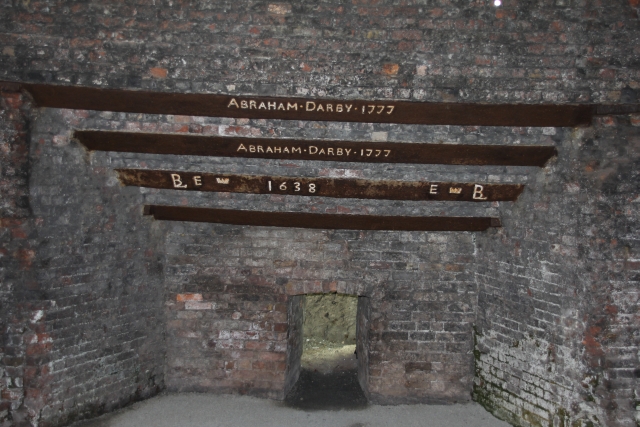
    Iron had been smelted at Coalbrookdale from the late 16th Century however the arrival of potmaker Abraham Darby in 1709 that catalysed the industry with his method to reliably use coke for the blast furnaces.

    coalbrookdale-by-night
    Coalbrookdale by night – the Bedlam furnaces at their peak

    Further downstream, the Madeley Wood smelter became infamous as the bedlam furnaces, named after the noise and confusion of London’s notorious asylum.

    With the new reliable way to smelt iron and a string of blast furnaces along the valley, production skyrocketed and the valley’s natural advantages of accessible coal, iron and water meant it became the centre of the industrial revolution.

    Increased production meant more workers and people flocked in from the surrounding agricultural communities — not in a dissimilar way to today’s experience in China.

    quiant-streets-old-slums

    That increased population meant more slums, what is today’s cute village was once sqaulid poverty, albeit an improvement on the life of an agricultural worker. Epidemics were common with 32,000 lives lost in cholera in 1831-2.

    ironbridge-iron-bridge-industrial-revolution

    Despite the squalor of the workers’ quarters, the ironmasters were proud men and Coalbrookdale’s new bridge could only be build of one material — iron.

    ironbridge-cast-iron-coalbrookdale
    “This Bridge was cast at Coalbrookdale”

    Ironmasters like John Wilkinson and Abraham Derby III were also ferocious promotors of their product and the bridge stands as a proud, strong advert for the strength of Coalbrookdale’s iron. Wilkinson himself built the first cast iron barge a few years later and was eventually buried in a cast iron coffin.

    boy-and-black-swan
    Boy and Black Swan cast iron statue

    Eventually though the smelters of Coalbrookdale began to lose their competitive edge as mining and blast furnace technology improved, the ironmasters responded with moving into decorative and intricate cast iron features like the Boy and Swan statue that now graces the gardens of the Coalbrookdale Iron Museum.

    ruins-of-bedlam-at-ironbridge
    The ruins of the bedlam blast furnaces at Coalbrookdale

    Despite their successes, Coalbrookdale’s slide continued, with coal production peaking in 1871 and a steady decline over the following century.

    modern-use-of-ironworks

    Today, there’s not a lot of industry in Coalbrookdale except for one plant that keeps the area’s engineering tradition running.

    For Britain, the question is how the nation’s economy continues it’s engineering traditions, 45 minutes drive away is a relic of Twentieth Century industry — the Austin motor works at Longbridge.

    Today an assembly plant fills a small corner of the formerly sprawling factory site and over it flies the flag of it’s new owners. The People’s Republic of China.

    Birmingham-MG-car-works-PRC-flag

    We live in interesting times.

    Similar posts:

  • Walking Spaghetti Junction’s canals

    Walking Spaghetti Junction’s canals

    One of the most maligned places in Britain is Spaghetti Junction, an interchange on the M6 Motorway just north of Birmingham’s city centre in the centre of the nation.

    Despite its poor reputation, Spaghetti Junction though has a story to tell — a tale of how physical trade routes change slowly with the motorway being the latest of five major junctions in the area.

    Courtesy of Wikipedia
    Courtesy of UK Highways Agency and Wikipedia

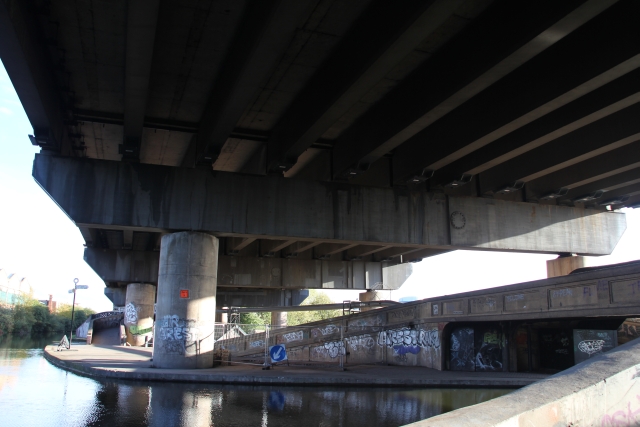
    Immediately below the motorway are the major roads, connecting these and Birmingham were the reason for building Spaghetti Junction in the late 1960s.

    Below those are the canals and it’s notable that just as Birmingham lies at the centre of Britain’s motorway network, it also formed the core of the industrial revolution’s canal network and much of the railway system.

    birmingham_spaghetti_junction_canal_intersection

    Wikipedia describes how critical Spaghetti junction is for the nation’s infrastructure.

    Underneath the motorway junction are the meeting points of local roads, the river Tame‘s confluences with the River Rea and Hockley Brook, electricity lines, gas pipelines, the Cross-City and Walsall railway lines and Salford Junction, where the Grand Union Canal, Birmingham and Fazeley Canal and Tame Valley Canal meet.

    Despite it’s importance the area is dingy and it’s not a good idea to hang around too long, particularly when you have an expensive camera, but it’s worthwhile to linger for a few minutes to appreciate how important these links were to the industrial revolution.

    birmingham-canal-route

    Following the canals away from Spaghetti Junction gives a feeling of the post-industrial nature of Birmingham’s economy something that the city, like most of Britain, is still struggling with.

    Birmingham-gas-basin-canal-junction

    Eventually the canal ends in the city’s convention centre district where a tourist can get a safer, and better, appreciation of Britain’s canal system at the Gas Street Canal Basin.

    While the basin is a bit twee and touristy it does also give a friendly overview of the canal network that replicates closely the railway system that replaced it and today’s roads.

    How these trade routes evolve in the digital economy will be interesting, the recent PayPal survey on the new electronic spice routes illustrates how economies are changing.

    Whether our descendents will wander the abandoned motorways and freeways in two hundred years and wonder at our industrial might is something we might want to ponder. Whether what replaces them is another layer of infrastructure is another question.

    Similar posts: