Category: Uncategorized

  • is G’day China a good idea?

    is G’day China a good idea?

    Yesterday’s announcement by the Prime Minister’s  of an Australia Week in China may prove far more successful than the G’day USA events the idea is based upon.

    G’day USA has been run for a decade and showcases Australia’s attractions, skills and businesses at events in Los Angeles and New York.

    It’s been moderately successful but an emphasis on movie stars appearing at black tie Hollywood events illustrates Australian governments’ disproportionate focus in throwing money at US movie producers.

    If China Week follows the US example we can expect private, exclusive dinners where Twiggy Forrest, Clive Palmer and the BHP board entertain Chinese plutocrats over bowls of shark fin soup and braised tigers’ testicles.

    Should China Week follow that model then it will probably share G’day USA’s middling successes.

    The opportunity to do it differently though is great as the Chinese-Australian relationship is far younger and hasn’t been locked into Crocodile Dundee type stereotypes on both sides.

    As the Chinese economy matures and evolves, there’s an opportunity for Australian businesses and industries which haven’t been available for exporters to the US.

    Done properly, G’day China could help the profile of Australian businesses in many sectors, particularly in those affected by the great Chinese rebalancing.

    Let’s hope they do it properly.

    Image of the Chinese embassy in Canberra, Australia from Alpha on Wikimedia

    Similar posts:

  • Who rules the company parking spots?

    Who rules the company parking spots?

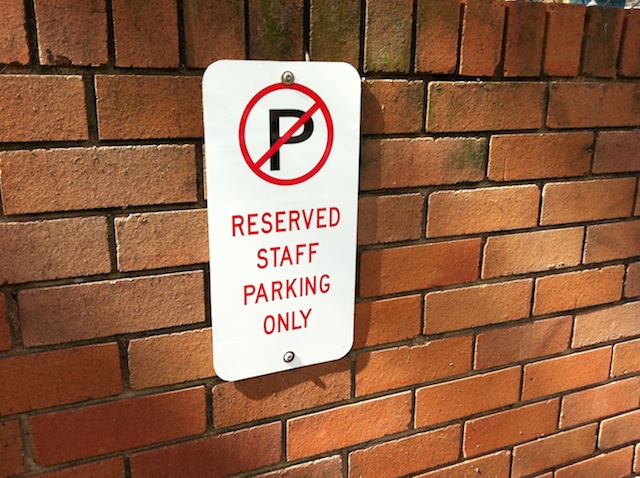
    While at school I worked at a local shopping centre and one of the many ways to  irritate managers was to park in the spots closest to the shops.

    “If the staff take all the spaces near the shops” said the store manager, “then customers have to walk further and might go somewhere else. The customers alway comes before the staff.”

    That’s true and one of the surest signs of a poorly run business is the location of the staff parking spots, particularly when they are reserved for management.

    executive-car-parking-spot

    Similarly the type of company cars management award themselves with can be a warning sign for wary partners.

    If customers, staff and suppliers have to walk past an array of expensive prestige cars in the shady and sheltered executive parking spots they can be pretty certain they are not going to be the number one priority at that business.

    While running PC Rescue I quickly learned this when visiting potential customers, one client in particular invited me to review their network and make recommendations.

    On arriving, I had to feed a parking meter in the street before picking my way past a series of high end Mercedes, two Porsches and a Maserati.

    After looking at their network, which hadn’t had a cent spent on it for the best part of a decade, I gave the Managing Director a ballpark figure of what he was looking at to bring his systems into this century.

    “That’s way too much!” he thundered and proceeded to lecture me on why my rates were extortionate – all the while I politely listened while thinking I’d driven to the job in a base model Holden Barina and was paying for parking.

    Needless to say we didn’t get the job.

    One of the worst, most soul destroying things in business is dealing with entitled customers and this client was a classic example. I genuinely feel sorry for whoever landed the job.

    Who parks where and what they drive is a good measure for the calibre of a business’ leadership and the egos of management. It’s a good starting place for deciding who you’re going to do business with.

    Similar posts:

  • Repelling the online break and enter merchants

    Repelling the online break and enter merchants

    Last week’s bust of a gang of credit card thieves by the Australian Federal Police is a warning to businesses on the need to take computer security seriously.

    In Australia a Romanian crime gang targeted small retail businesses’ computer system and stole customers’ credit card details. They would then use the data to create fake credit cards.

    A year ago US Authorities broke up a similar gang who had targeted Subway computer franchises which netted the gang over $10 million before they were caught.

    In both cases the gangs used remote access software that was included with their victim’s Point Of Sale (POS) equipment. Once logged into the target’s computers, the bad guys were able to install key logging and monitoring software so they could steal credit card details as they were entered into the system.

    There’s a number of lessons in both the Australian and US experiences for big and small business on securing systems safely.

    Use secure passwords

    It’s almost boring to say this, but you need strong passwords for your systems and networks. Make sure you change all default passwords on the systems so they aren’t easily guessed or broken into.

    Secure your systems

    The Subway hack happened because of sloppy security, you can harden your systems by following good practices such as updating your systems, having malware protection and proper access policies.

    Both the Australian and US incidents happened on Windows computers. The crooks were able to get into the computers and then install software because the victims were running in Administrator mode which allows anybody on the computer to control the system.

    Daily use should be in limited user mode which stops people from installing software or changing system settings andAdministrator accounts should only be used for system maintenance and have very strong passwords which are different to the normal limited user profile.

    Turn off remote access

    Another common factor in the US and Australian incidents is the use of remote access software so technicians can check things and managers can login in from home and other sites.

    Unless these are properly set up they are a serious security risk. Unless you or your supplier knows exactly what they are doing, these can open a door from the public Internet straight into your system.

    Do not use them unless you are 100% confident in yours, or your suppliers’, ability to run these properly.

    Comply with standards

    Another factor in these incidents is that systems haven’t complied with the PCI-DSS security standards for card payments. Again if you don’t understand these – and they are complex – find a POS vendor or payments processor who does.

    Basically, the standard requires that customers’ card details are not stored on your systems and that devices for processing payments are kept separate from other equipment in your shop or office. Following these basic rules would avoid many of the problems.

    Consider cloud services

    Many of the problems businesses confront with security is because they don’t have the skills or resources to deal with the ever evolving security threats.

    Moving POS systems and other business critical functions onto cloud services addresses many of these issues so it is worthwhile considering ditching expensive, unreliable and sometimes insecure server or desktop based systems and move to cloud services that use tablet computers or smartphones.

    Whichever choice you make, it’s important to be engaging suppliers and consultants you can trust because if your customers can’t trust you with their details, then you are out of business.

    Similar posts:

  • Protecting yourself on Facebook

    Protecting yourself on Facebook

    One of the topics we looked at in yesterday’s ABC 702 Morning show was how to protect yourself on Facebook.

    We had a number of callers struggling with controlling spam and scams that seem to be coming from their Facebook details. To fix this, you need to lock your personal details so they can’t be seen by the public.

    The detailed instructions on how to lockdown your Facebook page are available on the Netsmarts website.

    Our next ABC Mornings spot will probably be in late January. We’ll let you know when it’s approaching.

    Similar posts:

  • Feeding the content beast

    Feeding the content beast

    One of the sad truths of the tech media is just how much news is really regurgitated media release, this is part of a bigger problem where online channels demand that sites deliver content and are ‘first’ to get announcements online.

    Yesterday’s Google-ICOA scandal where a forged media release was regurgitated world wide across the tech and general media illustrates the weaknesses in the latter imperative when a fake announcement was released through PR Wire, a news release service.

    To exacerbate the problem, the forgers used PR Wire’s Premium service which guarantees the release is not only distributed across services like Bloomberg and Reuters but also passed on to Associated Press which in turn distributes the story to hundreds of media outlets world wide.

    Which is exactly what happened; here’s the Sydney Morning Herald’s report ripped straight from the wire. A quick Google search on a phrase in the AP report shows 1,259 other outlets also spat out the same Associated Press story.

    Nobody at PR Wire, Associated Press or at any of the 1260 outlets chose to call Google or ICOA to confirm the story was true. Neither did anyone at the various tech blogs who chose to rewrite the PR Wire release as ‘news’.

    Around the world at mainstream newspapers, tech blogs and online news services writers are under massive pressure to feed the content beast which is why these mistakes are inevitable.

    The content beast also means a lot of rubbish gets published, just to keep new material churning across the home page. A good example is in yesterday’s Gizmodo article on how to save money on soda machine gas refills.

    While the writer and editors thought this tosh – which was probably inspired from a media release – was worth posting, readers quickly pointed out that using industrial gas for food uses is dangerous and the economics dubious.

    A classic example of the audience being smarter than the writer; something becoming increasingly common as poor quality garbage is posted under provocative, attention grabbing headlines.

    The question is whether the content beast is worth feeding, readers don’t care and increasingly we’re all struggling to reduce the noise and clutter in our inboxes and social media channels.

    Reducing the noise is becoming most internet users priority and this means publications whose value is dubious will end up being winnowed out or, even worse, being ignored.

    In the market where users are reducing clutter it’s only the useful, relevant, trusted and genuinely informative sources that will survive.

    For Associated Press, this means they are going to have to terminate their relationship with PR Wire if they are going to remain useful and trusted.

    AP’s clients are going to have to add more value than just spitting out whatever turns up on the wire as the SMH and 1,200 other sites did with the Google story.

    The tech blogs are most challenged of all. Increasingly they have little to offer except a race to the bottom in regurgitating spin and third rate articles.

    It’s possible that the Google scandal is good for the tech media, it’s going to force the sites with a future to do smarter, better writing and rely less on PR releases or shouting “first” when they get a story.

    The ones who don’t are history and no-one will miss them.

    Similar posts: