Category: Uncategorized

  • Jonah Peretti’s seven digital advantages

    Jonah Peretti’s seven digital advantages

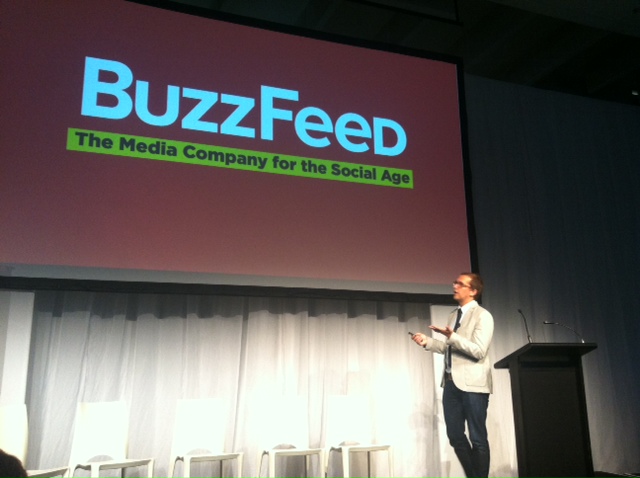
    Buzzfeed founder Jonah Peretti laid out his vision of the changing media industry in his year end memo but he missed the one item most important – revenue.

    “Print revenue is decelerating at a rapid pace, cable subscriptions and TV ratings are starting to decrease even for live sports, and traditional media businesses are at various stages of a terrifying decline,” writes Peretti in accurately describes the challenges facing the industry.

    Buzzfeed’s success has largely relied on sharing across social media, particularly Facebook. In his memo Peretti lays out how he sees the modern social and personalised publishers as having seven digital advantages over the push model of the mass media days.

    1. Instant access to fresh content
    2. On-demand access to entire media libraries
    3. Nearly free distribution enabling many free ad-supported services
    4. Global distribution providing access to content from every market
    5. Data about audiences allowing personalization and customization of content experience
    6. A feedback loop between audiences and content creators making media production more dynamic and responsive
    7. Social experiences where people can use content to communicate and connect with the people who matter to them and weave media into their daily lives

    Peretti is absolutely right, those digital advantages put online platforms far ahead of print publishers and broadcasters although the advertisers haven’t quite figured out how to make these positives work for them.

    That advertisers can’t get their models to work on the digital platforms is also a problem for Peretti and Buzzfeed and the site had to half its 2016 revenue estimates earlier this year.

    In the search for new opportunities, Buzzfeed hired a new Vice President of Marketing earlier this month as it appears the branded content model is too labor intensive and video isn’t proving to be the river of gold most online publishers hoped.

    The advertising model appears to be just as broken for online publishers as it is for the traditional channels.

    As Peretti has pointed out in previous end of year memos, new media platforms always struggle in their early years.

    The difference in the modern media world is the internet destroyed the scarcity of publisher and broadcaster controlled advertising space, replacing it with an almost unlimited inventory supplied by Google, Facebook and other services that take most of the profit.

    A better comparison to today’s online advertising conundrum are the early days of radio where it took RCA’s David Sarnoff to figure out how to make broadcasting profitable.

    Like radio, online has great advantages over the older distribution methods but the revenue models that worked for those more traditional businesses don’t work on the newer medium.

    Peretti, like every online publisher, is trying to find that new model and it seems he’s as further away from discovering it as the rest of us.


    Similar posts:

    • No Related Posts
  • Human bullies and autonomous vehicles

    Human bullies and autonomous vehicles

    What happens when drivers encounter autonomous vehicles on the highways?

    Conventional wisdom is the roads will be carnage as logically thinking robots literally collide with irresponsible humans.

    The Chief Executive of Mercedes-Benz America has a different take, it may be that humans quickly learn to bully safety conscious and law abiding autonomous vehicles on the road.

    Speaking at a motoring conference in Las VegasDietmar Exler suggested the immediate future will see aggressive drivers taking advantage of driverless vehicles programmed to avoid collisions and risky situations.

    This raises an interesting question – will autonomous vehicles actually make the roads less safe in the earlier days despite being safer themselves?

    How humans interact with new technologies is never a certain thing, and the idea that people will bully robots is a delicious, and plausible idea. It does raise though some interesting possibilities as robots become common in our lives.

    Similar posts:

    • No Related Posts
  • Hacking the smartcity

    Hacking the smartcity

    Last Saturday the San Francisco Muni’s fare system came to a halt after hackers successfully penetrated the ticketing system.

    Across the city’s stations, ticket machines were disabled and access gates were opened, resulting in free rides that many, including this writer, took advantage of.

    While the Muni’s management are claiming public safety and customer information wasn’t compromised, it is a very public reminder of the weaknesses in the Internet of Things and smartcity technologies.

    Given the complexity of smartcity technologies it’s inevitable that hackers and malicious actors will find their way into Internet facing networks. The range of vendors involved and the vast diversity of devices, old and new, in the systems guarantees there will always be weaknesses.

    The great challenge for the Internet of Things industry and smartcity advocates is to secure these diverse systems. The stakes are high for the communities using these technology.

    Similar posts:

    • No Related Posts
  • Maintaining the home base – why many startups don’t fully move to Silicon Valley

    Maintaining the home base – why many startups don’t fully move to Silicon Valley

    This is the third of four stories I did for The Australian on why local entrepreneurs are making their way to the United States’ Bay Area. 

    For all the benefits of moving to the US, many startup founders want to remain down under. According to last year’s Startup Muster survey of Australia’s tech community, only 18% of local entrepreneurs intend to move overseas, and even those going offshore keep the bulk of their operations Down Under.

    The reasoning for keeping operations in Australia vary, but for those focusing on Silicon Valley costs are a key concern. Didier Elzinga of Melbourne’s Cultureamp decided to keep management and the bulk of operations in the company’s home town due to several aspects. “For us there are many great benefits, including lifestyle, but commercial decisions play into it too,” he says.

    “Our engineering team is based in Melbourne, and we are happy not to be competing for talent in the bloodbath that is Silicon Valley. In the longer term we also believe the world is moving to the East – and Australia has the opportunity to be the eastern most tip of the West, or the western most tip of the East.”

    Needing a US presence

    Having a North American presence proved essential for the sentiment measurement company, “for us a US office was an easy decision as most of our clients were tech companies based in the Bay Area” says Elzinger.

    “We had someone working in customer success there from fairly early on, and then we officially beefed up our presence when one of our co-founders Jon Williams moved to San Francisco in 2014.” Since establishing a San Francisco base, Cultureamp has raised six million dollars in capital raisings and opened offices in New York and London.

    Running a global business from Melbourne can be demanding but Elzinger believes it is worthwhile, “other than timezones we’ve yet to run into any major obstacles,” he says. “For me as CEO, it can mean a lot of travel, I try and get to the States at least once a quarter, most times more. But overall, we feel we’ve made the right decision, and are proud to grow a global company from Melbourne.”

    The travel can be demanding for an Australian based business and Temando’s CEO Karl Hartman found the demands of regularly flying across the Pacific left the company at a disadvantage. “Previously when I was flying here once a quarter, things moved gradually,” he recalls. “Being here means we can move much more quickly, some things need to be face-to-face.”

    The expense of Silicon Valley

    A San Francisco base comes at a cost though, “it’s very expensive here.” Hartman warns, “we have a focused team here in the US that is largely focused around partnerships, project management and go-to-market. But we keep our developers largely in Australia.”

    “I’d caution any Australian company looking at coming here to fill engineering jobs that coming here is very expensive, I’d argue you can find very good talent in Australia,” he says. “I’d also argue it’s easier for Aussie companies to raise seed investments in Australia.”

    Holding costs down is particularly critical for earlier stage companies points out Affinity Live’s Geoff McQueen. “It’s about a third less to employ a developer in the Illawarra than the Bay Area,” says McQueen who has kept his development team in the company’s home town of Wollongong. “Saving those costs gives a startup with limited funding a lot more time.”

    Keeping the skills base

    Data analytics startup Instaclustr is another keeping most of its operations in Australia while opening offices in the United States, Europe and Japan. “We established a leadership team and sales office in the US, but all of our engineering and support services are located in Australia, at the University of Canberra,” CEO Peter Nichol explained to The Australian.

    Instaclustr, which recently raised $2 million in seed funding for its data analytics service running on the open source Apache Cassandra system, chose to maintain operations in Australia to avoid having to compete with the salaries and expectations for high-tech staff in the US.

    A favourable Australian dollar and a relationship with local education institutions were also key factors says Nichol, “the skill sets that we are chasing are rare, so we have decided to built a knowledge base and big data experts through a partnership with the University of Canberra.”

    Keeping close to customers

    Like most tech companies having a US presence, if only for management and sales, has proved essential for Instaclustr. “The main reason,” Nichol says, “was to be to near our customers and partners from a physical and time zone perspective. Over 60% of our customer base is located in North America and 100% of ecosystem partners.”

    Despite the benefits of remaining in Australia, the movement of Australian entrepreneurs overseas is increasing. While only eighteen percent of the 602 startups surveyed for the 2015 Startup Muster report intended to move overseas, it was an increase of fifty percent over the previous year.

    That many heading overseas want to keep operations and employment local should be encouraging for those trying to Australia into a global startup centre and has to be a factor in developing a local ecosystem and government policies that support it.

    Similar posts:

  • Blood sucking freaks

    Blood sucking freaks

    Silicon Valley billionaire Peter Thiel wants to inject young people’s blood to stay youthful reports Vanity Fair.

    One man who isn’t concerned about eternal youth is veteran investor Bill Gross who believes the current record low interest rates are too risky.

    We live in interesting times.

    Similar posts:

    • No Related Posts