Category: web

  • A quick Christmas checklist for hospitality businesses

    A quick Christmas checklist for hospitality businesses

    For listeners of my regular spot on ABC Riverland, here’s a quick checklist for regional business owners to make sure their online presence is ready for the Christmas holidays.

    Prospective customers are using the web to find businesses and attractions, so taking advantage of the free listing services by the major search engines and directories is the first step.

    Google Plus Local

    The search engine giant’s local service gives a free business listing that feeds into their results and those of many GPS devices and social media services.

    Fill in as many fields as possible, making sure you don’t forget opening hours and payment methods you accept.

    You can also upload photos and menus to your Google Local listing, all of these will help you come up higher in the search engine results.

    True Local

    News Limited’s True Local offers a similar service to Google and this also feeds into various services along with the local news sites run by the newspaper chain.

    Again, fill in as many fields as possible and make sure all your essential business details are listed.

    Sensis

    While the Yellow and White Pages may be dying, a free listing with their site will help come up on the various Telstra sites and companies that partner with them.

    Review sites

    Eatability, Yelp and Tripadvisor are all popular sites and applications used by customers to research accommodation and venues. You need to grab your listing and check what previous customers have said about you.

    Social media

    Along with having your own listing on Facebook, LinkedIn, Twitter and possibly sites like Pinterest; you should be doing regular searches to check what people are saying about you and your district.

    One of the great things about social media is it’s a great market intelligence tool. For instance if there’s lots of people coming to your town to go fishing and there’s nobody catering for them, then this is an opportunity. Google Alerts can help you with this.

    Your own website

    Most important of all is your own website. Check that it works on smartphones and tablet computers, if necessary borrow a friend’s Android or Apple device and see what your site looks like on it.

    When you review this with your web developer also check your keywords are working and make sure yourmeta-tagsall reflect what you have to offer your customers.

    The Christmas-New Year rush is too important a period for hospitality business to miss out on customers. A few small thing might get you the visitors who might have kept on driving to the next town.

    Similar posts:

  • Google tries to drive American business online

    Google tries to drive American business online

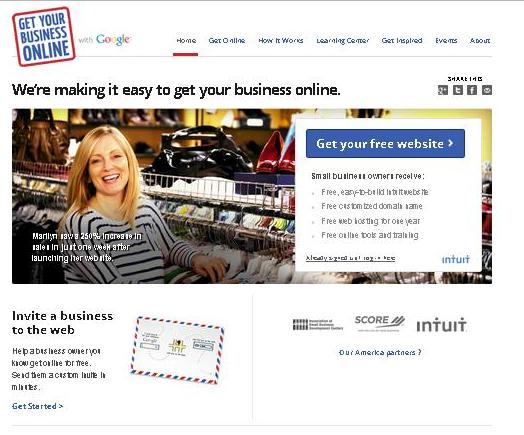
    Google’s quest to sign the world’s businesses up to websites stepped into the big time this week with the launch of America, Get Your Business Online.

    The US program is based upon the Getting British Business Online program which was followed up with similar projects in Australia and then Texas prior to being launched nationally across the States.

    An interesting aspect with the rollout of the various programs has been Google’s choice of partners — in Britain the key supporter was the incumbent telecommunication company BT.

    For some reason the subsequent programs have chosen to partner with accounting software companies and small business groups. The US program is no exception.

    These partnerships are interesting as the software companies involved are threatened by online cloud services — both Intuit and MYOB have their business models of selling boxed software to small businesses under siege.

    While Google regularly cite the Boston Consulting Group’s survey on the importance of websites to business, it seems most small operators don’t care as about half of small businesses don’t care about an online presence most developed countries.

    In Australia, the Getting Aussie Business Online fell short of its 50,000 sign up target which indicates smaller enterprises still don’t see the point.

    They may be right — for the local locksmith or lawn mowing service a Google Places account may be all they need rather than a relatively high maintenance website.

    Part of the problem is that small business proprietors are probably the most time poor people on the planet, so  filling in another set of forms is one of the last things they will do.

    Were Google to link Google + for Business to their other services so information wasn’t being duplicated there would be a far quicker and greater take up of their services.

    America, Get Your Business Online should be a useful service for some local enterprises but the real challenge for Google is to integrate their services to make it easier for smaller operations to use.

    Similar posts:

  • Owning the customer

    Owning the customer

    During the tech boom of the late 1990s the early wave of web developers had a business model that required locking customers into a relationship.

    Having spent thousands of dollars for designing and building a website, a business then found they would have to spend hundreds of dollars every time they wanted to make even a minor change.

    While that model didn’t work out for web designers as new tools appeared that made it easy for customers to look after their own sites, it’s still the ambition of many businesses to ‘own’ as much of the customer as possible.

    Department store credit cards, supermarket petrol cards and airline frequent flier programs are all examples of how big businesses try to lock their customers into their ecosystem.

    Possibly the dumbest, and most counterproductive all, are the media companies with policies of not linking outside their own websites. The idea is to keep readers on their sites but in reality it damages their own credibility and betrays their lack of understanding how the web works.

    The airlines too have discovered the risks in trying to ‘own’ their customers as their devaluing frequent flier programs has irritated and disillusioned their most loyal clients.

    Many businesses, particularly banks and telcos, try to tie you up into knots of contractual obligations with reams of terms and conditions. All of this is an attempt to make the customer a slave to their business.

    Outside of having a legally protected monopoly, you can’t ‘own’ a customer – the customer has to grant the favour of doing business with them.

    They’ll only do business with you if they trust that you’ll do the right thing by your promises; whether it’s delivering the cheapest product, the best service or quickest delivery. The moment their trust begins to slip, you risk losing their business.

    Executives who talk of the concept of owning the customer are either working in organisations with little competition or those steeped in 1980s management practices. If you hear them talking like that, it might be best to take your business, and investments, elsewhere.

    Owning customers didn’t work for the web designers of the early 2000s and it won’t work for businesses in other sectors. The only way to ensure most of your clients keep coming back is to deliver on what you’ve promised them.

    Similar posts:

  • Extending the knowledge graph

    Extending the knowledge graph

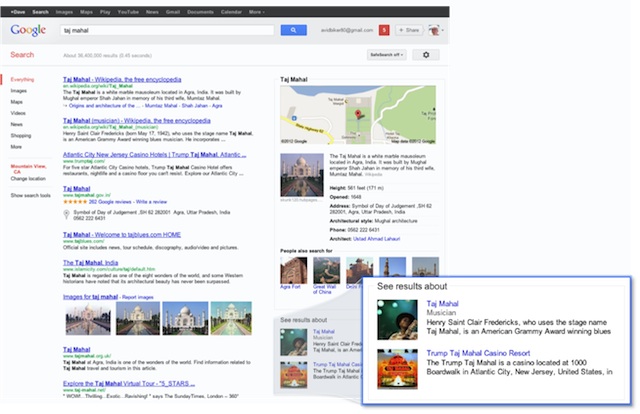
    Google’s latest search changes – introduced by Search Senior Vice President Amit Singhal – are another development, or baby step as Amit would call it, in making data more useful for us.

    The flood  of data that’s washed over us since the web arrived has left most of us befuddled. Increasingly, a basic keyword search just hasn’t been enough to find the information we’re looking for and we’ve had to trawl through pages of irrelevant information.

    One of the aims of Google’s new features is to make data more relevant to a user – so if someone in the US types “Kings” into Google, they will be given details of the Los Angeles Kings hockey team or the TV series “Kings”.

    Those details will include snippets of information about the topic. It could be the teams venue or the cast of the TV show. For tourist locations it could be some basic facts or transport information.

    Amit is particularly proud of integrating tourist information and flight details into search and Gmail which indicates Google is beginning to leverage its buyout of the ITA travel booking network last year.

    Google’s treatment of data reflects what’s happening with other services. At the recent Australian Xero conference and in an interview with MYOB executives, it’s been emphasised how knowledge is being aggregated to give customers and users better, more useful results.

    With Google’s knowledge graph we’re seeing the realisation of what big data can do, there’s many baby steps ahead but there’s a lot of potential.

    Similar posts:

  • Making business accessible

    Making business accessible

    Internet payments giant Paypal yesterday released a survey showing how businesses with a website grow faster than those without an online presence.

    There’s surprise to anyone paying attention that a business website is essential, but what happens if a business’ site isn’t accessible to those with impaired eyesight or a disability?

    We tend not to think about accessibility issues when building websites and that oversight might be hurting the effectiveness of our online marketing efforts.

    Access iQ was launched two weeks about by Media Access Australia, a not for profit organisation that works to improve disabled access to the media which was formed out of the sale of the Australian Caption Centre in 2005.

    Federal Disability Commissioner Graeme Innes pointed out at the Access iQ launch that accessibly makes life easier for everyone – making shopping centres and footpaths easier for wheelchairs to navigate also made those places more accessible for parents with prams, the elderly and able bodied people. Everybody, particularly the shopkeepers, won by making things easier for everybody.

    What’s true in the physical world has even more effect online, as the features which accessibility programs use are the same ones the all important search engines use when ranking websites.

    Titles, headings and metadata – the descriptions of the site, pages and images built into websites – are important as they let search engines and accessibility programs understand what a site is actually about.

    Getting your metadata right is a basic part of Search Engine Optimization and it’s key to having an accessible website as well.

    A good tool for checking how well metadata is being used on your website is the Australian diagnostic site BuiltWith, whose free service gives you a basic report on how a page is using SEO best practices.

    While how well a site uses headings and metadata is important, its also important that the site works properly. Problems with a website’s design make it run slower and can affect how it works in some browsers. So minimising design errors on a page matters as well.

    The best tool for checking a website’s underlying code is the W3C’s Markup Validation Service. This checks your site is complying with web standards and picks up an errors that might have crept into the design. Eliminating as many errors as possible means the site runs quicker while improving the SEO and accessiblity aspects.

    For checking accessiblity issues, the Web Accessibility Evaluation tool (WAVE), shows you where problems might lie in your site and steps through each part of a page highlighting potential issues.

    While a web site’s code isn’t something business managers and owners should spend a lot of time worrying about, the accessibility and SEO does matter so it’s good practice to use these tools to check how your site is performing.

    Once you’ve run these tests, sit down with your website developer and see where you can improve. The more accessible a web site is, the more it will help your customers.

    Similar posts: